
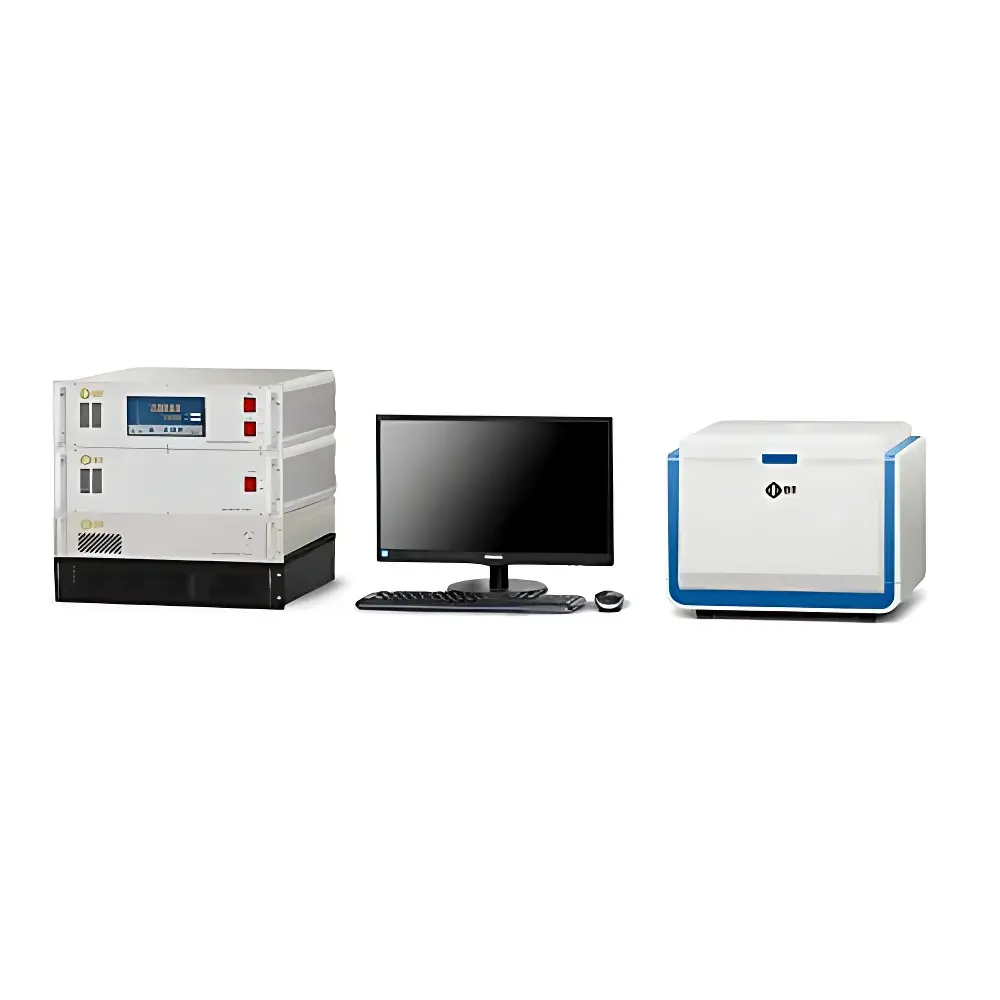
NIUMAG EDUMR20-015V-I Benchtop Nuclear Magnetic Resonance Imaging (MRI) Educational System
| Brand | NIUMAG |
|---|---|
| Origin | Shanghai, China |
| Manufacturer Type | Authorized Distributor |
| Product Category | Domestic |
| Model | EDUMR20-015V-I |
| Instrument Type | Benchtop MRI System |
| Sample Compatibility | Solid and Liquid Samples |
| Magnet Type | Permanent Magnet |
| Static Field Strength | 0.5 ± 0.08 T |
| Probe Coil Diameter | 15 mm |
| Effective Sample Volume | Ø12.5 mm × H25 mm |
| Image Linearity (x/y/z) | >90% |
| Spatial Resolution | <0.08 mm |
| Data Access | Raw k-space data export enabled |
Overview
The NIUMAG EDUMR20-015V-I is a compact, benchtop nuclear magnetic resonance (NMR) imaging educational system engineered for pedagogical rigor and technical authenticity in undergraduate and graduate laboratory instruction. Unlike simplified NMR demonstration tools, this instrument implements true pulse sequence-based MRI physics—including spin excitation, phase encoding, frequency encoding, and k-space trajectory acquisition—using a permanent magnet with a homogeneous 0.5 ± 0.08 T static field. It operates on the fundamental principles of Larmor precession, RF excitation, gradient spatial encoding, and Fourier-domain image reconstruction. Designed specifically for physics, biomedical engineering, medical imaging technology, and electronic instrumentation curricula, the EDUMR20-015V-I bridges theoretical spectroscopy with hands-on MRI hardware architecture and signal processing workflows. Its open-access design enables direct engagement with core MRI subsystems—magnet assembly, gradient coil driver circuits, RF transmit/receive chains, and digital signal acquisition modules—making it uniquely suited for labs emphasizing experimental methodology, instrumentation literacy, and algorithmic validation.
Key Features
- True MRI platform architecture: Implements standard spin-echo, gradient-echo, and inversion-recovery pulse sequences with user-defined TR/TE/TI parameters.
- Fully open hardware interface: Modular mechanical design permits safe disassembly and reassembly of magnet yoke, gradient coils, RF probe, and shim assemblies—supporting structural diagnostics and hands-on engineering training.
- Raw k-space data access: All acquired complex-valued k-space datasets are exportable in standard binary or MATLAB-compatible formats, enabling offline reconstruction, artifact analysis, and algorithm development (e.g., compressed sensing, parallel imaging, deep learning reconstruction).
- Benchtop footprint & safety-compliant operation: Self-shielded permanent magnet system eliminates cryogen handling, high-voltage hazards, or RF shielding room requirements—ideal for teaching laboratories with standard electrical infrastructure.
- Integrated real-time acquisition software: Includes waveform visualization (RF pulses, gradient waveforms), real-time FFT spectrum display, and live k-space filling animation to reinforce conceptual understanding of spatial encoding dynamics.
- Calibrated spatial resolution: Achieves sub-0.08 mm in-plane resolution within the Ø12.5 mm × 25 mm cylindrical FOV, verified via standardized phantom imaging per ASTM E2734-10 guidelines for educational MRI performance assessment.
Sample Compatibility & Compliance
The EDUMR20-015V-I supports both solid and liquid samples—ranging from polymer gels and plant tissues to aqueous phantoms and paramagnetic-doped solutions—within its 12.5 mm diameter × 25 mm height detection volume. Sample holders are non-magnetic and chemically inert (PEEK and borosilicate glass options available). The system complies with IEC 61000-6-3 (EMC emission limits) and IEC 61000-6-2 (immunity requirements) for laboratory equipment. While not intended for clinical diagnosis, its pulse sequence structure, gradient timing fidelity, and RF calibration protocols align with foundational MRI engineering standards referenced in ISO/IEC 17025-accredited NMR teaching labs. All firmware and acquisition software support audit-trail logging for GLP-aligned educational documentation.
Software & Data Management
The proprietary EDUMR Control Suite runs on Windows 10/11 and provides dual-mode operation: guided experiment mode (for introductory labs) and expert mode (for advanced coursework). It includes built-in DICOM export (Level 1 conformance), raw k-space (.kspace binary + JSON metadata), and time-domain FID export. Reconstruction algorithms—filtered backprojection, 2D/3D FFT, and iterative SENSE—are implemented in open-source Python libraries (NumPy, SciPy, PyTorch), with full source code provided for academic adaptation. Software architecture supports FDA 21 CFR Part 11-compliant user authentication, electronic signatures, and immutable acquisition logs—enabling integration into regulated research training environments.
Applications
- Undergraduate physics labs: Visualizing Larmor frequency dependence on B₀, measuring T₁/T₂ relaxation times via inversion-recovery and spin-echo experiments.
- Biomedical engineering capstone projects: Designing custom pulse sequences, optimizing SNR vs. scan time trade-offs, evaluating motion correction strategies.
- Radiologic technology programs: Hands-on comparison of k-space sampling patterns (Cartesian, spiral, radial) and their impact on point spread function and aliasing artifacts.
- Electronics & instrumentation courses: Characterizing gradient amplifier linearity, RF coil Q-factor, and ADC dynamic range using embedded oscilloscope-triggered signal monitoring.
- Continuing education: Modular workshops on MRI safety fundamentals (SAR estimation, peripheral nerve stimulation thresholds), DICOM workflow integration, and AI-assisted segmentation validation.
FAQ
Is the EDUMR20-015V-I suitable for quantitative T₁/T₂ mapping?
Yes—built-in multi-echo and multi-inversion-time acquisition modes enable pixel-wise monoexponential fitting using vendor-provided MATLAB scripts and documented reference protocols.
Can third-party reconstruction pipelines be integrated?
Absolutely—the system exports fully calibrated k-space data with precise timing metadata (gradient onset delays, RF pulse durations, dwell times), compatible with ISMRM-recommended reconstruction frameworks including Berkeley Advanced Reconstruction Toolbox (BART) and SigPy.
Does it support field homogeneity optimization?
Yes—manual passive shimming is supported via adjustable ferromagnetic shim trays; field maps can be acquired using dual-echo gradient echo sequences and analyzed using included field mapping utilities.
What safety certifications does the system hold?
It meets CE marking requirements under Directive 2014/30/EU (EMC) and 2014/35/EU (LVD), and conforms to IEC 61010-1 for laboratory electrical safety.
Is remote operation supported for hybrid or distance-learning labs?
Yes—via secure RDP or VNC over institutional LAN/WAN, with role-based access control and session recording enabled for instructional oversight.




