
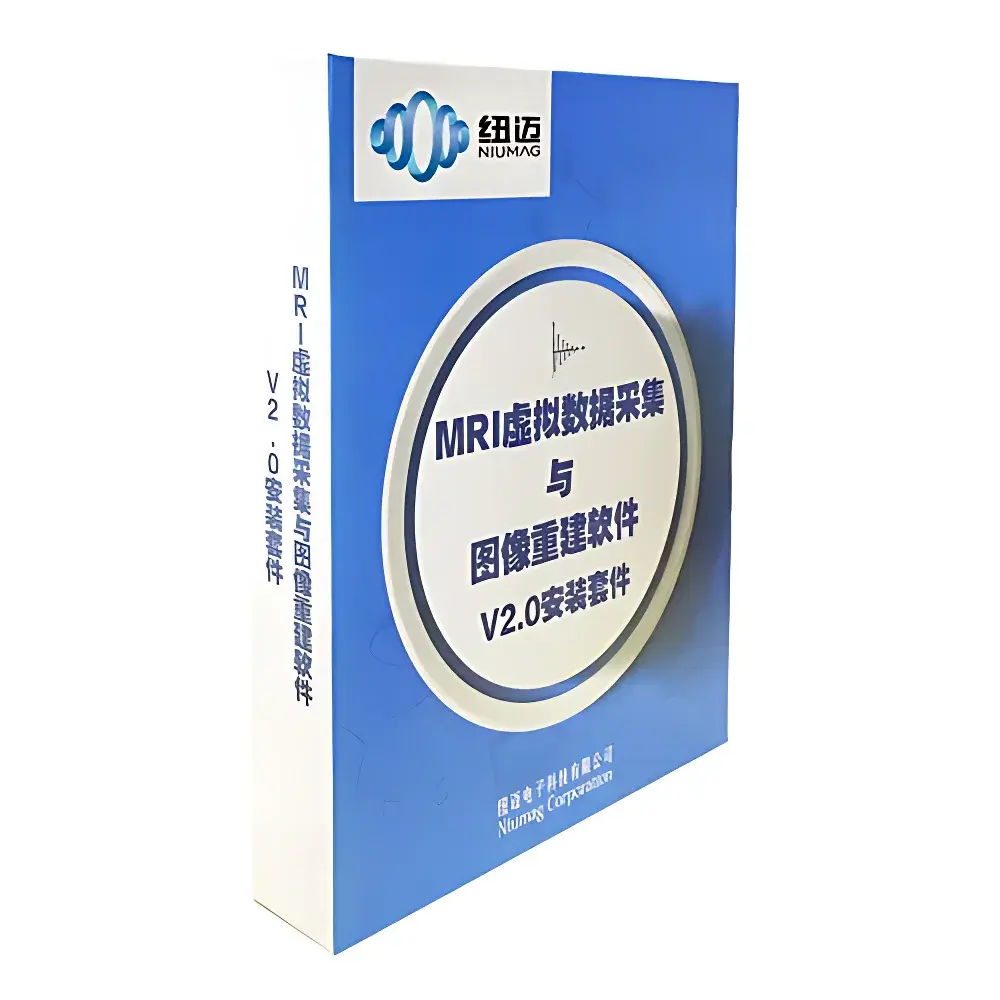
NIUMAG EDUVMR Virtual NMR Teaching and Training System
| Brand | NIUMAG |
|---|---|
| Origin | Jiangsu, China |
| Manufacturer Type | Authorized Distributor |
| Region of Origin | Domestic (China) |
| Model | EDUVMR |
| Pricing | Upon Request |
Overview
The NIUMAG EDUVMR Virtual NMR Teaching and Training System is a pedagogically engineered software-hardware integrated platform designed to deliver comprehensive, hands-on instruction in nuclear magnetic resonance (NMR) principles and magnetic resonance imaging (MRI) physics—without reliance on high-field superconducting magnets or RF hardware infrastructure. Built upon first-principles simulation of spin dynamics, radiofrequency excitation, gradient encoding, k-space trajectory generation, and Fourier-based image reconstruction, the EDUVMR system enables students and instructors to explore the full MR signal chain: from Bloch equation-driven magnetization evolution through pulse sequence design, spatial encoding, raw data acquisition, k-space filling strategies (e.g., Cartesian, spiral, radial), and inverse Fourier transform reconstruction. It replicates the functional workflow of clinical and preclinical MRI scanners while abstracting away hardware-specific constraints—making it ideal for undergraduate physics labs, biomedical engineering curricula, and radiology technician training programs where access to physical MRI systems is limited by cost, safety regulations, or facility requirements.
Key Features
- Fully interactive simulation of core MRI pulse sequences: Gradient Echo (GRE), Spin Echo (SE), Fast Spin Echo (FSE), T2-weighted imaging, fat suppression (CHESS, STIR), water suppression (WATERGATE), and inversion recovery with variable inversion times.
- Real-time visualization of k-space evolution during data acquisition—including undersampling artifacts, aliasing, and Gibbs ringing—linked directly to parameter adjustments (TR, TE, TI, flip angle, bandwidth, matrix size).
- Parametric modeling of system imperfections: static magnetic field inhomogeneity (ΔB₀), gradient nonlinearity, eddy current effects, and electronic noise injection (Gaussian, Rician) to demonstrate their impact on SNR, contrast fidelity, and geometric distortion.
- Reconstruction engine supporting magnitude, phase, and complex-valued image outputs; supports zero-filling, apodization, and parallel imaging (SENSE/GRAPPA) emulation.
- Modular lesson framework aligned with ACR–AAPM MRI physics curriculum guidelines, including pre-built lab modules on relaxation contrast mechanisms, diffusion weighting, and echo train behavior.
Sample Compatibility & Compliance
The EDUVMR system operates independently of physical samples or biological tissues. Instead, it employs mathematically defined digital phantoms—including Shepp–Logan, modified brain, multi-tissue abdominal, and custom-defined ROI structures—with programmable T1/T2 values, proton density, and diffusion coefficients. All simulations adhere to the fundamental electromagnetic and quantum mechanical constraints described in ISO 10974 (MRI safety), IEC 62464-1 (MRI system performance testing), and the AAPM Report No. 135 (MRI physics education standards). The software architecture supports audit-ready logging of all user interactions, parameter changes, and output images—facilitating GLP-compliant documentation for academic accreditation and institutional review board (IRB) submissions.
Software & Data Management
The EDUVMR platform runs on Windows 10/11 (64-bit) with OpenGL 4.5+ support and integrates seamlessly with standard DICOM viewers (e.g., OsiriX, Horos, 3D Slicer) via export of reconstructed images in DICOM 3.0 format (SOP Class UID: 1.2.840.10008.5.1.4.1.1.4). Raw k-space data is exportable as MATLAB (.mat) or NumPy (.npy) arrays for advanced algorithm development. All session data—including pulse sequence definitions, parameter sets, phantom configurations, and reconstruction logs—is stored in SQLite databases with timestamped entries and user ID tagging. The system includes built-in compliance features for FDA 21 CFR Part 11: electronic signatures, role-based access control (instructor/student modes), and immutable audit trails for all critical actions.
Applications
- Undergraduate and graduate courses in medical physics, biomedical engineering, and applied electromagnetics.
- Certification preparation for ARRT MRI registry exams and ESR European Diploma in Radiology (EDiR) modules.
- Development and validation of novel reconstruction algorithms (e.g., compressed sensing, deep learning–based denoising) using ground-truth k-space data.
- Protocol optimization workshops for radiographers and MRI technologists focusing on SAR management, contrast mechanism selection, and artifact mitigation.
- Remote laboratory delivery in hybrid and online STEM programs—fully compatible with LMS platforms (Canvas, Moodle, Blackboard) via SCORM 1.2 packaging.
FAQ
Does EDUVMR require connection to physical NMR hardware?
No. EDUVMR is a standalone simulation environment and operates entirely in software without interfacing with magnets, gradient coils, or RF transceivers.
Can users import custom pulse sequences or modify existing ones?
Yes. The system provides an open XML-based pulse sequence definition schema, enabling instructors to author and validate new sequences compliant with standard MRI timing constraints.
Is DICOM export suitable for PACS integration in teaching hospitals?
Yes. Exported DICOM objects conform to PS3.10 file format specifications and include required metadata fields (StudyInstanceUID, SeriesInstanceUID, ImagePositionPatient, etc.) for seamless ingestion into clinical PACS environments.
How does EDUVMR handle GPU acceleration for real-time k-space simulation?
The software leverages CUDA-accelerated linear algebra kernels for Bloch equation solvers and FFT-based reconstruction, supporting NVIDIA GPUs with compute capability ≥ 6.0 (Pascal architecture or newer).
Is student usage activity logged for grading and assessment purposes?
Yes. The instructor dashboard provides aggregated analytics on time-on-task, parameter deviation from reference protocols, error rate in artifact identification, and reconstruction accuracy scores—all exportable as CSV reports.






