
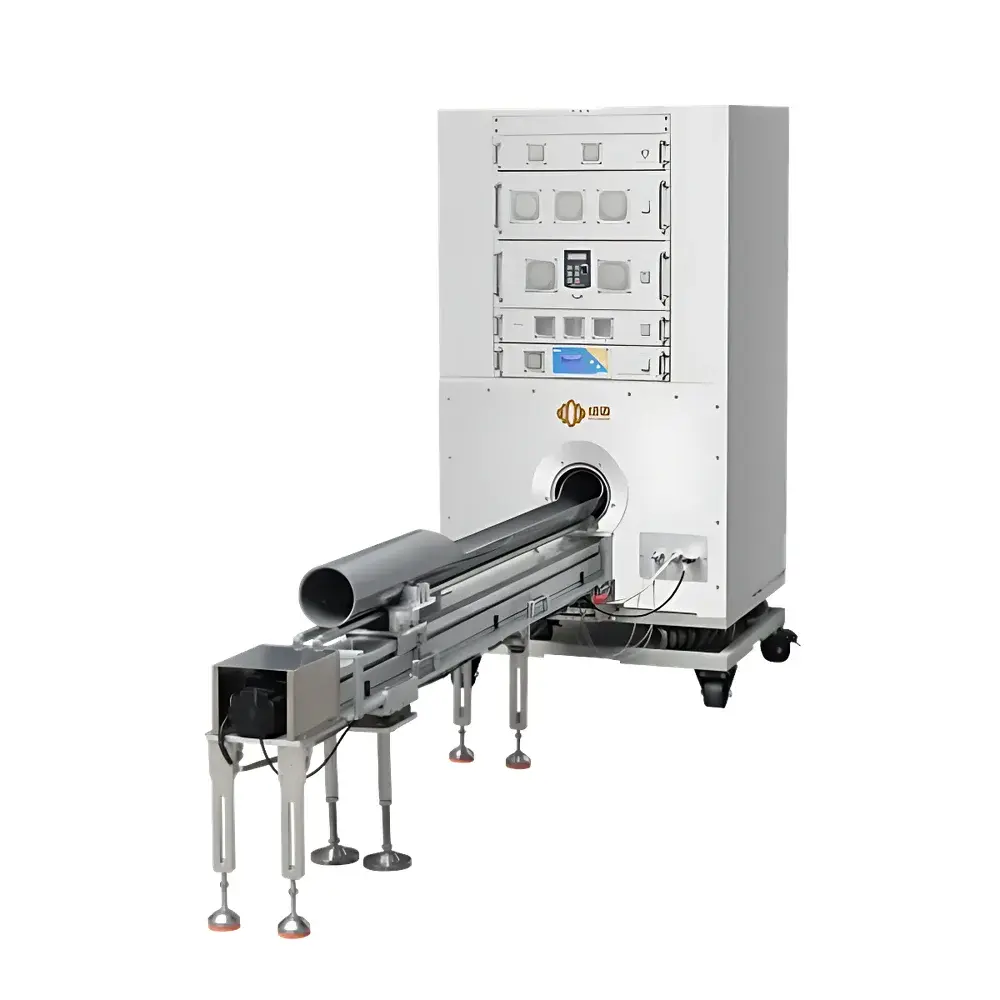
NIUMAG Low-Field Nuclear Magnetic Resonance Analyzer for Coalbed Methane Reservoir Characterization
| Brand | NIUMAG |
|---|---|
| Origin | Jiangsu, China |
| Manufacturer Type | Authorized Distributor |
| Product Category | Domestic |
| Model | Full-Diameter Core Analyzer |
| Instrument Type | Low-Field NMR Spectrometer |
| Sample Type | Solid-Liquid Dual-Mode |
| Magnetic Field Strength | 6.2 MHz |
| Minimum Echo Time (TE) | 0.1 ms |
| Longitudinal Spatial Resolution | 1 cm |
| Maximum Core Length | 3.4 cm |
| Maximum Core Diameter | 115 mm |
| Capabilities | T₁/T₂ Relaxometry, T₁–T₂ Two-Dimensional Correlation Mapping |
Overview
The NIUMAG Low-Field Nuclear Magnetic Resonance Analyzer for Coalbed Methane Reservoir Characterization is an engineered solution designed specifically for quantitative petrophysical evaluation of coal cores under near-in-situ conditions. Operating at a Larmor frequency of 6.2 MHz (corresponding to a magnetic field strength of approximately 0.147 T), this system leverages the fundamental principles of pulsed low-field NMR to probe hydrogen-bearing fluids—primarily water and adsorbed methane—in coal matrix pores. Unlike high-field systems optimized for molecular structure elucidation, this analyzer prioritizes robustness, spatial resolution, and rapid acquisition in heterogeneous, conductive, and paramagnetic coal samples. Its measurement foundation rests on spin–lattice (T₁) and spin–spin (T₂) relaxation time distributions, which correlate directly with pore size distribution, fluid saturation, surface-to-volume ratio, and gas adsorption dynamics. The instrument supports both bulk relaxation analysis and T₁–T₂ two-dimensional correlation mapping—enabling discrimination between mobile gas-phase protons, bound water, and clay-bound hydrogen—critical for differentiating free gas, adsorbed gas, and irreducible water saturation in coal seams.
Key Features
- Full-diameter core compatibility: Accepts intact cylindrical coal cores up to 115 mm in diameter and 3.4 cm in length—preserving native pore connectivity and avoiding destructive sectioning.
- Sub-millisecond echo time capability: Achieves TE = 0.1 ms using optimized pulse sequences and shielded RF hardware, enabling detection of ultra-short T₂ components from micropores (<2 nm) and strongly adsorbed methane layers.
- Centimeter-scale longitudinal resolution: Implements gradient-enhanced slice-selective excitation and phase-encoding reconstruction to resolve T₂ distributions along the core axis at 1 cm intervals—supporting stratified porosity and saturation profiling.
- Automated core handling: Integrated motorized stage enables unattended, sequential axial scanning of 1-meter-long core sections; full acquisition per segment completed in ≤18 minutes.
- Portable magnet architecture: Utilizes a custom-designed Halbach-array permanent magnet assembly, reducing total system mass by ~50% versus conventional resistive or superconducting platforms—facilitating deployment in field laboratories, mine sites, and mobile geochemical units.
Sample Compatibility & Compliance
The analyzer accommodates both dry and saturated coal cores—including those preserved under reservoir pressure (e.g., via pressure-retaining coring). It supports solid–liquid dual-mode operation: simultaneous characterization of adsorbed gas (via proton signal suppression protocols and inversion recovery methods) and interstitial water. All measurements adhere to ASTM D7170 (Standard Test Method for Determining Pore Size Distribution of Porous Solids by Low-Field NMR), and data acquisition workflows are structured to support GLP-compliant documentation. While not certified to FDA 21 CFR Part 11 out-of-the-box, the software architecture provides audit-trail logging, user access control, and electronic signature readiness—enabling validation per ISO/IEC 17025 and internal QA/QC requirements for exploration laboratories.
Software & Data Management
NIUMAG’s proprietary NMR Studio™ platform delivers integrated pulse sequence control, real-time signal processing, and multi-dimensional spectral deconvolution. Key modules include Inverse Laplace Transform (ILT) solvers for T₂ distribution quantification, T₁–T₂ joint inversion algorithms, and spatially resolved relaxation mapping. Raw FID data are stored in vendor-neutral HDF5 format, with metadata conforming to the NMR-ML schema. Export options include CSV, MATLAB .mat, and standardized Petrophysics Interchange Format (PIF) for interoperability with Petrel, Techlog, and CMG reservoir simulators. All processing steps are scriptable via Python API, supporting reproducible batch analysis across large core libraries.
Applications
- Quantitative determination of total porosity, effective porosity, and microporosity fraction in coal matrices.
- Pressure-dependent adsorption isotherm derivation via sequential T₂ measurements on cores equilibrated at varying CH₄ partial pressures.
- Discrimination of mobile vs. immobile fluid phases using T₁/T₂ contrast and diffusion-weighted encoding.
- Permeability estimation through empirical correlations between geometric mean T₂ and hydraulic conductivity (validated against steady-state permeameter data).
- Monitoring water saturation hysteresis during desorption–rehydration cycles to assess coal cleat sealing behavior.
FAQ
Does this system require cryogens or external cooling infrastructure?
No. The permanent magnet operates at ambient temperature and requires no liquid nitrogen or helium. Only standard 220 V AC power and Ethernet connectivity are needed.
Can T₁–T₂ maps be acquired on partially saturated coal cores?
Yes. The system supports variable repetition time (TR) and echo train length (ETL) optimization to resolve overlapping relaxation populations in mixed-fluid systems.
Is calibration traceable to national standards?
Relaxation time calibration is performed using reference standards traceable to NIST SRM 1921b (water-glycerol mixtures); porosity calibration employs gravimetrically verified glass bead packs.
What sample preparation protocols are recommended for preserved coal cores?
Cores should be sealed in aluminum foil and stored at 4 °C prior to analysis. For saturated samples, immersion in deuterated water minimizes background signal interference during gas-phase proton quantification.
How is data integrity maintained during long-term field deployment?
All acquisitions include hardware timestamping, checksum-verified data streaming, and automatic RAID-1 mirrored storage—ensuring recoverability after power interruption or thermal fluctuation.
Related Products





