
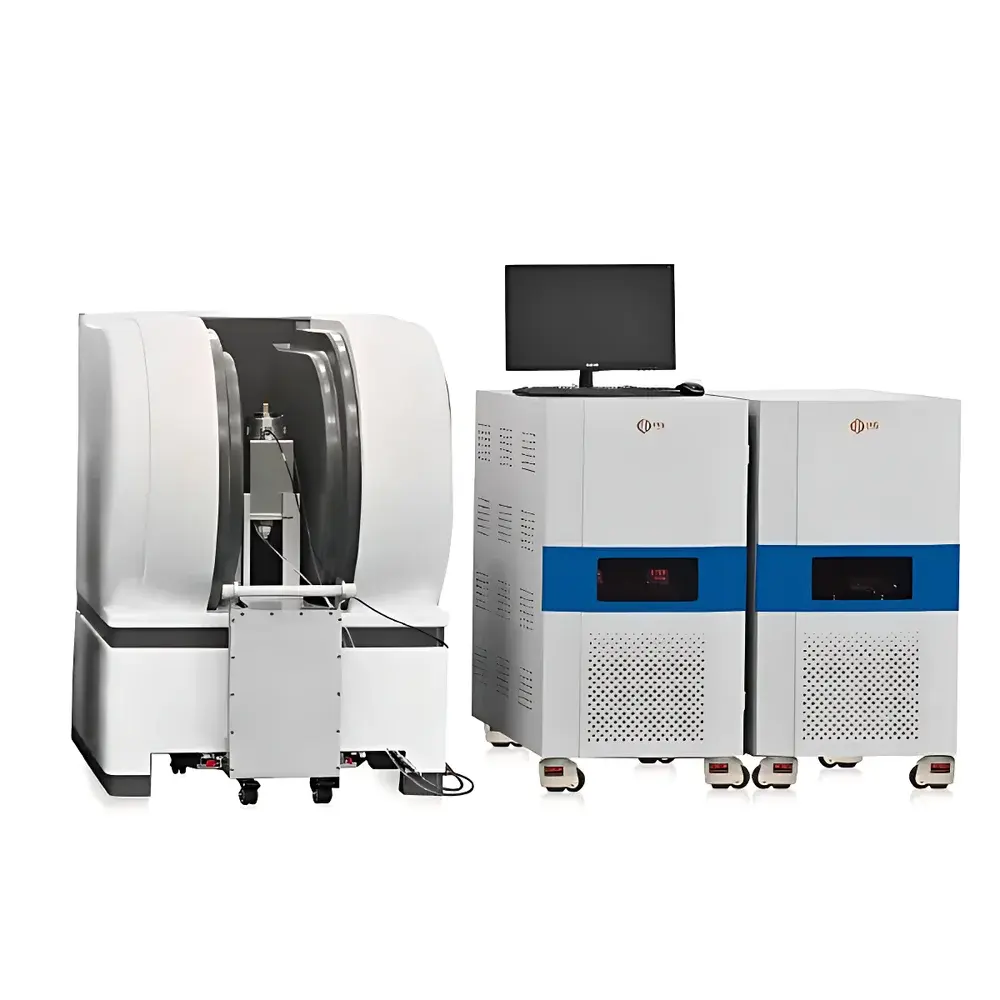
NIUMAG MacroMR-1 Low-Field Nuclear Magnetic Resonance Analyzer for Soil and Porous Media
| Brand | NIUMAG |
|---|---|
| Origin | Jiangsu, China |
| Instrument Type | Low-Field NMR Analyzer |
| Sample Compatibility | Solid-Liquid Dual-Mode |
| Magnetic Field Strength | 0.3 T ± 0.03 T |
| Magnet Configuration | C-Type Open Magnet |
| Field Homogeneity | ≤50 ppm |
| Maximum Sample Dimension | Ø150 mm × H100 mm |
| Probe Orientation | Transverse/Longitudinal |
| Gradient System | Advanced Integrated Gradient Coil |
| Sample Diameter Range | 25–150 mm |
Overview
The NIUMAG MacroMR-1 is a dedicated low-field nuclear magnetic resonance (LF-NMR) analyzer engineered for non-invasive, quantitative characterization of soil pore structure and water dynamics. Unlike conventional destructive or indirect methods—such as mercury intrusion porosimetry (MIP), gas pycnometry, or gravimetric moisture analysis—the MacroMR-1 leverages the intrinsic magnetic properties of hydrogen nuclei (1H) in water to probe pore-scale physical environments without sample alteration. Operating at a stable 0.3 T field, the system measures transverse relaxation time (T2) distributions of pore-confined water, which correlate directly with pore size via surface-to-volume ratio effects governed by the Bloembergen–Purcell–Pound (BPP) model. This enables robust, calibration-free quantification of pore-size distribution (PSD), total porosity, bound vs. free water fractions, and spatially resolved water mobility—critical parameters for understanding soil hydraulic conductivity, water retention, freeze-thaw behavior, and biogeochemical transport.
Key Features
- C-type open magnet architecture with transverse and longitudinal probe options—enabling unobstructed sample loading for intact soil cores up to Ø150 mm × 100 mm height.
- High-stability, temperature-regulated RF probe with integrated gradient coil system—ensuring signal reproducibility across repeated acquisitions and environmental perturbations.
- Modular accessory interface supporting custom core holders, pressure cells, thermal jackets, and fluid saturation modules—facilitating controlled multi-parameter experiments (e.g., temperature-, pressure-, or flow-coupled NMR).
- Pre-calibrated pulse sequences optimized for soil science applications—including CPMG (Carr–Purcell–Meiboom–Gill) for T2 mapping, inversion recovery for T1 analysis, and diffusion-weighted imaging for restricted water mobility assessment.
- Rugged industrial-grade electronics and vibration-damped platform—designed for long-term operation in laboratory, field-deployable, or greenhouse-based monitoring setups.
Sample Compatibility & Compliance
The MacroMR-1 accommodates heterogeneous, unprocessed soil specimens—including undisturbed field cores, repacked aggregates, frozen/thawed samples, and cement-stabilized soils—without drying, grinding, or vacuum saturation. Its solid-liquid dual-mode capability allows simultaneous interrogation of mineral matrix signals and interstitial water phases. The instrument complies with ISO/IEC 17025:2017 general requirements for competence of testing and calibration laboratories, and supports audit-ready data logging aligned with GLP (Good Laboratory Practice) principles. While not FDA 21 CFR Part 11 certified out-of-the-box, its raw data export formats (FID, ASCII, HDF5) are fully compatible with validated third-party software for regulated environments requiring electronic record integrity and user access control.
Software & Data Management
Acquisition and processing are performed using NIUMAG’s proprietary MesoMR Studio v4.x suite, featuring intuitive workflow templates for soil-specific protocols. Key functions include T2 spectrum inversion (non-negative least squares with regularization), pore-size distribution conversion using established surface relaxivity (ρ2) models, layer-wise depth profiling, and time-series tracking of water redistribution during drainage or infiltration. All datasets retain full metadata (pulse sequence parameters, temperature logs, gradient strengths) and support batch processing. Export options include CSV, MATLAB .mat, and standardized NIfTI for cross-platform interoperability with GIS or finite-element modeling tools. Audit trails record operator ID, timestamp, parameter edits, and file modifications—meeting traceability requirements for academic publication and regulatory submissions.
Applications
- Pore Structure Characterization: Quantitative porosity, pore-size distribution (0.1–1000 µm range), layered PSD profiling, cryo-porosimetry for nanopore analysis in clay-rich matrices.
- Soil Water Dynamics: Volumetric water content mapping, unfrozen water quantification in permafrost, freeze-thaw cycle kinetics, moisture redistribution under evaporation gradients.
- Multi-Physics Coupling Studies: In-situ monitoring of hydration in cemented soils, CO2 sequestration analogs, solute transport via diffusion-relaxation correlation, coupled thermal-hydraulic-mechanical (THM) response under triaxial stress.
- Structural Integrity Assessment: Non-destructive detection of microcracking, frost heave-induced heterogeneity, acid/salt corrosion progression, and mechanical damage evolution during cyclic loading.
FAQ
What is the minimum detectable pore size using the MacroMR-1?
The effective lower limit depends on surface relaxivity and measurement temperature but typically resolves pores down to ~10 nm in clay-dominated soils when combined with cryogenic conditioning and optimized echo spacing.
Can the system perform real-time monitoring during dynamic processes?
Yes—time-resolved CPMG acquisition enables sub-minute temporal resolution for tracking rapid events such as infiltration fronts or rapid thawing, subject to SNR constraints and hardware duty-cycle limits.
Is external calibration required for porosity quantification?
No—absolute porosity is derived from integrated T2 signal amplitude referenced to a known water standard, eliminating reliance on empirical correlations or destructive reference measurements.
Does the instrument support spectral editing to distinguish organic vs. aqueous protons?
Not natively; the MacroMR-1 operates in the low-field regime where chemical shift dispersion is negligible (~0.1 ppm at 0.3 T). It distinguishes water states solely via relaxation and diffusion contrasts—not chemical identity.
How is data integrity ensured during extended field deployments?
The system includes internal temperature and field drift compensation algorithms, battery-backed real-time clock, and redundant local + network-attached storage—supporting uninterrupted operation over multi-week unattended campaigns.





