
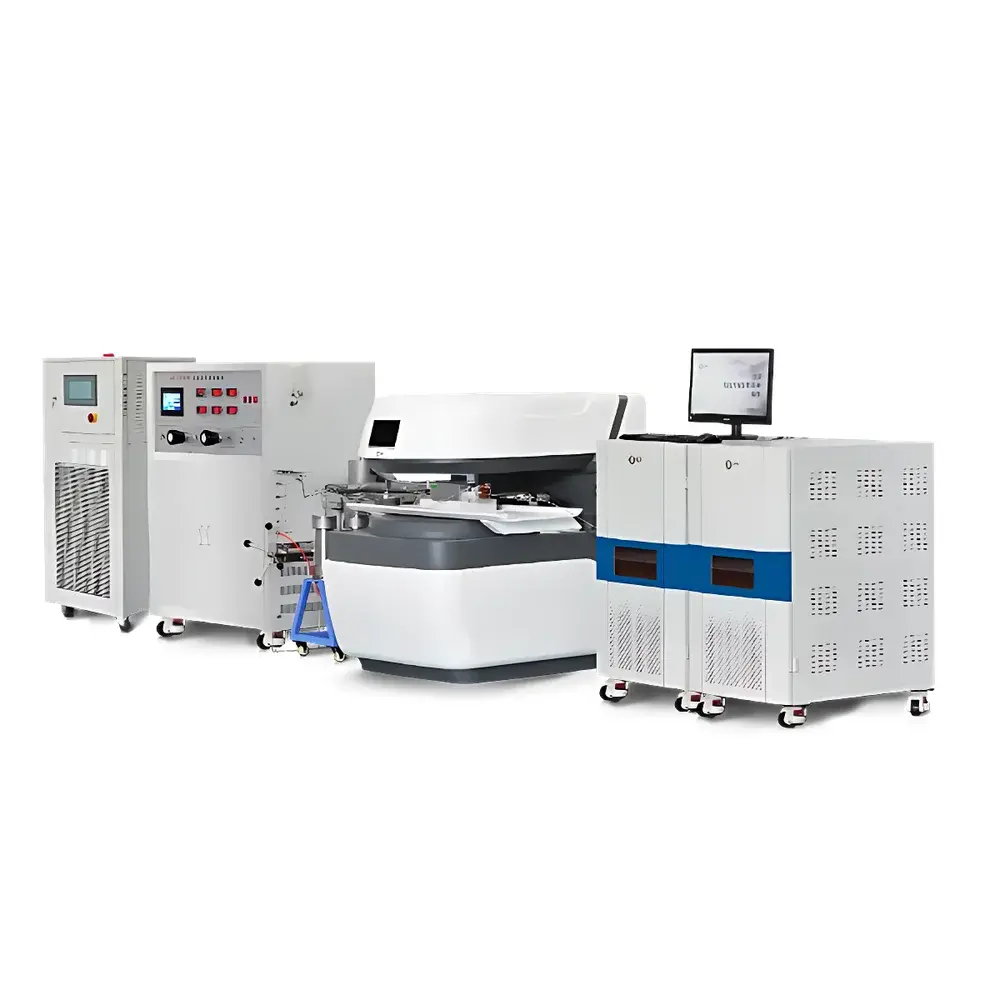
NIUMAG MacroMR-2 Low-Field Nuclear Magnetic Resonance Analyzer for Unconventional Core Analysis
| Brand | NIUMAG |
|---|---|
| Origin | Jiangsu, China |
| Model | MacroMR-2 |
| Instrument Type | Low-Field NMR Analyzer |
| Sample Type | Solid-Liquid Dual-Phase Core Samples |
| Field Strength | 0.3 T ± 0.03 T |
| Magnet Homogeneity | ≤50 ppm |
| Magnet Configuration | C-Type Open-Bore |
| Sample Access | Transverse/Longitudinal |
| Standard Operating Conditions | Up to 100 °C / 40 MPa (Customizable to 150 °C / 70 MPa) |
| Probe Options | 1–6 inch diameter |
| Core Imaging Capability | Real-Time T₁/T₂ Mapping & Dynamic Fluid Saturation Monitoring during In-Situ Displacement |
Overview
The NIUMAG MacroMR-2 is a purpose-engineered low-field nuclear magnetic resonance (LF-NMR) analyzer designed specifically for quantitative structural and fluid characterization of unconventional reservoir core samples. Operating at a static magnetic field strength of 0.3 T, the system leverages the fundamental principles of spin relaxation (T₁ and T₂) in hydrogen-bearing fluids—primarily water, oil, and hydrocarbon gases—to non-invasively probe pore-scale architecture, fluid distribution, and transport properties within tight sandstones, shales, coal seams, and other low-permeability geological media. Unlike high-field NMR spectrometers optimized for molecular structure elucidation, the MacroMR-2 emphasizes robustness under simulated downhole conditions, enabling direct correlation between laboratory-derived NMR parameters (e.g., transverse relaxation time distributions, diffusion-relaxation correlations, and proton density maps) and petrophysical properties such as porosity, pore-size distribution, movable/immobile fluid saturation, relative permeability, and wettability indices. Its open C-type magnet architecture supports flexible integration of temperature-pressure cells and displacement modules, making it suitable for dynamic, in-situ experiments aligned with industry-standard reservoir simulation protocols.
Key Features
- Integrated high-stability permanent magnet system with ≤50 ppm homogeneity over a 60 mm DSV (diameter spherical volume), ensuring reproducible signal acquisition across heterogeneous core samples.
- Dual-adjustable RF probe design mitigates sample-induced magnetic susceptibility artifacts, maintaining high signal-to-noise ratio (SNR) even under extreme thermal and mechanical stress (up to 150 °C / 70 MPa with optional HTHP module).
- Real-time NMR imaging capability during active fluid displacement: enables time-resolved visualization of oil/water saturation fronts, capillary trapping behavior, and phase redistribution under controlled confining pressure and injection rate.
- Comprehensive pulse sequence library supporting one-dimensional T₂/T₁ inversion, two-dimensional T₁–T₂ correlation mapping, diffusion-weighted imaging (DWI), and multi-echo spin-echo acquisitions compliant with ASTM D7264 and ISO 10113 methodologies.
- Fourth-generation embedded NMR console with FPGA-accelerated data processing, onboard spectral deconvolution algorithms, and automated baseline correction—reducing post-processing time by up to 60% compared to legacy systems.
- Self-diagnostic firmware with continuous hardware health monitoring, thermal drift compensation, and real-time alarm logging traceable via timestamped audit trails compliant with GLP and internal QA/QC requirements.
Sample Compatibility & Compliance
The MacroMR-2 accommodates cylindrical core plugs ranging from Ø25 mm × 50 mm to Ø150 mm × 300 mm (with appropriate probe selection), including whole-round cores, trimmed plugs, and fractured or laminated specimens. It supports both saturated and partially saturated states, as well as gas-saturated configurations when used with compatible pressure vessels. The system meets CE electromagnetic compatibility (EMC) standards and conforms to IEC 61000-6-3 for industrial environments. While not FDA-cleared (as it is not a medical device), its data acquisition architecture complies with ALCOA+ principles for raw data integrity, and audit trail functionality satisfies basic 21 CFR Part 11 readiness for regulated research labs conducting E&P-related R&D under ISO/IEC 17025 frameworks.
Software & Data Management
NIUMAG’s proprietary MesoScan™ v4.2 software provides a unified interface for instrument control, sequence programming, real-time image reconstruction, and petrophysical parameter extraction. All acquired FIDs and processed spectra are stored in vendor-neutral HDF5 format with embedded metadata (sample ID, temperature, pressure, pulse sequence, operator, timestamp). Batch processing workflows support automated T₂ cutoff determination using the Timur-Coates or SDR models, and custom scripting (Python API) allows integration with third-party reservoir simulators (e.g., CMG, Eclipse) or machine learning pipelines for pore-network modeling. Export options include CSV, MATLAB .mat, and DICOM-compliant NIfTI for cross-platform visualization.
Applications
- Reservoir Rock Characterization: Quantitative porosity estimation, pore-throat size distribution via T₂ cutoff calibration, bound vs. free fluid identification, and clay-bound water quantification using multi-exponential decay analysis.
- Enhanced Oil Recovery (EOR) Evaluation: Real-time monitoring of polymer flood front propagation, surfactant-induced wettability alteration, and CO₂ miscible displacement efficiency under reservoir-relevant P/T conditions.
- Unconventional Resource Assessment: Isothermal adsorption/desorption kinetics of CH₄ and CO₂ on shale organic matter; hydrate formation/dissociation dynamics; supercritical CO₂ fracturing mechanics and matrix interaction studies.
- Mechanical Integrity Testing: In-situ NMR monitoring during triaxial compression to correlate microcrack initiation with changes in T₂ distribution and bulk fluid mobility.
- Acidizing & Stimulation Design: Time-lapse imaging of pore network evolution during HCl or organic acid treatments, enabling quantification of etched surface area and secondary porosity generation.
FAQ
What is the minimum detectable porosity for tight rock samples?
The detection limit depends on sample volume, fluid content, and measurement time—but typical resolution for porosities ≥0.5% is achievable in standard 1-hour acquisitions on 1-inch core plugs.
Can the system be upgraded to support higher field strengths?
No—the MacroMR-2 is a fixed-field 0.3 T platform. For higher spectral resolution, NIUMAG offers the MesoMR series (0.5 T) with closed-bore geometry and enhanced homogeneity.
Is remote operation supported for unattended overnight runs?
Yes. The system supports secure SSH-based remote access, scheduled experiment queues, and automatic failure recovery with email/SMS alerts.
Does the software provide built-in reporting templates aligned with SPE or AAPG standards?
MesoScan™ includes customizable report generators with preconfigured templates for core analysis reports compliant with SPE 18729 and API RP 40 guidelines.
How is temperature calibration validated during high-temperature experiments?
Each HTHP cell integrates dual Pt100 sensors (internal and external), with real-time cross-checking against NIST-traceable reference thermocouples logged alongside NMR data.



