
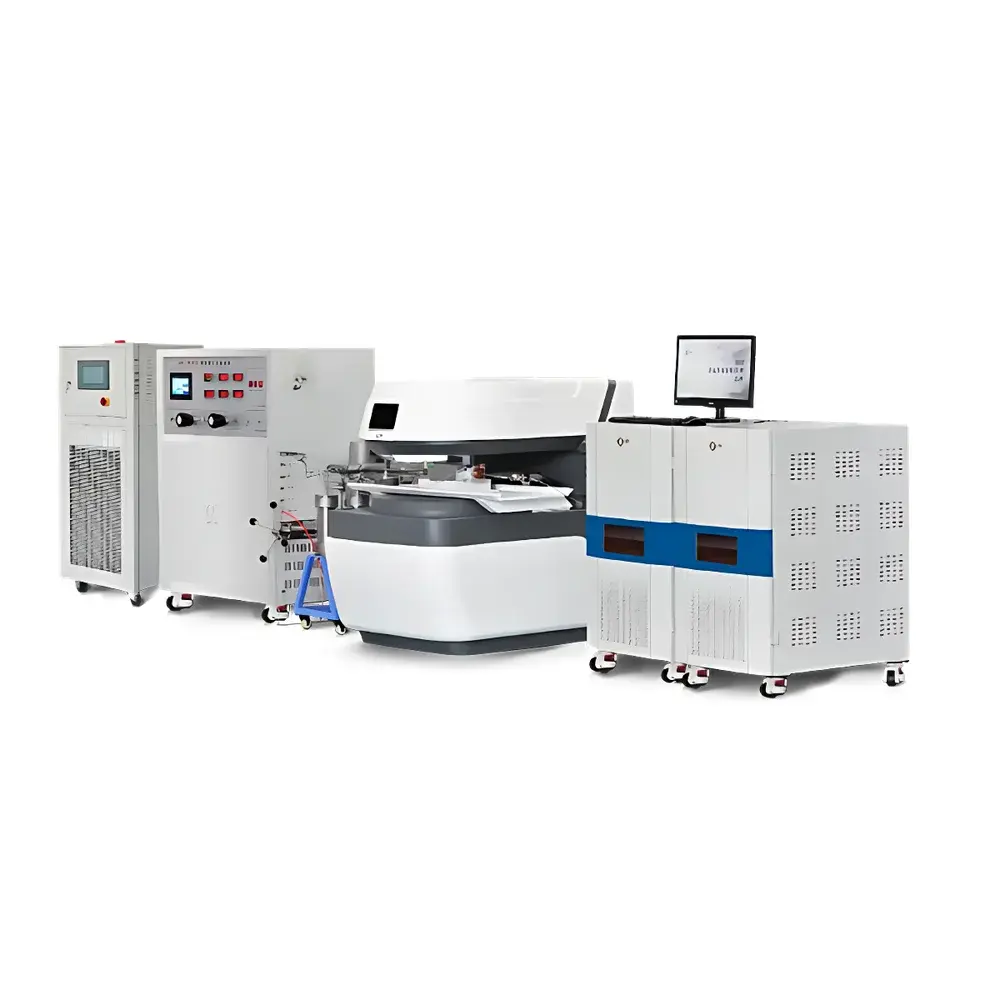
NIUMAG MacroMR Series Low-Field Nuclear Magnetic Resonance Analyzer for Coalbed Methane Adsorption/Desorption Analysis
| Brand | NIUMAG |
|---|---|
| Origin | Jiangsu, China |
| Model | MacroMR12-150H-I / MacroMR12-150H-HTHP (40 MPa-PMMR) / MacroMR12-110H-I |
| Magnetic Field Strength | 0.3 T ± 0.03 T |
| Magnet Homogeneity | ≤50 ppm |
| Magnet Type | C-shaped open configuration |
| Sample Orientation | Transverse or longitudinal |
| Sample Compatibility | Solid–liquid dual-mode |
| Instrument Class | Low-field NMR spectrometer |
| Compliance | Designed for ASTM D7169, ISO 10101-2, and coal seam gas evaluation protocols per GB/T 29173–2012 and API RP 44 |
Overview
The NIUMAG MacroMR Series Low-Field Nuclear Magnetic Resonance Analyzer is an engineered solution for quantitative, non-invasive investigation of coalbed methane (CBM) adsorption and desorption dynamics under simulated reservoir conditions. Unlike conventional gravimetric or volumetric methods—which require sample destruction, equilibrium assumptions, and lack temporal resolution—this system leverages the intrinsic sensitivity of hydrogen nuclei (1H) in pore-confined water and adsorbed CH4 to low-field NMR relaxation phenomena. Specifically, it exploits the distinct transverse relaxation time (T2) contrast between hydrogen-bearing species in adsorbed states (short T2, typically < 1 ms) and free-phase gas or bulk water (longer T2, > 10 ms), enabling unambiguous differentiation and quantification of adsorbed versus free methane without physical intrusion. The instrument operates at a stable 0.3 T field with homogeneity ≤50 ppm across the active volume, ensuring reproducible T1/T2 spectral acquisition and robust signal-to-noise performance for heterogeneous coal matrices.
Key Features
- C-shaped open magnet architecture accommodating core samples up to 4 inches (101.6 mm) in diameter—ideal for intact coal cores preserving natural cleat and matrix structure
- High-precision temperature-controlled probe with integrated gradient coils for spatially resolved relaxation mapping and diffusion-weighted analysis
- Modular high-pressure cell options (up to 40 MPa) and programmable thermal control (–20 °C to 120 °C) enabling true in-situ simulation of deep CBM reservoir environments
- Multi-parameter acquisition capability: T1 inversion recovery, T2 CPMG echo trains, proton density mapping, and multi-exponential spectral deconvolution
- Non-destructive, repeatable measurements on the same sample across multiple adsorption/desorption cycles—critical for hysteresis quantification and kinetic modeling
Sample Compatibility & Compliance
The MacroMR analyzer supports solid–liquid dual-mode operation, accommodating raw coal cores, pulverized samples, and saturated rock specimens with native moisture content. Its design conforms to industry-standard testing frameworks including ASTM D7169 (for hydrocarbon adsorption isotherms), ISO 10101-2 (coalbed methane characterization), and GB/T 29173–2012 (Chinese national standard for coal seam gas evaluation). When configured with pressure vessels and calibrated transducers, the system meets traceability requirements for ISO/IEC 17025-accredited laboratories. All hardware and firmware are architected to support GLP-compliant data integrity, including audit-trail-enabled acquisition logs and user-access-controlled parameter locking—aligning with FDA 21 CFR Part 11 principles for regulated research environments.
Software & Data Management
Built upon the proprietary MacroMR Studio platform, the system delivers comprehensive post-processing workflows for T2 spectrum inversion (using NNLS or SVD algorithms), pore-size distribution derivation via calibration with nitrogen adsorption (BET) or mercury intrusion porosimetry (MIP), and dynamic adsorption/desorption curve fitting using Langmuir, Dubinin–Astakhov, or multi-site models. Raw FID and echo train data are stored in vendor-neutral HDF5 format with embedded metadata (temperature, pressure, RF pulse sequence, shimming status). Export modules support CSV, MATLAB .mat, and ASCII formats for integration with third-party reservoir simulators (e.g., CMG, ECLIPSE) and statistical analysis packages (Python SciPy, R). Software validation documentation—including IQ/OQ protocols and version-controlled release notes—is provided for laboratory qualification.
Applications
- Coal Reservoir Characterization: Quantitative porosity partitioning (micropore/mesopore/macropore), bound vs. movable fluid saturation, moisture-dependent adsorption capacity, and competitive CO2/CH4 exchange kinetics
- In-Situ Process Monitoring: Real-time tracking of desorption fronts during depressurization, thermal stimulation effects on diffusion coefficients, and hydraulic fracture-induced permeability evolution
- Enhanced Recovery Research: Evaluation of CO2 sequestration potential, N2 or flue gas injection efficacy, and surfactant-assisted desorption mechanisms
- Geomechanical Coupling Studies: Triaxial stress–strain–NMR correlation under confining pressure, cleat closure behavior, and damage-induced T2 shift patterns
- Hydrate & Supercritical Fluid Systems: CH4·nH2O formation/decomposition kinetics, scCO2–coal interaction, and pore-scale displacement efficiency in gas-water two-phase flow
FAQ
Can this instrument distinguish between adsorbed methane and free-phase methane quantitatively?
Yes—the T2 relaxation time distribution provides a physically grounded basis for separating signals from hydrogen nuclei in different molecular mobility regimes, enabling direct quantification of adsorbed and free fractions when calibrated against reference standards.
Is it possible to perform measurements under reservoir-relevant pressure and temperature simultaneously?
Yes—optional high-pressure cells (up to 40 MPa) and temperature-controlled probes (–20 °C to 120 °C) allow concurrent control of both parameters, replicating downhole conditions for isothermal adsorption/desorption experiments.
Does the system support automated sequential testing across multiple samples?
The MacroMR platform integrates with robotic sample changers (optional) and supports batch script execution for unattended acquisition of T2 spectra, reducing operator dependency and improving inter-sample comparability.
How is data traceability ensured for regulatory submissions?
All acquisitions include embedded timestamps, operator IDs, environmental sensor readings, and hardware configuration fingerprints; audit trails are exportable and compatible with LIMS integration for full ALCOA+ compliance.
What sample preparation is required prior to NMR measurement?
Minimal preparation is needed—intact cores may be used directly; for powdered coal, standard sieving and moisture equilibration per ASTM D3173 are recommended to ensure consistent surface-to-volume ratios and hydration state control.






