
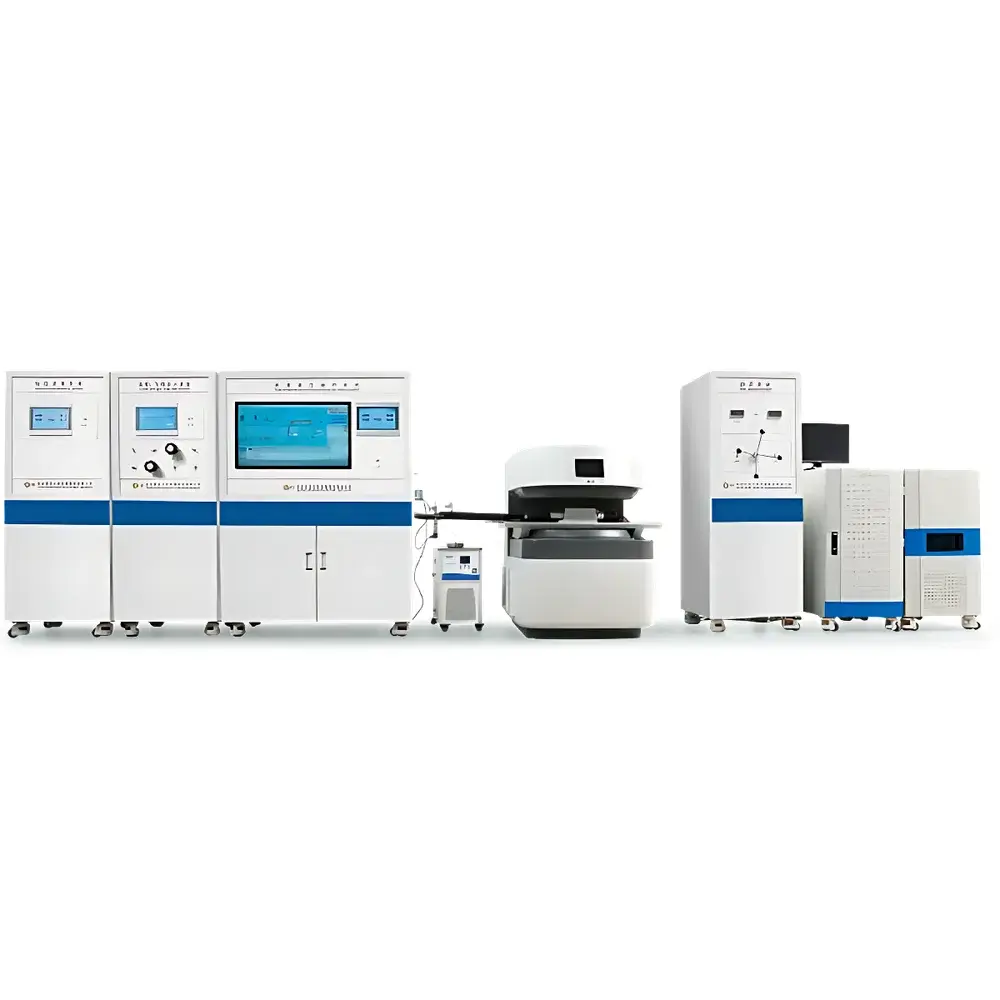
NIUMAG MacroMR12-150H-HTHP Low-Field Nuclear Magnetic Resonance Imaging System for Rock Mass Fracture Evaluation
| Brand | NIUMAG |
|---|---|
| Origin | Jiangsu, China |
| Model | MacroMR12-150H-HTHP |
| Magnetic Field Strength | 0.3 T ± 0.03 T |
| Sample Orientation | Transverse/Longitudinal |
| Magnet Type | C-shaped Open Permanent Magnet (NdFeB) |
| Maximum Sample Dimensions | Ø ≤ 25.4 mm × L ≤ 80 mm (under HTHP conditions) |
| Sample Compatibility | Solid–Liquid Dual-Phase Rock Cores |
| Temperature & Pressure Capability | Integrated High-Temperature High-Pressure (HTHP) Probe Support |
| Gradient System | High-Precision Active Gradient Coil Assembly |
| RF Probe | Temperature-Stabilized Broadband Tunable Probe |
Overview
The NIUMAG MacroMR12-150H-HTHP is a benchtop low-field nuclear magnetic resonance (LF-NMR) imaging and relaxometry system engineered specifically for quantitative evaluation of fracture initiation, propagation, and fluid transport behavior in geological rock masses under controlled thermo-mechanical stress. Unlike conventional CT or ultrasonic methods, this system leverages the intrinsic sensitivity of NMR to hydrogen-bearing fluids (e.g., water, brine, hydrocarbons) within porous media, enabling non-invasive, time-resolved characterization of pore-scale fluid distribution, saturation dynamics, and microstructural evolution during simulated in-situ stress conditions. Its C-shaped open permanent magnet architecture—constructed from high-coercivity NdFeB materials—delivers field homogeneity and thermal stability essential for longitudinal T2, diffusion-weighted (DWS), and multi-echo spin-echo acquisitions across heterogeneous rock samples. Designed for geomechanical laboratories and reservoir engineering R&D centers, the system supports real-time monitoring of fracture network development under coupled temperature–pressure–fluid loading, directly informing tunnel support design, hydraulic fracturing optimization, and long-term geotechnical risk assessment.
Key Features
- C-shaped open magnet configuration with 110–150 mm clear bore diameter, enabling unobstructed access for large-diameter rock core handling and integration of custom HTHP pressure vessels
- 0.3 T permanent magnet system with ±0.03 T field uniformity over a 60 mm DSV (diameter spherical volume), optimized for robust signal-to-noise ratio in low-gamma nuclei detection
- Dual-axis sample orientation capability (transverse and longitudinal) for flexible experimental geometry alignment relative to applied stress fields
- High-stability temperature-controlled RF probe with active gradient coils, supporting quantitative T1/T2 mapping, diffusion tensor imaging (DTI), and stimulated echo sequences
- Modular accessory ecosystem including multiple rock core holders (Ø25–150 mm), triaxial stress cells, fluid injection manifolds, and cryogenic stages for freeze–thaw cycle simulation
- Integrated hardware synchronization interface for external load frames, pressure controllers, and peristaltic pumps—enabling true multi-physics data correlation
Sample Compatibility & Compliance
The MacroMR12-150H-HTHP accommodates solid–liquid composite samples typical of geotechnical and petroleum engineering workflows: intact and fractured rock cores (sandstone, shale, limestone, granite), cementitious materials, frozen soils, and consolidated sediments. Sample dimensions are configurable up to Ø25.4 mm × 80 mm under high-temperature (up to 150 °C) and high-pressure (up to 70 MPa) conditions when used with certified HTHP accessories. All hardware and software modules comply with ISO/IEC 17025:2017 general requirements for testing laboratories; data acquisition protocols align with ASTM D7928-17 (particle size distribution via NMR), ASTM D4644-21 (soil moisture content), and ISO 10119:2020 (porosity measurement in porous solids). Full audit trail functionality satisfies GLP and GMP documentation requirements per FDA 21 CFR Part 11 for regulated research environments.
Software & Data Management
Control and analysis are performed via NIUMAG’s proprietary MesoMR Studio v5.x platform—a validated, scriptable environment supporting batch processing, ROI-based quantification, and parametric image generation. The software includes pre-built pulse sequence libraries for Carr–Purcell–Meiboom–Gill (CPMG), inversion recovery, and diffusion-edited acquisitions, with optional MATLAB and Python API integration for custom algorithm deployment. Raw FID data are stored in vendor-neutral NIfTI-1 format with embedded metadata (field strength, temperature, pressure timestamps, gradient amplitudes). All processed datasets include traceable calibration logs, instrument status flags, and user-defined experiment annotations—ensuring full reproducibility and regulatory compliance in peer-reviewed publications or technical reporting.
Applications
- Quantitative mapping of fracture aperture distribution and connectivity in stressed rock cores using T2 cutoff-based saturation profiling
- Time-lapse monitoring of water migration pathways during cyclic freeze–thaw or acid leaching experiments in carbonate reservoir analogs
- In-situ characterization of cement hydration kinetics and microcrack coalescence under sustained compressive loading
- Multi-parameter pore structure analysis (porosity, pore size distribution, bound/free fluid ratio) across stratified shale samples
- Validation of discrete element modeling (DEM) and lattice Boltzmann simulations against experimental NMR-derived permeability tensors
- Correlation of NMR-derived fluid saturation gradients with concurrent acoustic emission (AE) event localization during uniaxial compression tests
FAQ
What sample types are compatible with the MacroMR12-150H-HTHP?
Solid–liquid dual-phase geological specimens including cylindrical rock cores (Ø ≤ 25.4 mm, L ≤ 80 mm), cement paste, frozen soil columns, and saturated clay aggregates.
Does the system support true in-situ stress application during NMR acquisition?
Yes—when integrated with third-party triaxial cells or servo-hydraulic load frames via TTL synchronization, the system acquires NMR data synchronously with mechanical loading profiles.
Can T2 distributions be correlated with absolute permeability estimates?
Yes—the software includes built-in SDR (Schlumberger–Doll Research) and Timur–Coates models calibrated against standard reference sands and Berea sandstone cores.
Is the system compliant with FDA 21 CFR Part 11 for regulated laboratory use?
Yes—electronic signatures, audit trails, role-based access control, and immutable raw data archiving are fully implemented and validation-ready.
What is the minimum detectable pore size resolution under standard operating conditions?
Based on T2 relaxation cutoff calibration, effective pore radius resolution is approximately 0.1–100 µm, dependent on fluid viscosity and surface relaxivity of the rock matrix.
Related Products




