
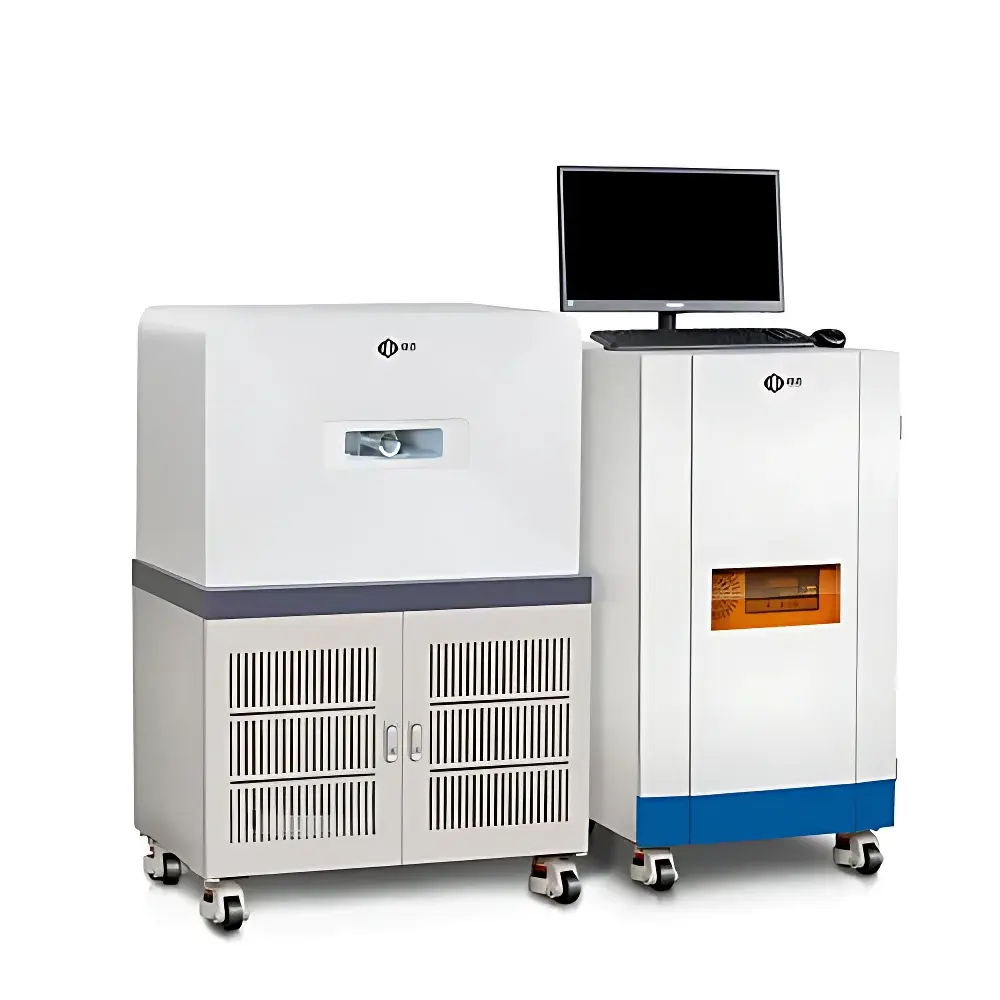
NIUMAG MesoMR21 Low-Field Nuclear Magnetic Resonance (NMR) Core Analyzer with Imaging Capability
| Brand | NIUMAG |
|---|---|
| Origin | Jiangsu, China |
| Manufacturer Type | Authorized Distributor |
| Origin Category | Domestic |
| Model | MesoMR21 |
| Instrument Type | Low-Field NMR Analyzer |
| Sample Type | Solid-Liquid Dual-Mode |
| Operating Frequency | 21.3 MHz |
| Magnet Type | Permanent Magnet |
| Magnetic Field Strength | 0.5 ± 0.03 T |
| Probe Coil Diameter | 60 mm |
| Optional Frequencies | 12 MHz / 21.3 MHz |
| Field Homogeneity | ≤ 10 ppm over 30 mm DSV |
Overview
The NIUMAG MesoMR21 is a benchtop low-field nuclear magnetic resonance (NMR) analyzer engineered for quantitative petrophysical characterization and non-invasive imaging of geological core samples. Operating at a fundamental Larmor frequency of 21.3 MHz (corresponding to a static magnetic field of 0.5 ± 0.03 T), the system leverages pulsed NMR principles—primarily spin-echo (CPMG) and inversion-recovery sequences—to extract intrinsic relaxation parameters (T2, T1, T1ρ) from hydrogen-bearing fluids (e.g., water, hydrocarbons) within porous media. Unlike high-field NMR spectrometers optimized for molecular structure elucidation, the MesoMR21 is purpose-built for robust, reproducible measurement of bulk fluid dynamics in heterogeneous rock matrices under controlled environmental conditions. Its permanent magnet architecture ensures operational stability, minimal cryogen dependency, and suitability for long-term deployment in core labs, E&P research centers, and university geoscience facilities.
Key Features
- Modular platform supporting customizable configurations—including vertical/horizontal sample loading, variable-temperature stages (–40 °C to +80 °C), and high-pressure cells (up to 70 MPa) for reservoir condition simulation.
- 60 mm diameter radiofrequency (RF) probe coil optimized for standard cylindrical core plugs (1″–1.5″ diameter, up to 10 cm length), enabling uniform excitation and signal reception across typical reservoir rock specimens.
- Dual-frequency capability (12 MHz / 21.3 MHz) allows comparative analysis across field strengths to assess diffusion-sensitivity effects and surface relaxation contributions in tight formations.
- Integrated gradient coils (up to 0.1 T/m) enable diffusion-weighted imaging (DWI) and spatially resolved T2 mapping, facilitating pore-scale heterogeneity visualization without destructive sectioning.
- Rugged mechanical design with active temperature stabilization and passive shimming ensures <10 ppm field homogeneity over a 30 mm diameter spherical volume (DSV), critical for quantitative relaxation time distribution (T2谱) deconvolution.
Sample Compatibility & Compliance
The MesoMR21 accommodates solid-liquid composite samples, including saturated/unsaturated core plugs, cuttings, shale fragments, and synthetic porous media. It supports both routine QC workflows and advanced experimental protocols—such as cyclic freeze-thaw, imbibition/drainage, CO2 adsorption-desorption, and multi-phase fluid displacement—under simulated reservoir conditions. The instrument complies with ISO 17025:2017 general requirements for competence of testing and calibration laboratories. Data acquisition and processing workflows are structured to support GLP-compliant reporting; audit trails, electronic signatures, and raw FID export capabilities align with FDA 21 CFR Part 11 expectations for regulated environments where traceability is required.
Software & Data Management
Control and analysis are performed via NIUMAG’s proprietary MesoMR Studio software suite, built on a modular architecture supporting sequence programming, real-time parameter optimization, and batch processing. Key modules include: (i) T2 spectrum inversion using non-negative least squares (NNLS) with regularization; (ii) porosity and saturation quantification calibrated against gravimetric standards; (iii) capillary pressure curve derivation via T2-to-pore-radius conversion (using surface relaxivity ρ2 and bulk diffusion coefficient D); and (iv) 2D/3D NMR imaging reconstruction (filtered backprojection or iterative SENSE-based algorithms). All raw data (FID, echo trains, k-space files) are stored in vendor-neutral HDF5 format, ensuring interoperability with MATLAB, Python (SciPy/Numpy), and third-party reservoir simulation platforms.
Applications
- Petrophysical evaluation: porosity, irreducible water saturation (Swirr), movable fluid fraction, permeability estimation (via Timur-Coates or SDR models), and wettability assessment (through spontaneous imbibition T1/T2 contrast).
- Pore structure characterization: T2 distribution analysis for pore-size spectrum inference, identification of microporosity vs. macroporosity domains, and clay-bound water (CBW) quantification.
- Dynamic process monitoring: in-situ tracking of fluid redistribution during drainage, imbibition, thermal stress cycling, and reactive transport experiments.
- Shale gas/oil systems: kerogen-hosted hydrocarbon mobility, nanopore confinement effects, and gas adsorption kinetics via variable-temperature T1 relaxation profiling.
- Geomechanical studies: coupling NMR-derived fluid saturation maps with acoustic emission or micro-CT data for fracture propagation modeling.
FAQ
What is the minimum detectable porosity for sandstone cores using the MesoMR21?
Detection limit depends on signal-to-noise ratio (SNR), acquisition time, and surface relaxivity—but routinely achieves <0.5% porosity resolution for standard Berea sandstone with ≥128 CPMG echoes and 4k transients.
Can the system be integrated with external pressure vessels or environmental chambers?
Yes—the MesoMR21 features standardized flange interfaces and RF feedthroughs compatible with third-party high-pressure cells (e.g., Hassler-type) and climate-controlled enclosures, provided RF shielding integrity is maintained.
Is T1–T2 correlation mapping supported?
Yes—built-in inversion routines generate joint T1–T2 distributions from 2D NMR experiments, enabling differentiation of fluid phases (e.g., bound water vs. free oil) based on relaxation contrast.
Does the software support ASTM D7264 or ISO 10113 compliance for modulus calculations?
No—those standards apply to mechanical tensile testing; however, NMR-derived parameters (e.g., T2 cutoff, movable fluid index) correlate empirically with dynamic moduli per published correlations in SPE papers (e.g., SPE-195985-MS).
What level of technical support and method validation assistance is provided?
NIUMAG offers application-specific method development workshops, SOP documentation templates aligned with API RP 40 and ISO 14688, and remote troubleshooting via secure VNC with logged session archives for audit readiness.






