
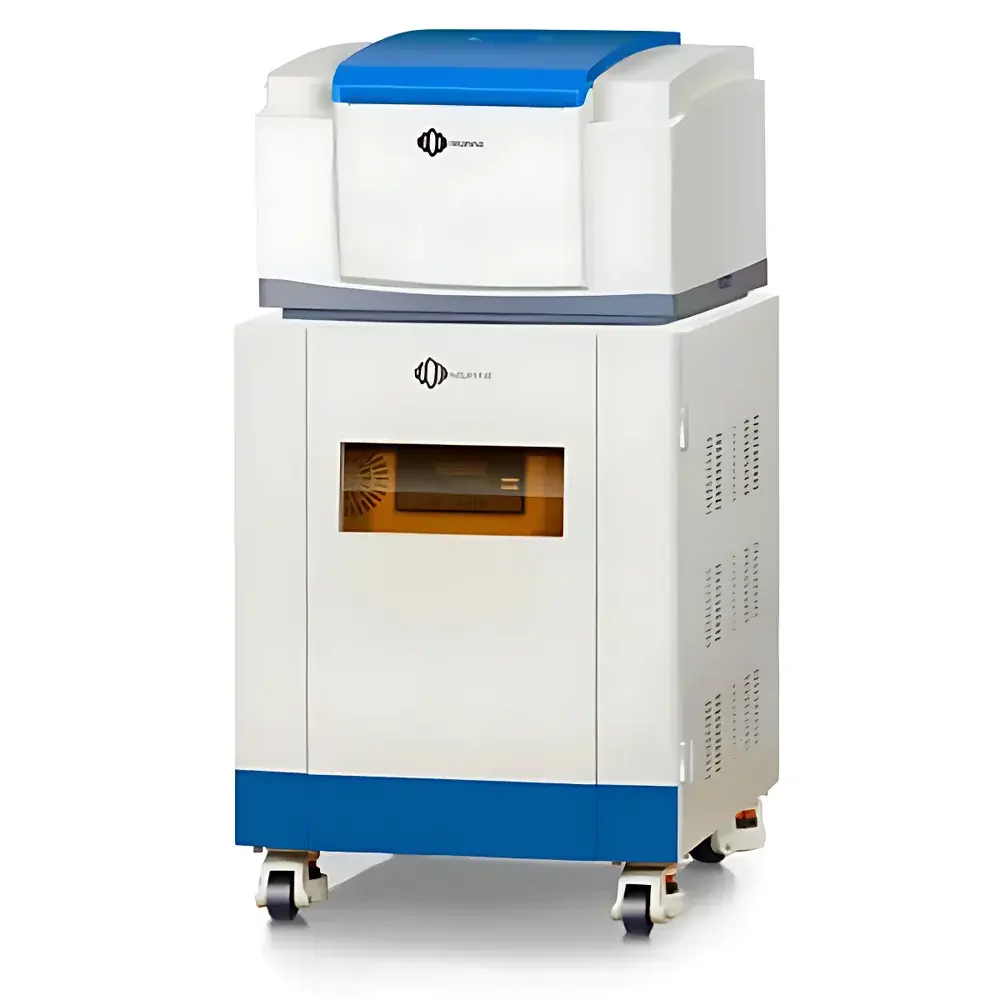
NIUMAG MesoMR23-040V Two-Dimensional Low-Field Nuclear Magnetic Resonance Analyzer
| Brand | NIUMAG |
|---|---|
| Origin | Jiangsu, China |
| Manufacturer Type | Authorized Distributor |
| Origin Category | Domestic |
| Model | MesoMR23-040V |
| Instrument Type | Low-Field NMR Analyzer |
| Sample Type | Solid-Liquid Dual-Phase Core Samples |
| Operating Frequency | 23 MHz |
| Data Acquisition Method | Pulsed Fourier Transform (PFT-NMR) |
Overview
The NIUMAG MesoMR23-040V is a purpose-built two-dimensional low-field nuclear magnetic resonance (2D LF-NMR) analyzer engineered for quantitative petrophysical characterization of unconventional reservoir rock cores. Operating at a stable Larmor frequency of 23 MHz—corresponding to a static magnetic field strength of 0.50 ± 0.03 T—the system leverages pulsed Fourier transform NMR methodology to acquire high-fidelity T1–T2 correlation spectra. Unlike conventional single-dimension NMR logging tools, this instrument resolves hydrogen-bearing fluid components (e.g., bound water, movable water, light hydrocarbons, heavy oil, and kerogen-associated hydrogen) based on their distinct longitudinal (T1) and transverse (T2) relaxation signatures. The 23 MHz operating frequency delivers significantly improved signal-to-noise ratio (SNR) and spectral resolution over lower-frequency systems (e.g., 2.5 MHz), particularly critical for low-porosity, low-permeability formations such as shale, tight sandstone, and carbonate reservoirs where short-T2 signals dominate and are otherwise difficult to resolve.
Key Features
- Optimized hardware architecture for robust acquisition of short-T2 decay signals (< 1 ms), enabling accurate quantification of clay-bound water and micropore-confined fluids.
- Dual-mode probe compatibility: supports standardized 1-inch (25.4 mm) and 1.5-inch (38.1 mm) core plugs, plus custom 10 mm diameter mini-cores for high-throughput screening.
- Longitudinal sample insertion design ensures uniform RF field distribution and minimizes susceptibility-induced line broadening.
- Integrated temperature-controlled probe option (±0.1 °C stability) for controlled thermal studies of fluid mobility and phase transitions in reservoir analogs.
- Hardware-accelerated pulse sequence execution with sub-millisecond timing precision, supporting advanced 2D inversion algorithms including SVD-based non-negative least squares (NNLS) and compressed sensing reconstruction.
Sample Compatibility & Compliance
The MesoMR23-040V accepts intact or sectioned cylindrical rock core samples with diameters up to 38.1 mm and lengths up to 100 mm. It accommodates both dry and saturated (brine-, oil-, or gas-saturated) specimens without modification. All measurement protocols adhere to ASTM D7171–19 (Standard Test Method for Determination of Pore Size Distribution of Rock Core by Low-Field NMR) and ISO 17674–2:2022 (Petroleum and natural gas industries — Core analysis — Part 2: Low-field NMR methods). System validation includes daily SNR monitoring, T2 standard reference calibration using doped water phantoms, and full audit trail logging compliant with GLP and GMP documentation requirements.
Software & Data Management
Equipped with NIUMAG’s proprietary NMR-Studio v4.2 software suite, the instrument provides end-to-end workflow automation—from pulse sequence selection and parameter optimization to 2D spectral inversion, component deconvolution, and petrophysical modeling. Raw FID data are stored in vendor-neutral HDF5 format with embedded metadata (sample ID, operator, timestamp, temperature, field homogeneity metrics). The software supports FDA 21 CFR Part 11-compliant electronic signatures, role-based access control, and automated report generation in PDF/Excel formats conforming to internal QA/QC templates. Batch processing mode enables unattended overnight acquisition of multi-sample sets with real-time QC flagging for outlier detection.
Applications
- Quantitative differentiation of movable vs. irreducible hydrocarbon saturation in shale oil/gas systems via T1–T2 cross-plot clustering.
- Microstructural characterization: pore throat size distribution, effective porosity partitioning, and wettability assessment through surface relaxivity modeling.
- Thermal desorption simulation: tracking hydrogen mobility changes during programmed heating cycles to infer kerogen maturity and bitumen viscosity.
- Enhanced oil recovery (EOR) screening: evaluating surfactant or polymer flooding efficiency by monitoring T2 shift dynamics before/after treatment.
- Core-flooding integration: synchronized acquisition with pressure/flow sensors to correlate NMR-derived saturation maps with dynamic drainage/imbibition curves.
FAQ
What distinguishes the MesoMR23-040V from conventional 2.5 MHz NMR analyzers?
The 23 MHz platform provides ~9× higher intrinsic SNR and superior spectral dispersion, enabling reliable resolution of overlapping T1–T2 peaks in complex fluid mixtures—particularly essential for distinguishing light oil from water in low-permeability shales.
Can the system perform real-time downhole logging simulation?
No—it is a benchtop laboratory instrument designed for ex situ core analysis. However, its pulse sequences and inversion models are fully compatible with industry-standard logging interpretation frameworks (e.g., Schlumberger GeoFrame, Halliburton Techlog).
Is T1–T2 data acquisition fully automated?
Yes. Once sample geometry and preliminary T2 range are entered, the software auto-selects optimal echo spacing, repetition time, and number of scans per T1 increment, minimizing user-dependent variability.
Does the system support third-party spectral processing?
Raw time-domain data (FIDs) are exported in ASCII and HDF5 formats, enabling import into MATLAB, Python (scikit-learn, SciPy), or commercial NMR processing packages for custom inversion or machine learning workflows.
How is magnet homogeneity maintained during long-term operation?
The permanent magnet assembly incorporates passive shimming elements and temperature-compensated pole pieces; field drift is monitored continuously via built-in lock signal and corrected automatically every 30 minutes using adaptive gradient compensation.







