
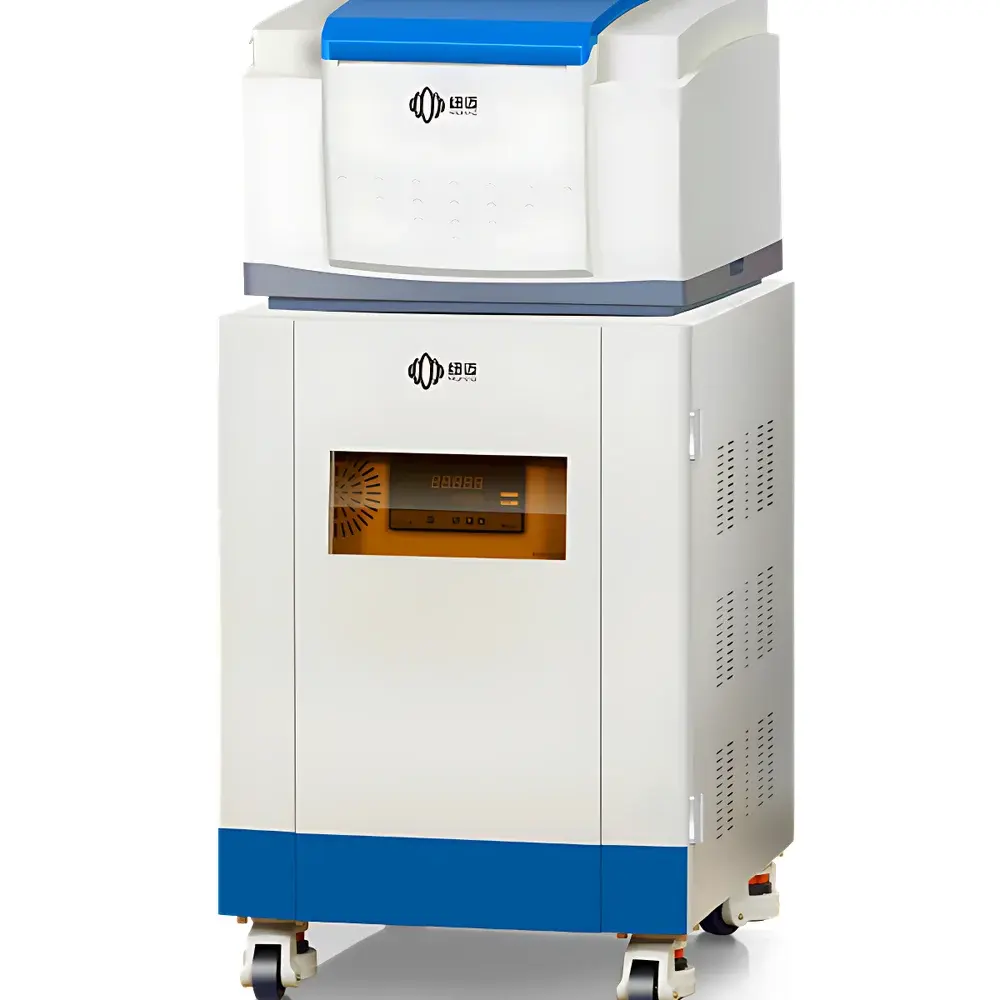
NIUMAG MicroMR Benchtop NMR Drilling Fluid Analyzer
| Brand | NIUMAG |
|---|---|
| Origin | Jiangsu, China |
| Manufacturer Type | Authorized Distributor |
| Country of Origin | China |
| Model | MicroMR |
| Pricing | Available Upon Request |
Overview
The NIUMAG MicroMR Benchtop NMR Drilling Fluid Analyzer is a compact, high-stability time-domain nuclear magnetic resonance (TD-NMR) instrument engineered specifically for real-time, non-destructive quantitative analysis of oil and water phases in drilling fluids and associated cuttings or oil-contaminated sludge. Operating at a fixed Larmor frequency (typically 20–23 MHz for permanent magnet systems), the MicroMR exploits the differential transverse relaxation times (T₂) of hydrogen nuclei in hydrocarbon versus aqueous environments to discriminate and quantify oil saturation, water saturation, and total fluid content without chemical reagents or sample drying. Its benchtop architecture—featuring a self-shielded, temperature-stabilized permanent magnet and integrated RF probe—enables deployment directly at rig sites, core labs, or mud logging units, supporting both offline batch analysis and semi-continuous online monitoring via optional flow-cell integration.
Key Features
- Compact, rugged benchtop design optimized for field laboratories and mobile logging units
- High-reproducibility TD-NMR measurements with <1.5% RSD for oil/water ratio across repeated runs on homogeneous samples
- Integrated temperature-controlled sample chamber (±0.5 °C stability) to minimize T₂ drift during extended acquisition
- Dual-mode operation: static vial-based analysis (standard 10–15 mL cylindrical tubes) and optional inline flow-cell configuration for real-time downhole fluid return monitoring
- Pre-calibrated pulse sequences—including CPMG (Carr–Purcell–Meiboom–Gill) for robust T₂ distribution analysis—and user-definable acquisition parameters (echo spacing, number of echoes, repetition time)
- Embedded industrial-grade controller with touch interface and local data storage (≥64 GB SSD)
Sample Compatibility & Compliance
The MicroMR accepts standard NMR-compatible cylindrical sample tubes (OD 25 mm, height ≤100 mm) containing native or centrifuged drilling fluid emulsions, oil-based mud (OBM) filtrates, synthetic-based mud (SBM) cuttings, and oil-contaminated drill cuttings or sludge. It requires no solvent extraction, filtration, or phase separation prior to measurement. The system complies with IEC 61000-6-3 (EMC emission standards) and meets mechanical safety requirements per ISO 13857. While not certified for hazardous area installation (e.g., ATEX/IECEx), it is routinely deployed in Zone 2/Class I Division 2 environments when housed in ventilated enclosures. Data integrity aligns with GLP principles; audit trails, electronic signatures, and raw FID/T₂ decay export support FDA 21 CFR Part 11 readiness when paired with validated software configurations.
Software & Data Management
The proprietary NIUMAG NMR Drilling Fluid Analysis Software (v4.x) provides an intuitive, role-based GUI for method setup, real-time spectrum visualization, and automated report generation. Core algorithms apply constrained non-negative least squares (CNLS) deconvolution to extract multi-component T₂ distributions, then map relaxation components to oil/water fractions using factory-established calibration curves traceable to NIST-traceable reference standards. Output parameters include oil saturation (% vol), water saturation (% vol), oil-to-water ratio (O/W), free/bound water index, and apparent viscosity proxy (derived from T₂ geometric mean). All raw data (FID, T₂ spectra, parameter tables) are stored in HDF5 format with embedded metadata (operator ID, timestamp, instrument serial, method name). Export options include CSV, PDF reports, and direct SQL database push for LIMS integration.
Applications
- Quantitative oil/water fraction determination in oil-based and synthetic-based drilling fluids during mud formulation and maintenance
- Real-time detection of formation fluid influx (e.g., hydrocarbon shows or aquifer entry) via trending of returning fluid O/W ratios
- Assessment of emulsion stability and water-phase inversion thresholds under varying temperature/pressure conditions
- Characterization of heavy vs. light oil components in cuttings based on T₂ spectral centroid shifts and short-T₂ component amplitude
- Evaluation of rheological modifier efficacy (e.g., organoclays, surfactants) by correlating T₂ changes with macroscopic viscosity and yield point
- Rapid screening of oil-contaminated drill cuttings for remediation prioritization (ASTM D7576-compliant workflow)
FAQ
Does the MicroMR require cryogens or external cooling?
No—the system employs a permanent magnet with passive thermal stabilization; no liquid helium, nitrogen, or chiller is needed.
Can it distinguish between free water and chemically bound water in bentonite-rich muds?
Yes—multi-exponential T₂ analysis resolves at least three relaxation components, enabling differentiation of bulk water, interlayer water in clays, and hydrocarbon-bound protons.
Is calibration transferable between instruments?
Calibration models are instrument-specific due to magnet homogeneity and probe Q-factor variations; however, cross-instrument validation protocols using reference mud standards are supported.
What sample volume is required for reliable quantification?
Minimum recommended volume is 8 mL for standard tubes; accuracy improves above 12 mL, especially for low-saturation (<5%) samples.
How is compliance with regulatory documentation requirements addressed?
The software supports 21 CFR Part 11–compliant configurations including electronic signatures, audit trail review, and locked report generation—subject to site-specific validation per GxP guidelines.





