
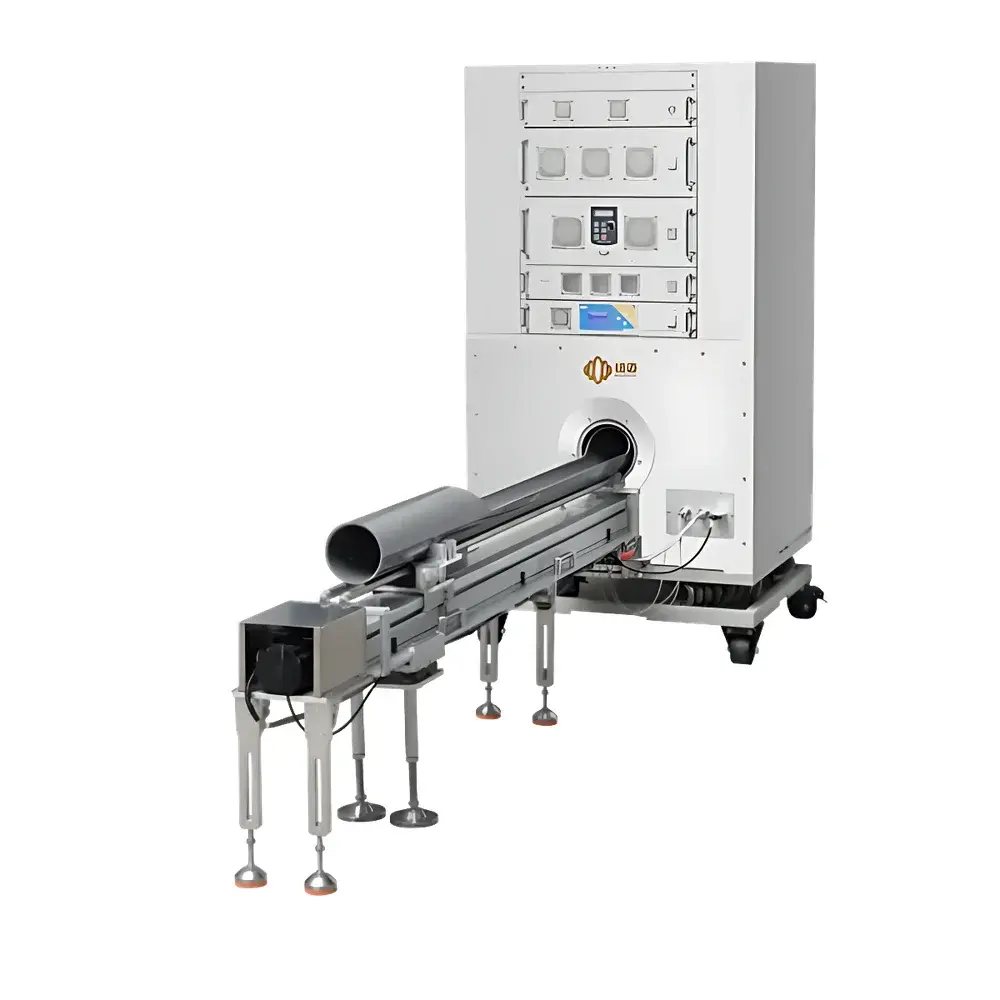
NIUMAG MRCL-110 Mobile Dual-Dimensional Low-Field NMR Core Analyzer for Full-Diameter Rock Samples
| Brand | NIUMAG |
|---|---|
| Origin | Jiangsu, China |
| Model | MRCL-110 |
| Instrument Type | Low-Field Nuclear Magnetic Resonance Analyzer |
| Sample Type | Solid–Liquid Combined (Full-Diameter Rock Cores) |
| Operating Frequency | 6.2 MHz |
| Maximum Core Length | 1 m |
| Maximum Core Diameter | 115 mm |
| Minimum Longitudinal Resolution | 1 cm |
| Primary Measurements | T₁ and T₂ Relaxation Spectra, T₁–T₂ Two-Dimensional Correlation Spectroscopy |
Overview
The NIUMAG MRCL-110 is a purpose-engineered mobile dual-dimensional low-field nuclear magnetic resonance (NMR) analyzer designed specifically for in-situ and near-wellbore characterization of full-diameter rock core samples. Unlike conventional benchtop or fixed-site high-field NMR systems, the MRCL-110 integrates a compact Halbach permanent magnet array with optimized gradient and RF subsystems to deliver field-stable, quantitative NMR measurements under non-laboratory conditions. Its operational principle relies on spin-echo-based pulse sequences—including CPMG for T₂ mapping and inversion-recovery with CPMG for T₁ profiling—enabling robust quantification of hydrogen-bearing fluid phases (e.g., brine, oil, gas condensate) within porous media. The system operates at 6.2 MHz (corresponding to ~0.147 T), balancing signal-to-noise ratio, portability, and insensitivity to magnetic susceptibility variations commonly encountered in heterogeneous geological materials. Engineered for geoscience field deployment, it supports real-time acquisition and on-board processing of T₁–T₂ correlation spectra—a critical capability for differentiating pore-fluid interactions, wettability assessment, and capillary pressure estimation without destructive sample preparation.
Key Features
- Mobile Halbach Magnet Architecture: Reduces total magnet mass by ~50% versus conventional designs, enabling transport across rugged terrain (e.g., mountainous outcrops, remote mining sites) via standard 4×4 vehicle integration.
- Full-Diameter Core Compatibility: Accommodates intact cylindrical cores up to 115 mm in diameter and 1 m in length—preserving native pore structure and avoiding coring artifacts associated with plug sampling.
- High-Resolution Axial Profiling: Achieves 1 cm longitudinal spatial resolution through optimized slice-selective excitation and phase-encoded gradient encoding, supporting stratified porosity and pore-size distribution analysis along core length.
- Automated Acquisition Workflow: Fully programmable sequence scheduling enables unattended 18-minute complete T₁–T₂ acquisition for a 1 m core, including shimming, calibration, and spectral reconstruction.
- Ruggedized Enclosure & Environmental Hardening: IP54-rated chassis with thermal management for operation between −10 °C and +45 °C; shock-mounted electronics compliant with MIL-STD-810G for vibration during transit.
Sample Compatibility & Compliance
The MRCL-110 accepts both saturated and partially saturated full-diameter rock cores—including sandstone, carbonate, shale, and tight reservoir analogs—without requirement for drying, vacuum saturation, or sectioning. It supports direct measurement of native-state fluid distributions, enabling validation against routine core analysis (RCA) and special core analysis (SCAL) datasets. While not certified to ISO/IEC 17025 for accredited testing, the instrument adheres to ASTM D7372 (Standard Practice for NMR Measurements of Hydrogen Index and Porosity) and aligns with industry best practices outlined in API RP 40 and SPE Recommended Practices for Low-Field NMR Core Analysis. Data integrity is maintained through hardware-level timestamping, audit-trail-enabled acquisition logs, and optional 21 CFR Part 11-compliant software modules for regulated environments.
Software & Data Management
Acquisition and processing are managed via NIUMAG’s proprietary MesoMR Studio v4.x platform, running on an embedded industrial PC. The software provides real-time visualization of echo trains, T₂ decay curves, T₁–T₂ contour maps, and derived petrophysical parameters—including total porosity, bound vs. movable fluid volume, and effective pore radius distributions. All raw FID data and processed spectra are stored in HDF5 format with embedded metadata (sample ID, acquisition date, operator, pulse sequence parameters). Export options include CSV, ASCII, and SEG-Y for interoperability with reservoir simulation workflows (e.g., Petrel, CMG). Remote diagnostics, firmware updates, and license management are supported via encrypted TLS-secured cloud portal access—requiring no inbound firewall configuration.
Applications
- Quantitative porosity and pore-size distribution mapping along core length, enabling zonation of reservoir quality.
- Differentiation of clay-bound water, capillary-bound water, and free fluid volumes using T₁–T₂ cross-plots.
- Assessment of hydrocarbon saturation and wettability state in mixed-wet and oil-wet systems.
- Monitoring of imbibition/drainage processes during SCAL experiments under controlled pressure/temperature conditions.
- Calibration and validation of logging-while-drilling (LWD) and wireline NMR tools in representative core material.
FAQ
Is the MRCL-110 suitable for regulatory submission of core analysis data?
It supports traceable, repeatable measurements aligned with ASTM D7372; however, formal regulatory acceptance depends on site-specific validation per client QA/QC protocols.
Can the system operate without external power sources?
Yes—it includes an integrated 24 V DC power management module compatible with vehicle alternators or portable lithium battery packs (≥3 kWh capacity recommended).
What level of technical expertise is required for daily operation?
Minimal training is required for routine acquisition; interpretation of T₁–T₂ spectra benefits from geoscience or petrophysics background, with NIUMAG offering role-based certification courses.
Does the system support custom pulse sequence development?
Advanced users may import user-defined C code modules via SDK interface, subject to hardware timing constraints and safety interlocks.
How is magnetic field homogeneity maintained during transport?
Passive shimming is performed pre-deployment; active dynamic shimming is not implemented, but the Halbach design ensures <±10 ppm drift over 8-hour field sessions.





