
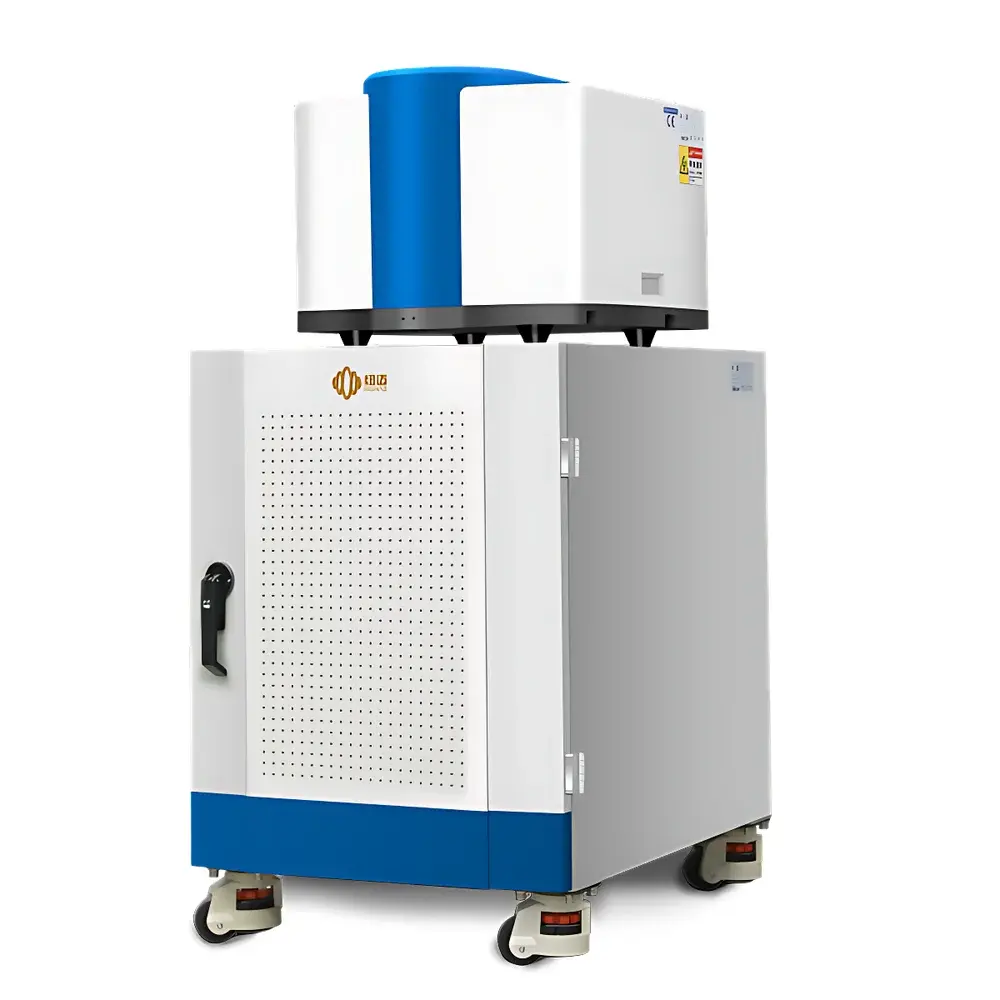
NIUMAG NM-PQ001 Low-Field Nuclear Magnetic Resonance Analyzer for Food Fatty Acid Content
| Brand | NIUMAG |
|---|---|
| Origin | Jiangsu, China |
| Manufacturer Type | Authorized Distributor |
| Country of Origin | Domestic (China) |
| Model | NM-PQ001 |
| Instrument Type | Low-Field NMR Analyzer |
| Sample Compatibility | Solid-Liquid Dual-Phase Samples |
| Magnetic Field Strength | 0.28 T ± 0.03 T |
| Sample Cavity Dimensions | Ø40 mm × H60 mm |
| Magnet Homogeneity | ≤40 ppm |
| Repeatability (11 Replicates) | ≤0.5% RSD |
| Oil Content Range | 1–100 wt% |
| Water Content Range | 2–10 wt% |
Overview
The NIUMAG NM-PQ001 is a dedicated low-field nuclear magnetic resonance (LF-NMR) analyzer engineered for quantitative and compositional analysis of fatty acids in food matrices. Unlike destructive wet-chemistry or chromatographic methods, this instrument leverages the intrinsic magnetic properties of hydrogen nuclei (1H) to non-invasively probe molecular mobility, binding states, and phase distribution within complex biological samples. In food systems, protons in acyl chains of triglycerides exhibit distinct transverse relaxation times (T2) that correlate with chain length, saturation degree, and physical state (e.g., crystalline vs. liquid oil). By acquiring multi-exponential T2 decay spectra and applying chemometric calibration models—validated against reference methods such as AOAC 996.06 (gas chromatography) or ISO 12966—the NM-PQ001 enables rapid estimation of total fatty acid content, saturated/unsaturated ratio, and solid fat content (SFC) without solvent extraction, derivatization, or sample homogenization.
Key Features
- Non-destructive, reagent-free operation: Eliminates organic solvents, acid catalysts, and saponification steps—reducing analytical waste, labor cost, and operator exposure risk.
- Integrated permanent magnet system: Stable 0.28 T field with ≤40 ppm homogeneity over a 40 mm diameter spherical volume, optimized for robust signal-to-noise ratio in routine QC environments.
- Wide dynamic range: Accurately quantifies oil content from 1% to 100% (w/w) and water content from 2% to 10% (w/w) across heterogeneous samples—including whole seeds (e.g., sesame, flax, olive), ground nuts, dairy powders, and processed meats.
- High measurement reproducibility: ≤0.5% relative standard deviation across 11 consecutive measurements under identical conditions—meeting internal method validation requirements for GLP-compliant laboratories.
- User-centric hardware design: Vertical bore configuration with motorized sample lift, intuitive touchscreen interface, and modular RF probe optimized for 20–60 MHz 1H detection.
Sample Compatibility & Compliance
The NM-PQ001 accepts intact, minimally prepared samples—no grinding, drying, or filtration required—preserving native microstructure and enabling longitudinal studies on shelf-life stability or thermal processing effects. It supports dual-phase (solid-liquid) analysis critical for emulsified foods (e.g., mayonnaise, cheese spreads) and oleaginous seeds where oil resides in cellular compartments. Methodologically, the instrument aligns with principles outlined in ISO 16584 (NMR determination of SFC), ASTM D6378 (low-field NMR for hydrocarbon analysis), and USP <1210> (analytical procedure validation). While not itself certified to 21 CFR Part 11, its software architecture supports audit trail generation, electronic signatures, and user-access controls when deployed in regulated GMP environments.
Software & Data Management
Equipped with NIUMAG’s proprietary MesoMR Studio v4.x, the system provides full control over pulse sequence selection (CPMG, IR, SE), real-time spectral preview, automated baseline correction, and multi-component T2 inversion using non-negative least squares (NNLS) algorithms. Calibration models are built using partial least squares regression (PLSR) against reference datasets; model files (.cal) support versioning, metadata tagging (operator, date, instrument ID), and export in CSV or HDF5 format. Raw FID data and processed spectra are stored in vendor-neutral formats compatible with third-party chemometric platforms (e.g., MATLAB, Unscrambler X, Python scikit-learn).
Applications
- Quantitative oil content screening in oilseed breeding programs (soybean, rapeseed, sunflower).
- Monitoring oxidative stability via T2 shortening kinetics during accelerated storage trials.
- Differentiating cis/trans isomer ratios in partially hydrogenated oils using diffusion-weighted NMR sequences.
- Mapping spatial oil distribution in meat cuts using single-sided NMR profiling (optional surface probe upgrade).
- Supporting regulatory submissions for nutritional labeling (e.g., FDA 21 CFR 101.9) by providing traceable, repeatable fat quantification.
FAQ
Does the NM-PQ001 require cryogens or external cooling?
No. It uses a self-contained permanent magnet system operating at ambient temperature—no liquid helium, nitrogen, or chiller units are needed.
Can it distinguish between saturated and unsaturated fatty acids directly?
Not at the molecular-species level like GC-FID; however, empirical correlations between T2 distributions and iodine value (IV) or oleic/linoleic ratios have been established for specific matrices (e.g., olive oil, palm oil).
Is method transfer possible between different NM-PQ001 units?
Yes—provided magnets are calibrated to the same field strength and probe tuning matches; inter-unit RSD for identical samples remains ≤1.2% when using standardized calibration protocols.
What sample preparation is required for seed analysis?
None beyond size reduction to fit the 40 mm diameter cavity; whole sesame or poppy seeds may be analyzed directly; larger seeds (e.g., almonds) require halving or quartering to ensure uniform field exposure.
How does LF-NMR compare to mid-field or high-field NMR for fatty acid analysis?
LF-NMR prioritizes speed, ruggedness, and cost-of-ownership over spectral resolution; it excels in routine QC where absolute chemical shift assignment is unnecessary but quantitative repeatability and throughput are critical.




