
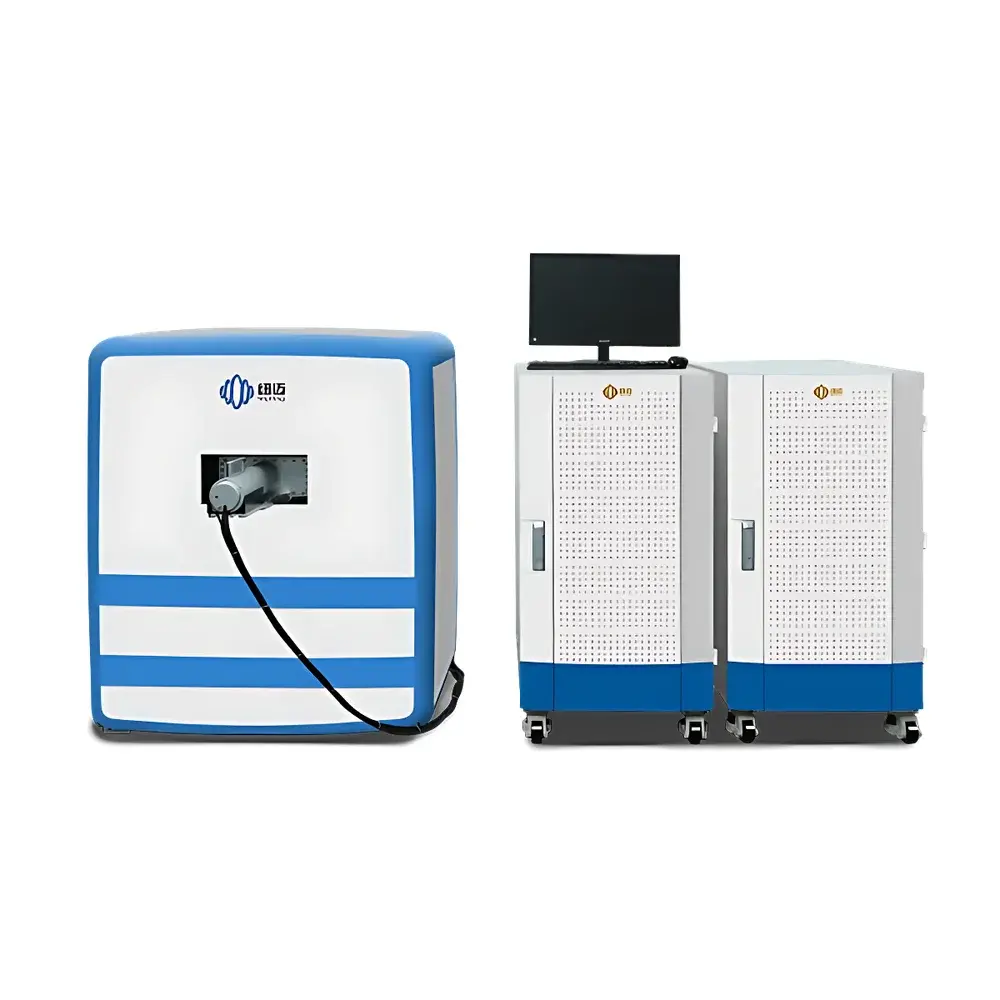
NIUMAG NM42-060H-I Small Animal MRI System
| Brand | NIUMAG |
|---|---|
| Origin | Jiangsu, China |
| Manufacturer Type | Authorized Distributor |
| Regional Classification | Domestic (China) |
| Model | NM42-060H-I-2 |
| Instrument Type | Low-Field Nuclear Magnetic Resonance Imaging System |
| Sample Type | Solid-Liquid Dual Compatibility |
| Magnet Type | Permanent Magnet |
| Field Strength | 1.0 T ± 0.05 T |
| Magnet Homogeneity | ≤30 ppm over Ø60 mm DSV |
| Supported Sample Mass Range | 1–350 g (mice, rats, excised tissues) |
| RF Coil Apertures | Ø60 / Ø45 / Ø35 / Ø30 / Ø25 mm |
| Max Reconstruction Matrix | 512 × 512 × 128 |
| Integrated Anesthesia & Respiratory Monitoring | Yes |
| Temperature-Controlled Animal Bed | Yes |
| Pulse Sequence Flexibility | Graphical GUI + Python API for custom sequence development |
| Data Throughput Architecture | Gigabit Ethernet-based real-time acquisition with <10⁻⁹ bit error rate |
Overview
The NIUMAG NM42-060H-I Small Animal MRI System is a dedicated low-field magnetic resonance imaging platform engineered for preclinical in vivo and ex vivo studies in rodent models. Operating at a stable 1.0 T permanent magnet field, the system leverages classical spin-echo and gradient-echo physics to generate high-fidelity anatomical and functional contrast across soft tissues. Unlike high-field superconducting systems requiring cryogens and RF-shielded rooms, this instrument employs a passively shielded permanent magnet architecture—enabling installation in standard laboratory environments without structural retrofitting. Its core spectrometer unit implements a gigabit-speed digital interface between the RF transmitter/receiver, gradient controller, and host workstation, ensuring deterministic timing, sub-millisecond pulse fidelity, and robust synchronization with physiological monitoring signals (e.g., respiratory gating). Designed explicitly for longitudinal studies in oncology, neurodegeneration, cardiovascular disease, and nanomedicine, the NM42-060H-I delivers reproducible quantitative MRI metrics—including T₁, T₂, PD-weighted contrast, fat-water separation, and diffusion-weighted imaging—without reliance on ionizing radiation or contrast agent administration.
Key Features
- Permanent Magnet Platform: Eliminates liquid helium dependency, quench risk, and active shielding infrastructure; operational stability maintained across ambient temperature fluctuations (18–25°C).
- Physiological Integration: Factory-integrated gas anesthesia delivery (isoflurane/O₂), real-time respiratory waveform acquisition, and breath-triggered acquisition logic to suppress motion artifacts.
- Thermal Regulation: Precision-heated animal bed (±0.3°C control) prevents hypothermia-induced physiological drift during extended scans (>60 min).
- Modular RF Probe Design: Interchangeable volume coils (Ø25–60 mm) with automatic impedance matching and Q-factor optimization per sample geometry.
- Open-Access Pulse Programming: Graphical sequence editor compliant with ISMRM-standard pulse definition syntax; supports Python-based scripting for advanced k-space trajectory design (spiral, radial, PROPELLER) and real-time reconstruction hooks.
- Data Integrity Architecture: End-to-end checksummed data path from ADC to disk; metadata-enriched NIfTI-1 export with DICOM-SR compatibility for PACS integration.
Sample Compatibility & Compliance
The NM42-060H-I accommodates live rodents (mice: 15–35 g; rats: 150–350 g), excised organs (brain, liver, tumor xenografts), hydrogels, tissue scaffolds, and nanoparticle suspensions. All hardware and firmware comply with IEC 62353 (medical electrical equipment safety testing) and ISO 13485:2016 (quality management for medical devices). Image acquisition protocols adhere to consensus standards published by the American College of Radiology (ACR) and the European Society for Magnetic Resonance in Medicine and Biology (ESMRMB) for preclinical MRI. Audit trails, user authentication logs, and electronic signature support align with GLP-compliant study workflows and satisfy baseline requirements for FDA 21 CFR Part 11 readiness when deployed with validated third-party LIMS integration.
Software & Data Management
The system runs on a dual-boot Linux/Windows 10 workstation hosting NIUMAG’s proprietary MRIStudio v4.x suite. Core modules include: (i) ScanConsole for protocol selection, parameter tuning, and real-time image preview; (ii) ReconEngine, supporting parallel imaging (SENSE), compressed sensing (CS-MRI), and multi-echo T₂ mapping with mono-/bi-exponential fitting; (iii) QuantifyPro, providing ROI-based analysis of relaxation times, apparent diffusion coefficient (ADC), fat fraction, and dynamic contrast enhancement (DCE) pharmacokinetics. Raw data is stored in vendor-neutral HDF5 format with embedded BIDS-compliant sidecar JSON files. Export options include DICOM-RT, NIfTI-1, and MATLAB .mat for downstream analysis in SPM, FSL, or custom Python pipelines. All software updates undergo regression testing against ASTM E2927-21 (standard practice for MRI system performance verification).
Applications
- Oncology: Longitudinal monitoring of orthotopic glioblastoma growth, metastatic burden quantification, and treatment response assessment via DCE-MRI and diffusion kurtosis imaging (DKI).
- Neuroscience: Structural volumetry of hippocampal subfields, white matter tractography using DTI, and functional connectivity mapping via resting-state fMRI (rs-fMRI) at 1.0 T.
- Nanomedicine: In vivo tracking of iron oxide nanoparticles (SPIONs) via T₂*-weighted susceptibility mapping; relaxivity (r₁/r₂) calibration of novel Gd-based agents under standardized phantom conditions.
- Cardiovascular Research: Cine-MRI for left ventricular ejection fraction (LVEF), myocardial strain analysis, and infarct sizing using late gadolinium enhancement (LGE) analogues.
- Musculoskeletal Studies: Cartilage T₂ mapping for early osteoarthritis detection; tendon microstructure characterization via ultrashort TE (UTE) sequences.
FAQ
Is the NM42-060H-I suitable for regulatory submission studies?
Yes—when operated within defined SOPs and validated acquisition protocols, its output meets ALPAC/ICH guidelines for nonclinical imaging data. Full traceability is ensured via embedded DICOM headers, audit logs, and version-controlled sequence binaries.
What coil configurations are supported for longitudinal mouse brain imaging?
A dedicated Ø35 mm quadrature volume coil is recommended for whole-brain coverage in adult C57BL/6 mice (20–25 g); optional surface coils (Ø25 mm) enable higher SNR for cortical layer-specific fMRI.
Can users implement custom diffusion encoding schemes?
Yes—the Python API exposes full control over gradient amplitude, duration, and timing; users have successfully implemented oscillating gradient spin echo (OGSE) and double-pulsed field gradient (d-PFG) sequences for restricted diffusion modeling.
Does the system support retrospective motion correction?
No—real-time prospective motion correction is not implemented. However, respiratory gating, cardiac triggering, and post-hoc rigid-body registration in QuantifyPro mitigate most physiological motion effects.
What maintenance is required beyond routine cleaning?
Annual magnet homogeneity verification (using NIST-traceable phantoms) and RF amplifier calibration are recommended. No cryogen refills, vacuum pump servicing, or shimming adjustments are necessary due to permanent magnet stability.






