
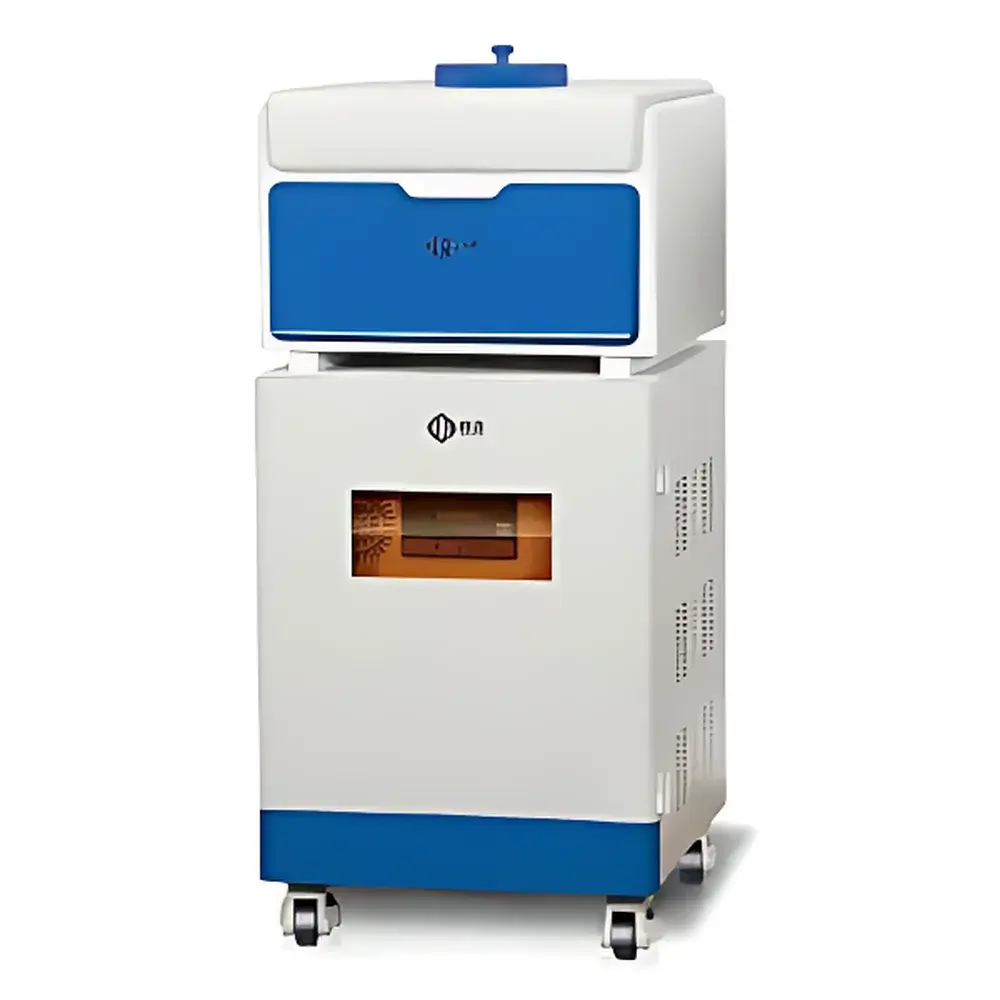
NIUMAG NMI20 Low-Field Nuclear Magnetic Resonance Analyzer
| Brand | NIUMAG |
|---|---|
| Origin | Jiangsu, China |
| Manufacturer Type | Authorized Distributor |
| Product Category | Domestic |
| Model | NMI20 |
| Instrument Type | Low-Field NMR Analyzer |
| Sample Compatibility | Solid-Liquid Dual-Mode |
| Magnet Type | Rare-Earth Permanent Magnet |
| Probe Inner Diameter | 40 mm |
| Core Functionality | T₁/T₂ Relaxometry & MRI (Proton Density, T₂-Weighted, T₁-Weighted) |
| Pulse Sequences | FID, SE, CPMG, SEG-CPMG, IR, MSE, FSE |
Overview
The NIUMAG NMI20 Low-Field Nuclear Magnetic Resonance Analyzer is a benchtop, permanent-magnet-based NMR system engineered for quantitative relaxometry and non-invasive magnetic resonance imaging (MRI) in industrial and academic laboratories. Operating at a static magnetic field strength typical of low-field systems (approximately 0.5 T), the NMI20 leverages proton (¹H) NMR signal detection to characterize molecular mobility, phase distribution, and binding states—particularly in water- and oil-containing systems. Its design follows fundamental NMR principles: spin excitation via RF pulses, free induction decay (FID) or spin-echo (SE) signal acquisition, and multi-exponential T₂ relaxation analysis to resolve populations of protons in distinct physical environments (e.g., bound vs. free water). Unlike high-field superconducting NMR spectrometers, the NMI20 eliminates cryogen dependency and RF shielding requirements, delivering robust, maintenance-free operation while retaining sufficient sensitivity and reproducibility for routine QC, process monitoring, and applied research in food science, agriculture, and materials characterization.
Key Features
- Rare-earth permanent magnet architecture—zero liquid helium or nitrogen consumption; no routine magnet maintenance or shimming required.
- 40 mm internal probe diameter—accommodates heterogeneous samples including whole fruits, meat cuts, emulsions, powders, gels, and packaged products without size limitation or destructive preparation.
- Integrated dual-mode functionality: simultaneous time-domain relaxometry (T₁, T₂, diffusion-weighted) and 2D MRI with user-selectable contrast weighting (proton density, T₁-weighted, T₂-weighted).
- Automated pulse sequence optimization: software-guided center frequency search, automatic 90°/180° pulse width calibration, and real-time field homogeneity adjustment—reducing operator dependency and inter-user variability.
- Three-step MRI workflow: intuitive graphical interface enables slice selection (arbitrary position, orientation, thickness), sequence selection, and reconstruction—completed in under 2 minutes per sample for standard protocols.
- No chemical reagents, no ionizing radiation, no sample dehydration or staining—fully compliant with green analytical chemistry principles and non-destructive testing (NDT) standards.
Sample Compatibility & Compliance
The NMI20 accepts solid, semi-solid, liquid, and multiphase samples—including raw, cooked, frozen, or packaged food matrices—without pretreatment. Its broad dynamic range supports samples with proton densities spanning 0.1–100% w/w water/oil content. The system meets ISO/IEC 17025 general requirements for competence of testing and calibration laboratories when operated under documented SOPs. While not FDA-registered as a medical device, its measurement traceability, data audit trails (via timestamped raw FID/echo train export), and parameter logging support GLP-compliant workflows in food safety, shelf-life prediction, and R&D documentation. All pulse sequences adhere to established NMR metrology conventions described in ASTM E2631 (Standard Guide for Quantitative Analysis by Low-Field NMR) and ISO 17088 (Foodstuffs — Determination of Water Content by Low-Field NMR).
Software & Data Management
The NMI20 ships with two modular, Windows-based software suites: the NMR Analytical Suite (for relaxometry) and the MRI Acquisition & Reconstruction Suite (for imaging). Both feature native support for HDF5 and ASCII export, enabling seamless integration with MATLAB, Python (NumPy/SciPy), or commercial statistical platforms. The analytical suite includes preconfigured modules for moisture/oil quantification, T₂ distribution deconvolution (using NNLS or SVD algorithms), and kinetic modeling of drying/rehydration processes. The MRI suite provides real-time k-space visualization, adaptive noise filtering (non-local means denoising), pseudo-color mapping, ROI-based intensity profiling, and DICOM-compatible export for cross-platform image review. All software logs full acquisition metadata—including gradient timing, RF amplitude, temperature sensor readings, and hardware status flags—ensuring full 21 CFR Part 11 readiness when deployed with optional electronic signature and audit trail modules.
Applications
- Quantitative fat/water content determination in meat, dairy, nuts, and fried snacks—correlating directly with AOAC Official Methods.
- Spatial mapping of water migration during freeze-thaw cycles, osmotic dehydration, or microwave drying—enabling mechanistic validation of mass transfer models.
- Non-invasive assessment of fruit ripeness, bruise detection, and internal defect screening—supporting automated grading and postharvest quality control.
- Characterization of protein hydration shells and myofibrillar network integrity in muscle foods—linking T₂ relaxation components to texture and juiciness metrics.
- Emulsion stability analysis via T₂ decay heterogeneity—differentiating coalesced oil droplets from intact dispersed phases in dressings and sauces.
- Real-time monitoring of starch gelatinization, retrogradation, or gluten network formation during thermal processing—providing time-resolved structural insights beyond conventional rheology.
FAQ
What sample types are compatible with the NMI20?
Solid, liquid, semi-solid, and multiphase samples—including intact fruits, meat slices, emulsions, powders, hydrogels, and sealed packaging—require no cutting, drying, or solvent extraction.
Does the NMI20 require cryogens or external cooling?
No. It employs a passively stabilized rare-earth permanent magnet; ambient air cooling suffices for continuous operation.
Can T₁ and T₂ relaxation times be measured independently?
Yes. Inversion-recovery (IR) and Carr–Purcell–Meiboom–Gill (CPMG) sequences are included, with full parameter control over repetition time (TR), echo spacing (TE), and number of echoes.
Is MRI data exportable for third-party analysis?
Yes. Raw k-space data, reconstructed magnitude/phase images, and T₂ maps are exportable in HDF5, NIfTI, and CSV formats—with complete metadata embedded.
How is system performance verified over time?
A built-in reference phantom (doped water/glycerol mixture) enables daily T₂ stability checks; long-term drift is tracked via automated calibration reports generated with each session.





