
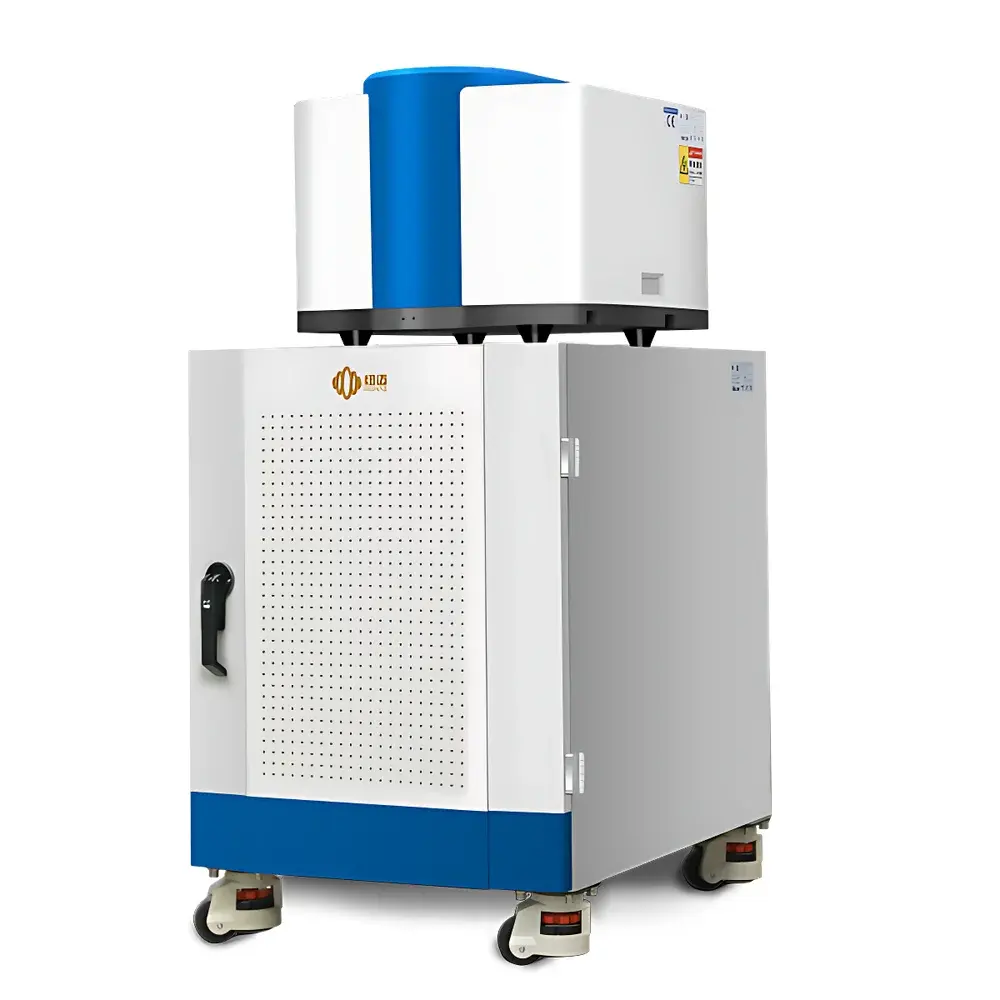
NIUMAG PQ001-10 Low-Field Nuclear Magnetic Resonance Analyzer for Peptide Intermediate Water Distribution Analysis
| Brand | NIUMAG |
|---|---|
| Origin | Jiangsu, China |
| Instrument Type | Low-Field NMR Spectrometer |
| Model | PQ001-10 |
| Magnet Type | Permanent Magnet |
| Static Magnetic Field Strength | 0.5 ± 0.03 T |
| Sample Compatibility | Solid-Liquid Hybrid Samples |
| Typical Measurement Time | ≤2 min per sample |
| Sample Preparation | Non-destructive, no pre-treatment required |
| Reusability | Fully reversible sample loading |
Overview
The NIUMAG PQ001-10 is a dedicated low-field nuclear magnetic resonance (LF-NMR) spectrometer engineered for quantitative and qualitative characterization of water distribution states in peptide intermediates. Unlike conventional gravimetric or Karl Fischer titration methods—which report only total moisture content—this instrument exploits the differential transverse (T₂) and longitudinal (T₁) relaxation behaviors of hydrogen protons in distinct microenvironments. By acquiring multi-exponential T₂ decay curves via CPMG pulse sequences, the system resolves coexisting water populations—including bulk/free water (T₂ > 100 ms), weakly bound water (T₂ ≈ 10–100 ms), and tightly bound hydration shells (T₂ < 10 ms)—directly correlated with peptide conformational stability, aggregation propensity, and lyophilization efficiency. The 0.5 T permanent magnet provides field homogeneity sufficient for reproducible relaxation time quantification across batched solid-phase synthesis intermediates, freeze-dried powders, and resin-bound peptides—without solvent extraction, thermal drying, or chemical derivatization.
Key Features
- Non-invasive, non-destructive analysis: Preserves sample integrity for downstream HPLC, MS, or bioactivity assays.
- Rapid acquisition: Full T₂ relaxation profile obtainable in under 120 seconds, enabling high-throughput QC screening in GMP-compliant peptide manufacturing environments.
- Zero-sample-prep workflow: Accommodates raw crude peptides, purified fractions, lyophilized cakes, and even resin-bound intermediates in standard 10 mm glass tubes.
- Robust permanent magnet architecture: Eliminates cryogen dependency, helium refills, and active shimming—reducing operational overhead and facility footprint.
- Temperature-controlled probe option (optional): Supports variable-temperature studies from 5 °C to 60 °C to map hydration thermodynamics and glass transition behavior.
Sample Compatibility & Compliance
The PQ001-10 accepts heterogeneous samples spanning solid, semi-solid, and suspension phases—critical for characterizing peptide intermediates at various synthesis stages (e.g., Fmoc-deprotected resins, cleaved crude mixtures, size-exclusion purified fractions). Its RF coil design ensures uniform excitation across diverse dielectric properties and magnetic susceptibilities typical of organic-aqueous peptide matrices. From a regulatory standpoint, LF-NMR data generated on this platform aligns with ICH Q5C (stability testing of biotechnological/biological products) and supports USP Analytical Instrument Qualification frameworks. While not inherently 21 CFR Part 11 compliant out-of-the-box, the system’s audit-trail-capable software (see below) permits configuration for GLP/GMP environments requiring electronic record integrity, user access control, and change history logging.
Software & Data Management
Control and analysis are performed via NIUMAG’s proprietary MesoMR Studio v4.x suite, which includes pulse sequence programming, automated T₂ inversion recovery and CPMG fitting, multi-component exponential decomposition (using NNLS or SVD algorithms), and customizable reporting templates. Raw FID and processed relaxation spectra are stored in vendor-neutral HDF5 format, facilitating integration with LIMS systems and third-party statistical platforms (e.g., JMP, Python-based SciPy workflows). All user actions—including parameter edits, calibration events, and report generation—are timestamped and logged with operator ID, satisfying ALCOA+ principles (Attributable, Legible, Contemporaneous, Original, Accurate, Complete, Consistent, Enduring, Available).
Applications
- Optimization of lyophilization cycle parameters by correlating residual moisture states (bound vs. free) with cake morphology and reconstitution time.
- Distinguishing between surface-adsorbed moisture and structural hydration critical for solid-state stability prediction per ICH Q1E.
- Monitoring dehydration kinetics during spray-drying or fluid-bed granulation of peptide APIs.
- Validating storage condition effects (e.g., 25 °C/60% RH vs. 40 °C/75% RH) on hydration shell integrity over accelerated stability timelines.
- Supporting root-cause analysis of aggregation events observed in SEC-HPLC by identifying shifts in bound-water populations preceding oligomer formation.
FAQ
Does the PQ001-10 require liquid nitrogen or helium cooling?
No—its permanent magnet operates at ambient temperature without cryogens.
Can it distinguish between water and other proton-containing solvents (e.g., DMSO, acetonitrile)?
Yes, through differential T₁/T₂ ratios and diffusion-weighted sequences; however, quantitative deconvolution requires reference standards and prior knowledge of solvent relaxivity.
Is method validation support available for regulatory submissions?
NIUMAG provides IQ/OQ documentation templates and assists with protocol development aligned with ASTM E2917 and ISO/IEC 17025 requirements.
What sample volume is required for reliable T₂ measurement?
Minimum detectable mass is 50 mg for dry powders and 200 µL for suspensions, assuming standard 10 mm diameter tube geometry.
How does LF-NMR compare to DSC or TGA for moisture assessment?
LF-NMR identifies molecular mobility states; DSC detects phase transitions (e.g., melting endotherms); TGA measures mass loss—complementary, not interchangeable, techniques.





