
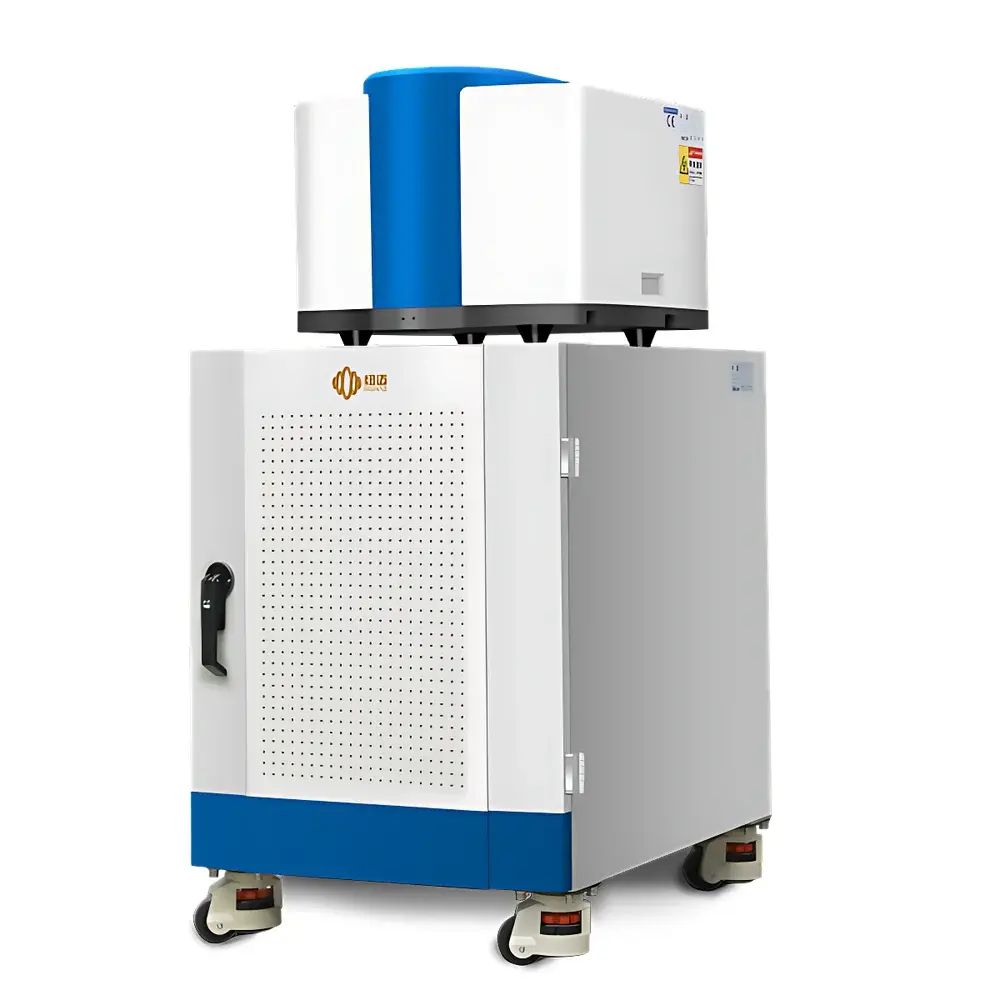
NIUMAG PQ001-13 Low-Field Nuclear Magnetic Resonance Analyzer for Ceramic Powder Dispersion Characterization
| Brand | NIUMAG |
|---|---|
| Origin | Jiangsu, China |
| Model | PQ001-13 |
| Instrument Type | Low-Field NMR Analyzer |
| Sample Compatibility | Solid-Liquid Hybrid (Powder Suspensions in Aqueous or Organic Media) |
| Measurement Principle | Transverse Relaxation Time (T₂) Distribution Analysis of Dispersant Molecules |
| Typical Test Duration | ≤ 3 min per sample |
| Sample Preparation | None required |
| Tube Diameter Compatibility | Standard 13 mm OD NMR tubes |
Overview
The NIUMAG PQ001-13 is a purpose-built low-field nuclear magnetic resonance (LF-NMR) analyzer engineered for quantitative dispersion characterization of ceramic powders in liquid media. Unlike optical or sedimentation-based methods, this instrument leverages the physical interaction between dispersed particles and surrounding solvent molecules—primarily through surface-induced restriction of molecular motion—to derive dispersion state information non-invasively. In ceramic suspensions, water or organic dispersants (e.g., ethanol, ethylene glycol, or PVP solutions) exhibit shortened transverse relaxation times (T₂) when adsorbed onto particle surfaces or confined within inter-agglomerate pores. The PQ001-13 acquires and deconvolutes the T₂ distribution spectrum using a CPMG (Carr–Purcell–Meiboom–Gill) pulse sequence, enabling discrimination between free, bound, and immobilized solvent populations. This provides a direct, physics-based metric—relative relaxation rate (R₂ = 1/T₂)—correlated with specific surface area, agglomeration degree, and colloidal stability. Designed for routine QC labs and R&D environments, it operates at a static field strength of ~0.3 T (12.8 MHz ¹H Larmor frequency), offering robust signal-to-noise performance without cryogenic cooling or high-power RF infrastructure.
Key Features
- Integrated benchtop architecture with compact footprint (< 600 × 450 × 350 mm) and < 35 kg mass, facilitating relocation between lab stations or production floors.
- 13 mm outer-diameter sample tube compatibility—accommodates standard NMR glassware as well as custom-designed high-throughput vials for suspension homogeneity verification.
- Automated CPMG acquisition with user-defined echo train length (8–2048 echoes), inter-echo spacing (0.1–2.0 ms), and repetition time (1–10 s), ensuring optimal resolution for both fast-relaxing bound phases and slow-relaxing bulk solvent.
- No sample pre-treatment required: raw slurries—including high-concentration (>40 vol%), high-viscosity (>500 mPa·s), or shear-thinning systems—can be loaded directly after gentle manual mixing.
- Embedded temperature control module (±0.5 °C stability over 25–60 °C range) enables isothermal dispersion stability monitoring under accelerated aging conditions.
Sample Compatibility & Compliance
The PQ001-13 supports heterogeneous solid–liquid systems typical of advanced ceramic processing: alumina, zirconia, silicon carbide, and silicon nitride powders suspended in water, ethanol, isopropanol, ethylene glycol, or proprietary dispersant formulations. It complies with ISO 14887 (Colloidal dispersions — Determination of dispersion stability) and aligns with ASTM D7928-21 guidelines for nanoparticle dispersion assessment via NMR relaxometry. Data acquisition and reporting workflows support GLP-compliant documentation: electronic signatures, audit trails, and user-access-level permissions are enforced through the embedded software platform. While not certified to FDA 21 CFR Part 11 out-of-the-box, the system architecture permits integration with validated LIMS environments requiring electronic record integrity.
Software & Data Management
The proprietary NMReDATA™ software suite provides full control over pulse sequence parameters, real-time spectral preview, and automated T₂ distribution inversion using non-negative least-squares (NNLS) algorithms. Quantitative outputs include mean T₂, T₂ geometric mean, peak area ratios (bound/free solvent), and dispersion index (DI) calculated as DI = (Abound / Atotal) × 100%. All datasets are stored in HDF5 format with embedded metadata (operator ID, timestamp, instrument calibration status, temperature log). Export options include CSV, PDF reports with annotated spectra, and XML-compatible structured data for downstream statistical process control (SPC) platforms. Batch analysis mode allows parallel processing of up to 24 samples with configurable pass/fail thresholds based on user-defined DI or R₂ criteria.
Applications
- Optimization of dispersant type and concentration (e.g., PVP, PAA, ammonium polyacrylate) in ceramic inkjet inks and tape-casting slurries.
- Monitoring time-dependent agglomeration kinetics during storage or thermal aging of zirconia suspensions used in dental CAD/CAM blanks.
- Quality gate testing for incoming α-alumina powder lots prior to spray drying—correlating NMR-derived dispersion indices with green body density and sintered grain uniformity.
- Supporting DOE studies for rheology modifier selection in SiC-based refractory coatings, where dispersion state directly governs thixotropic recovery behavior.
- Validating ultrasonic or high-shear homogenization protocols by quantifying post-processing changes in bound solvent fraction.
FAQ
Can the PQ001-13 measure absolute particle size distribution?
No. It does not provide direct particle diameter values. Instead, it reports dispersion state via solvent relaxation dynamics—a proxy correlated with effective surface area and agglomerate integrity.
Is calibration required before each test?
A single reference scan using deionized water is recommended daily to verify magnet homogeneity and RF coil tuning; no chemical standards are needed.
Does the instrument require shielding or special facility modifications?
No Faraday cage or dedicated room is necessary. Its low-field design ensures minimal electromagnetic interference with adjacent equipment.
Can it analyze opaque or highly absorbing suspensions?
Yes—unlike optical techniques, LF-NMR is insensitive to turbidity, color, or UV-absorbing additives, making it ideal for black ceramics or dye-loaded systems.
What maintenance is required?
Annual magnet shimming and RF probe impedance verification are advised; no consumables or cryogens are involved.




