
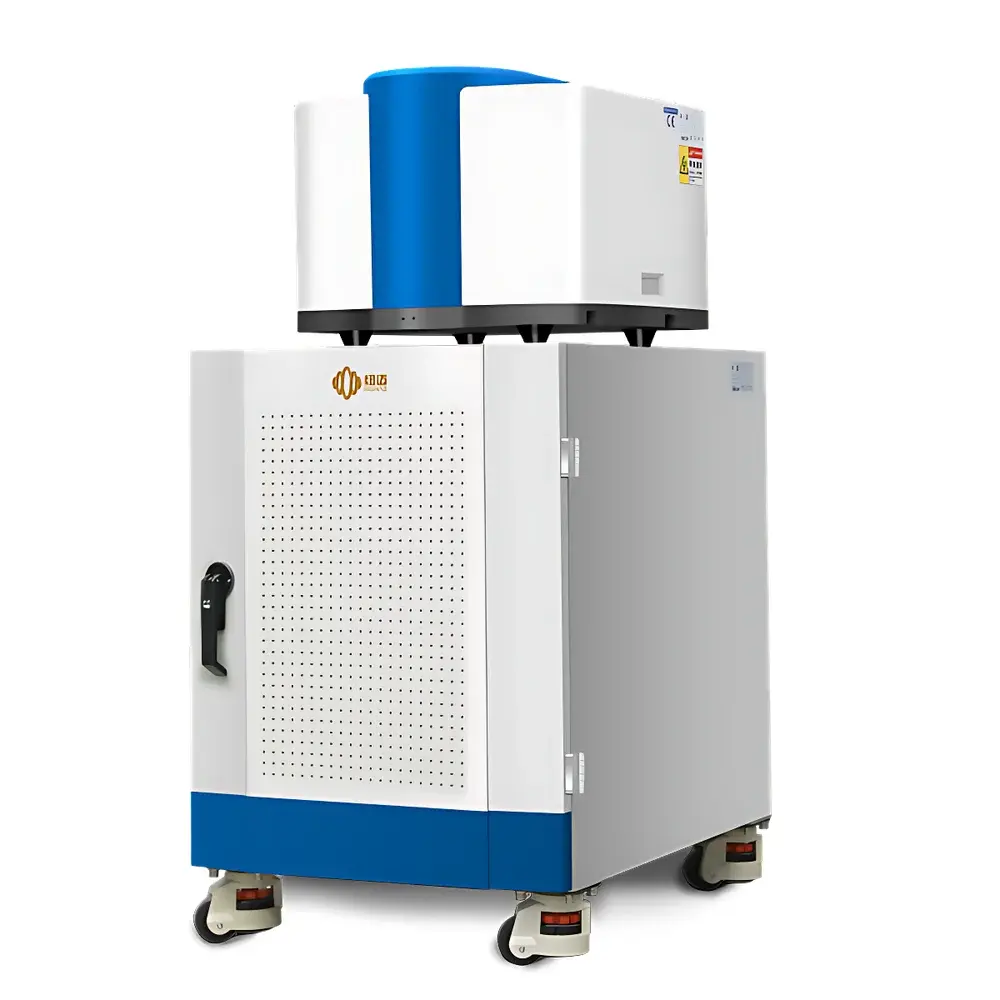
NIUMAG PQ001-14 Low-Field Nuclear Magnetic Resonance Analyzer for Ceramic Slurry Dispersion Characterization
| Brand | NIUMAG |
|---|---|
| Origin | Jiangsu, China |
| Instrument Type | Low-Field NMR Analyzer |
| Model | PQ001-14 |
| Magnet Type | Permanent Magnet |
| Static Magnetic Field Strength | 0.5 T ± 0.03 T |
| Magnetic Field Homogeneity | ≤30 ppm over H-volume |
| Sample Geometry | Cylindrical, Ø7.2 mm × H20 mm |
| Sample State | Solid–Liquid Composite (Suspensions, Pastes, Slurries) |
| Measurement Time per Sample | ≤3 min |
| Sample Preparation | None required |
Overview
The NIUMAG PQ001-14 is a dedicated low-field nuclear magnetic resonance (LF-NMR) analyzer engineered for quantitative characterization of dispersion behavior in ceramic slurries. Unlike optical or sedimentation-based methods, this instrument leverages the fundamental principles of transverse relaxation time (T2) distribution analysis to probe interfacial interactions between solid ceramic particles and liquid dispersants. In ceramic slurry systems—where particle size, surface chemistry, and solvent affinity collectively govern colloidal stability—the T2 decay profile directly reflects hydrogen mobility at particle–liquid interfaces. Shorter T2 components correspond to bound or immobilized protons near particle surfaces, while longer components represent bulk-like fluid motion. By deconvoluting these contributions via inverse Laplace transformation, the PQ001-14 delivers objective, non-invasive metrics including effective dispersion index, relative wetting degree, and apparent specific surface area—all without altering sample integrity or requiring dilution, centrifugation, or labeling.
Key Features
- Permanent magnet system delivering stable 0.5 T field with homogeneity ≤30 ppm over the defined H-volume, ensuring reproducible signal acquisition across repeated measurements.
- Compact, integrated benchtop architecture with large-bore sample chamber (Ø7.2 mm × 20 mm height), accommodating standard NMR tubes as well as irregularly shaped pastes and high-viscosity slurries without geometry constraints.
- Single-scan acquisition protocol completing full T2 relaxation measurement in ≤3 minutes—enabling rapid batch screening during formulation development or in-line QC workflows.
- No sample pretreatment required: measurements are performed directly on as-received slurries, preserving native particle network structure and avoiding artifacts from drying, filtration, or dilution.
- Robust hardware design optimized for industrial laboratory environments, with passive temperature stabilization and electromagnetic shielding compliant with IEC 61326-1 for electromagnetic compatibility.
Sample Compatibility & Compliance
The PQ001-14 supports heterogeneous ceramic suspensions across broad compositional ranges—including alumina, zirconia, silicon carbide, and silicon nitride slurries—with solid loadings up to 65 vol% and viscosities exceeding 10,000 mPa·s. Its solid–liquid discrimination capability extends to systems containing organic dispersants (e.g., polyacrylic acid, ammonium polyacrylate), aqueous electrolytes, and mixed solvent media. The instrument meets essential regulatory expectations for analytical instrumentation used in GMP-aligned R&D settings: raw data files include timestamped acquisition metadata, operator ID, and pulse sequence parameters; audit trails are retained per session; and all calibration records (field homogeneity mapping, RF coil tuning logs) are exportable in CSV format. While not certified to FDA 21 CFR Part 11 out-of-the-box, the system architecture supports integration with validated LIMS or ELN platforms for electronic signature enforcement and long-term archival.
Software & Data Management
Equipped with NIUMAG’s proprietary MesoMR Studio v4.x software suite, the PQ001-14 provides automated T2 inversion using non-negative least squares (NNLS) with regularization parameter optimization. Users can generate comparative dispersion profiles across formulation variants, overlay multiple decay curves, and extract quantitative descriptors—including mean T2, T2 distribution width (FWHM), and fractional amplitude of surface-bound proton populations. All processed data export natively to .csv and .xlsx formats; raw FID data is stored in vendor-neutral binary format (.dat) with embedded header metadata. Software validation documentation (IQ/OQ protocols) is available upon request for laboratories operating under ISO/IEC 17025 or ASTM E2500-22 guidelines.
Applications
- Formulation optimization of dispersant type and dosage in tape-casting slurries for multilayer ceramic capacitors (MLCCs), correlating NMR-derived dispersion indices with green tape density and defect rates post-lamination.
- Batch-to-batch consistency monitoring in sanitaryware and tile manufacturing, where slurry heterogeneity manifests as firing defects or glaze inconsistencies.
- Accelerated aging studies evaluating long-term colloidal stability of nanoparticle-loaded ceramic inks used in additive manufacturing (e.g., DIW, SLA).
- Surface modification validation—quantifying changes in proton confinement following silane coupling agent treatment of SiC or AlN powders.
- Supporting ASTM C1423-20 (Standard Test Method for Determining the Stability of Ceramic Slurries) through complementary physical insight beyond visual settling assessment.
FAQ
Does the PQ001-14 require cryogens or external cooling systems?
No. It operates with a self-contained permanent magnet and air-cooled RF electronics, eliminating liquid nitrogen or helium dependency.
Can it distinguish between agglomerates and primary particles?
While not a direct imaging modality, T2 distribution breadth and bimodal peak separation correlate strongly with aggregate population heterogeneity—validated against DLS and SEM in peer-reviewed ceramic processing literature.
Is method transfer possible between different PQ001-14 units?
Yes. Inter-unit reproducibility is maintained within ±2.5% for T2 mean values across identical slurry standards, provided magnet calibration and RF tuning are performed per manufacturer’s quarterly maintenance schedule.
What sample volume is required for statistically reliable results?
Minimum fill volume is 0.8 mL (equivalent to full insertion of Ø7.2 mm × 20 mm cylinder); underfilling reduces signal-to-noise ratio but does not bias relaxation time quantification.
How does it compare to laser diffraction for dispersion assessment?
Laser diffraction reports hydrodynamic size assuming spherical, non-interacting particles in dilute suspension. LF-NMR detects interfacial hydration states in undiluted, concentrated systems—making it complementary rather than competitive.




