
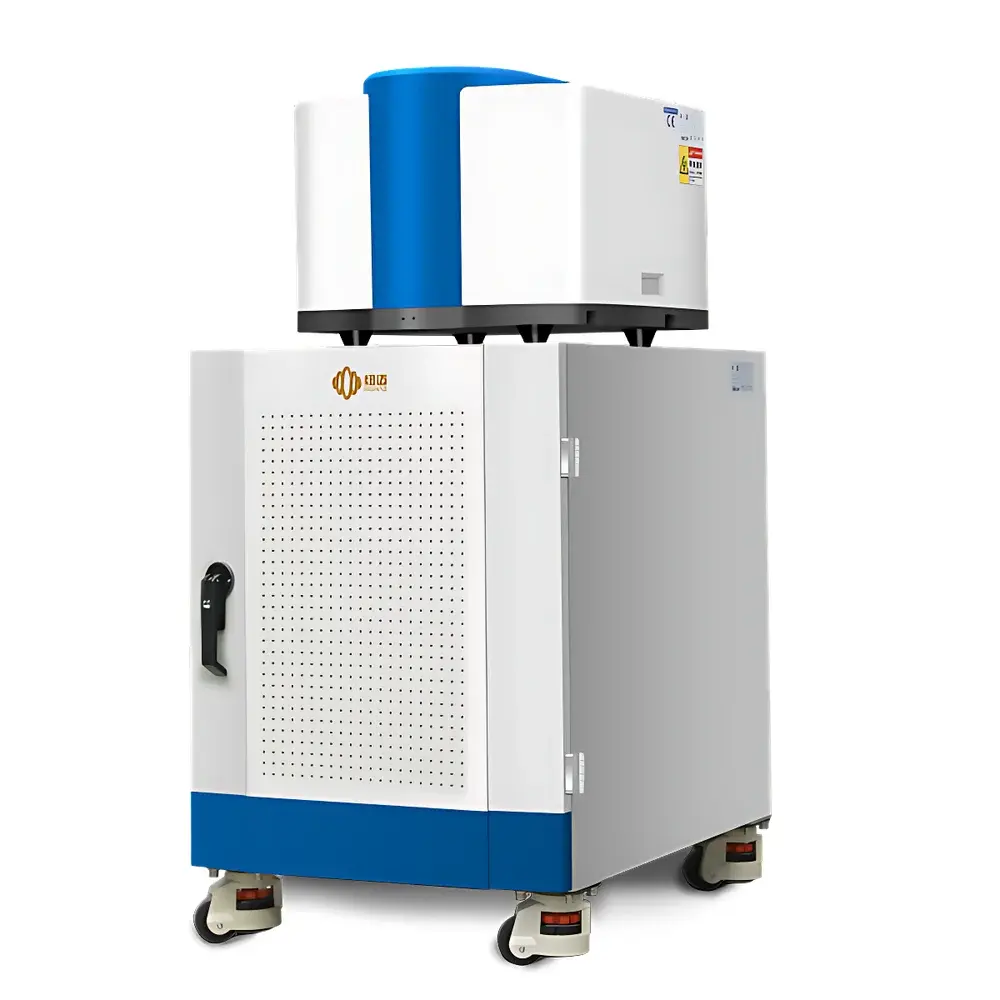
Niumag PQ001-15 Low-Field Nuclear Magnetic Resonance Analyzer for Thermal Conductive Powder Dispersion Characterization
| Brand | Niumag |
|---|---|
| Origin | Jiangsu, China |
| Instrument Type | Low-Field NMR Analyzer |
| Model | PQ001-15 |
| Sample Compatibility | Solid–Liquid Hybrid (Powder-in-Liquid Suspensions) |
| Magnet Type | Permanent Magnet |
| Static Magnetic Field Strength | 0.5 T ± 0.03 T |
| Sample Tube Dimensions | Ø12.5 mm × H15 mm (Cylindrical) |
| Magnetic Field Homogeneity | ≤30 ppm over H-volume |
| Measurement Time per Sample | ≤3 min |
| Wet Specific Surface Area Repeatability (RSD) | ≤1.0% |
| Probe Options | Multiple RF Coil Sizes Available |
Overview
The Niumag PQ001-15 is a dedicated low-field nuclear magnetic resonance (LF-NMR) analyzer engineered for quantitative, non-invasive assessment of dispersion quality in thermal conductive powders—critical functional fillers in thermal interface materials (TIMs). Unlike conventional optical or electron-based methods, this instrument exploits the intrinsic sensitivity of proton (1H) NMR relaxation behavior to local molecular mobility and interfacial interactions. In powder–solvent suspensions, hydrogen nuclei in the liquid phase experience distinct transverse (T2) relaxation times depending on their proximity to particle surfaces: bound solvent exhibits fast relaxation (short T2), while bulk-like solvent relaxes more slowly (longer T2). By acquiring and deconvoluting the multi-exponential T2 distribution, the PQ001-15 quantifies the fraction of immobilized surface-bound solvent—a direct proxy for effective particle surface area exposed to the medium and, therefore, for dispersion homogeneity. This principle enables robust evaluation of agglomeration state without assumptions about particle sphericity, density, or optical properties—making it uniquely suited for irregular, polydisperse, or high-concentration conductive fillers such as Al2O3, BN, Ag, Cu, graphene, and carbon nanotubes dispersed in silicone oils, epoxy prepolymers, or acrylic resins.
Key Features
- Permanent magnet system delivering stable 0.5 T field with homogeneity ≤30 ppm over the H-volume—optimized for high signal-to-noise ratio in routine industrial testing.
- Compact, integrated benchtop architecture with lightweight design and large-bore sample chamber accommodating standard Ø12.5 mm × 15 mm cylindrical tubes—compatible with slurries, pastes, gels, and sediment-prone suspensions.
- No sample pretreatment required: measurements performed directly on as-prepared dispersions; no drying, dilution, sonication, or staining needed.
- Single-sample acquisition completed in ≤3 minutes, enabling real-time feedback during slurry formulation, milling optimization, or surfactant screening.
- Multi-coil probe options support scalable analysis across diverse particle size ranges—from submicron ceramics to >50 µm metal flakes—without recalibration.
- Engineered for reproducibility: wet specific surface area repeatability demonstrated at RSD ≤1.0% under controlled temperature (±0.1 °C) and pulse sequence stability.
Sample Compatibility & Compliance
The PQ001-15 accepts heterogeneous solid–liquid systems without restriction on particle morphology, refractive index, electrical conductivity, or suspension viscosity. It is validated for use with opaque, colored, or highly concentrated dispersions (>60 wt% solids) where laser diffraction or dynamic light scattering fail. While not certified to ISO/IEC 17025 for accredited testing, the instrument supports GLP-compliant workflows through audit-trail-enabled software logging (user ID, timestamp, pulse sequence parameters, raw FID data, and processed T2 spectra). Its measurement principle aligns with ASTM D7928 (standard test method for particle size distribution of soil by low-field NMR), and data outputs are compatible with internal QC protocols aligned with ICH Q5C and USP guidelines for colloidal stability assessment.
Software & Data Management
The proprietary Niumag MesoMR software provides full control over pulse programming (CPMG, IR-CPMG), automated T2 inversion via non-negative least-squares (NNLS), and quantitative extraction of bound-fluid fraction, surface-area-weighted mean T2, and dispersion index (DI) derived from spectral width and peak asymmetry. All raw and processed data are stored in vendor-neutral HDF5 format with embedded metadata (field strength, temperature, coil type, operator ID). Software supports batch processing, statistical comparison across formulations, and export to CSV or Excel for integration into LIMS or MES platforms. Audit trail functionality complies with FDA 21 CFR Part 11 requirements when deployed with network authentication and electronic signature modules.
Applications
- Quantitative ranking of dispersant efficacy in thermal paste development.
- In-process monitoring of ball-milling or high-shear mixing endpoints for conductive filler slurries.
- Stability assessment of long-term storage behavior—detecting early-stage agglomeration prior to macroscopic sedimentation.
- Correlation of NMR-derived dispersion metrics with final TIM thermal conductivity (measured per ASTM D5470) and interfacial thermal resistance (per ISO 22007-2).
- Supporting DOE studies for optimizing surface modification chemistry (e.g., silane vs. phosphonic acid grafting on BN nanosheets).
- Quality control release testing for high-reliability applications in power electronics, EV battery modules, and LED packaging.
FAQ
How does LF-NMR differentiate between well-dispersed and agglomerated powders?
It measures the distribution of proton transverse relaxation times (T2) in the liquid phase. Agglomeration reduces total accessible surface area, decreasing the fraction of rapidly relaxing “bound” protons—resulting in a shift toward longer average T2 and narrower distribution width.
Can the PQ001-15 analyze powders in uncured polymer resins?
Yes—provided the resin contains mobile 1H-bearing moieties (e.g., –OH, –CH2–, vinyl groups) and viscosity permits adequate RF penetration; cured thermosets are generally incompatible due to restricted molecular motion.
Is calibration required using reference standards?
No absolute calibration is needed for relative dispersion ranking; however, wet specific surface area quantification requires empirical correlation with BET or gas adsorption data for each material–solvent pair.
What temperature control capabilities does the system offer?
An optional Peltier-based temperature module maintains sample temperature from 5 °C to 45 °C with ±0.1 °C stability—critical for assessing temperature-dependent dispersion stability.
Does the instrument support automation for high-throughput screening?
Yes—via RS-232/USB interface and SCPI command set, enabling integration with robotic liquid handlers and scheduling software for unattended multi-sample runs.




