
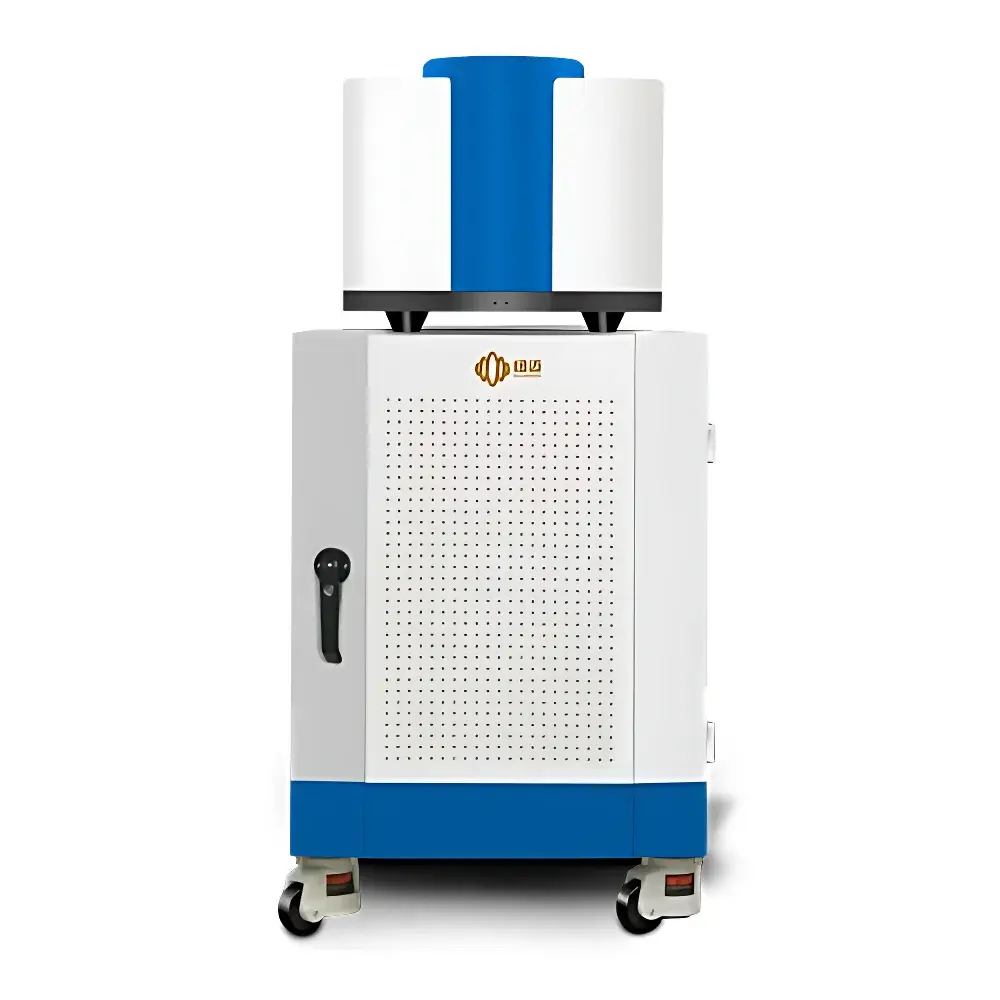
NIUMAG PQ001-16 Low-Field Nuclear Magnetic Resonance Analyzer for Surfactant Stability Assessment
| Brand | NIUMAG |
|---|---|
| Origin | Jiangsu, China |
| Manufacturer Type | Authorized Distributor |
| Origin Category | Domestic |
| Model | PQ001-16 |
| Instrument Type | Low-Field NMR Analyzer |
| Sample Type | Solid-Liquid Hybrid Samples |
| Magnet Type | Permanent Magnet |
| Magnetic Field Strength | 0.5 T ± 0.03 T |
| Sample Tube Diameter × Height | Ø24.2 mm × 25 mm |
| Power Consumption | <500 W |
| Single Measurement Time | <3 min |
| Detection Limit for Degradation Products | 0.1% (e.g., short-chain fatty acids, hydroperoxides) |
| Quantifiable Parameters | T₂ relaxation distribution, specific surface area, micelle morphology, crystallinity, tacticity, crosslink density, polymer blend composition, oil/water content |
Overview
The NIUMAG PQ001-16 Low-Field Nuclear Magnetic Resonance Analyzer is a purpose-engineered instrument designed to quantify molecular-level stability changes in surfactants over extended timeframes—ranging from weeks to years—without sample destruction or chemical derivatization. Unlike conventional accelerated aging protocols (e.g., elevated temperature/humidity exposure) or bulk property assays (pH, turbidity, viscosity), this system leverages the intrinsic sensitivity of proton (¹H) nuclear magnetic resonance to local molecular mobility and microenvironmental heterogeneity. In surfactant systems, aging processes—including oxidative cleavage of alkyl chains, hydrolysis of ester or amide linkages, and progressive micellar reorganization—are directly reflected in shifts in transverse relaxation time (T₂) distributions. The PQ001-16 employs a stable permanent magnet operating at 0.5 T ± 0.03 T, coupled with a high-efficiency RF probe optimized for broad-line ¹H detection in heterogeneous soft matter. Its non-invasive, quantitative measurement capability enables longitudinal monitoring of the same sample across multiple timepoints—a critical advantage for establishing degradation kinetics, validating shelf-life models, and verifying batch-to-batch consistency under real-world storage conditions.
Key Features
- Permanent magnet architecture eliminates cryogenic cooling requirements, ensuring operational stability, low maintenance, and reduced total cost of ownership.
- Sub-3-minute acquisition time per spectrum supports high-throughput screening while preserving sample integrity across repeated measurements.
- Integrated T₂ inversion recovery and CPMG pulse sequences enable robust quantification of multi-component relaxation spectra, resolving distinct proton pools (e.g., bound vs. free water, alkyl chain vs. headgroup protons, crystalline vs. amorphous polymer domains).
- Calibrated signal response allows absolute quantification of minor degradation species down to 0.1% w/w—such as short-chain carboxylic acids generated via β-scission or lipid hydroperoxides formed during autoxidation.
- Modular hardware design accommodates interchangeable RF coils and sample holders, supporting standardized testing of diverse formats including emulsions, gels, powders, and solid dispersions.
Sample Compatibility & Compliance
The PQ001-16 accepts solid–liquid hybrid samples within a defined geometry (Ø24.2 mm × H25 mm), making it compatible with routine QC vials, sealed glass tubes, and custom-designed packaging mock-ups. It complies with ISO/IEC 17025 general requirements for competence of testing and calibration laboratories, and its data acquisition and processing workflows support audit-ready documentation for GLP and GMP environments. While not an FDA 21 CFR Part 11–certified system out-of-the-box, its software architecture permits integration with validated electronic lab notebook (ELN) platforms and LIMS systems that enforce electronic signature, change control, and audit trail requirements. Method validation parameters—including specificity, linearity, limit of detection (LOD), limit of quantitation (LOQ), precision, and robustness—can be established per ICH Q2(R2) guidelines for stability-indicating assays.
Software & Data Management
The instrument is operated via NIUMAG’s proprietary NMIView™ software, which provides full control over pulse sequence selection, parameter optimization, spectral processing, and multivariate analysis. Raw FID data are stored in vendor-neutral formats (e.g., ASCII, HDF5), enabling third-party analysis using MATLAB, Python (NumPy/SciPy), or commercial chemometrics packages. T₂ distribution deconvolution utilizes non-negative least squares (NNLS) algorithms with regularization to ensure physically meaningful solutions. Batch processing tools facilitate comparative analysis across time-series datasets, while built-in statistical modules support ANOVA, PCA, and cluster analysis for identifying stability-critical formulation variables. All processing steps—including baseline correction, phase adjustment, and peak integration—are fully traceable and reproducible.
Applications
- Surfactant aging kinetics: Tracking time-dependent changes in T₂ components linked to hydrophobic tail mobility, headgroup hydration, and interfacial film rigidity.
- Emulsion and microemulsion stability: Quantifying droplet size distribution via diffusion-weighted NMR and detecting coalescence onset through bimodal T₂ shifts.
- Crystallinity assessment: Measuring polyethylene crystallinity and polypropylene isotacticity by distinguishing rigid-crystalline and mobile-amorphous proton fractions.
- Oil/water partitioning: Determining phase distribution in complex formulations without extraction or labeling.
- Crosslink density mapping in polymer-surfactant hybrids: Correlating network rigidity with T₂ decay rates in hydrogels and responsive matrices.
- Pharmaceutical excipient stability: Monitoring structural integrity of polysorbates, poloxamers, and lecithins in parenteral and topical dosage forms under ICH Q1A(R3) storage conditions.
FAQ
Can the PQ001-16 distinguish between different types of surfactant degradation pathways (e.g., oxidation vs. hydrolysis)?
Yes—by analyzing characteristic changes in T₂ relaxation components and correlating them with reference standards, oxidation (e.g., increased short-T₂ signals from aldehyde/hydroperoxide protons) and hydrolysis (e.g., emergence of new long-T₂ peaks from liberated fatty acids) can be differentiated.
Is method transfer feasible between PQ001-16 units across different laboratories?
Yes—provided magnet homogeneity, RF coil tuning, and temperature stabilization are maintained per NIUMAG’s installation qualification (IQ) protocol, inter-unit reproducibility of T₂ values falls within ±2% RSD for calibrated samples.
Does the system require routine shimming or field homogeneity adjustment?
No—the permanent magnet is pre-shimmed at factory and thermally stabilized; no user-accessible shimming is required during normal operation.
How is data integrity ensured during long-term stability studies spanning months?
Instrument performance is verified daily using a reference standard (e.g., doped water/glycerol mixture); all raw data and processing metadata are timestamped and archived with checksum validation to meet ALCOA+ principles.
Can the PQ001-16 be integrated into automated production QC lines?
Yes—via Ethernet-based remote command interface (SCPI-compatible), the analyzer supports trigger-based acquisition synchronized with conveyor belt positioning or robotic sample handling systems.





