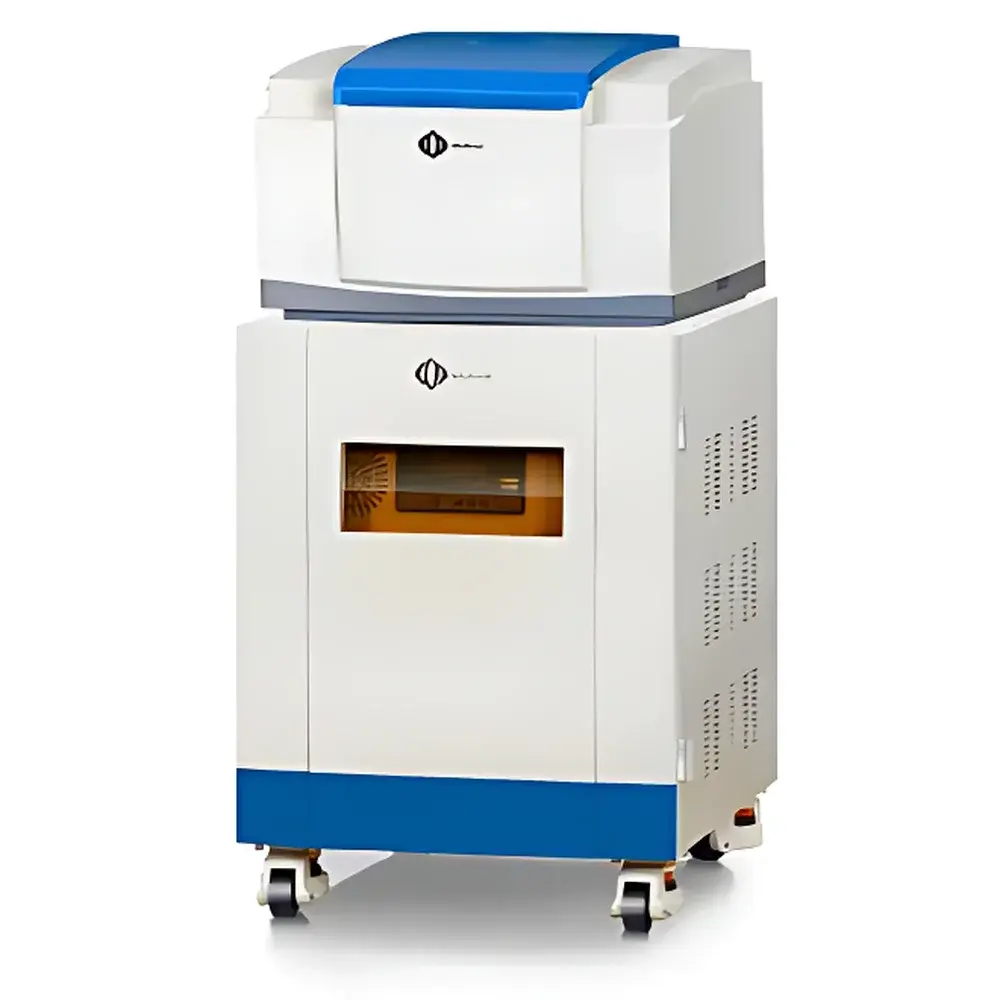
NIUMAG PQ001-5 Benchtop Low-Field NMR Oil Content Analyzer for Seeds
| Brand | NIUMAG |
|---|---|
| Origin | Jiangsu, China |
| Manufacturer Type | Authorized Distributor |
| Country of Origin | China |
| Model | PQ001-5 |
| Pricing | Upon Request |
| Magnet Type | Permanent Magnet |
| Magnetic Field Strength | 0.5 ± 0.08 T |
| Larmor Frequency | 21.3 MHz |
| Probe Coil Diameter | 25 mm |
Overview
The NIUMAG PQ001-5 is a compact, single-unit benchtop low-field nuclear magnetic resonance (LF-NMR) analyzer engineered specifically for rapid, non-destructive quantification of oil content in intact seeds. Based on the fundamental principle of proton spin relaxation—specifically the transverse relaxation time (T2) decay of hydrogen nuclei in triglyceride-rich vs. water-rich phases—the instrument delivers direct, calibration-based oil mass fraction measurements without chemical extraction or sample homogenization. Introduced in 2008 and refined through over 15 years of field deployment, the PQ001-5 employs a stable permanent magnet system operating at 0.5 T (21.3 MHz), ensuring consistent signal-to-noise performance across ambient laboratory environments. Its modular architecture supports configurable hardware and software options, enabling adaptation to both high-throughput seed quality control in agricultural processing facilities and method development in plant breeding research laboratories.
Key Features
- Non-invasive analysis: No solvent use, no sample grinding or drying required—intact seeds retain viability and structural integrity post-measurement.
- High reproducibility: Typical relative standard deviation (RSD) < 1.2% for repeated measurements of homogeneous seed batches under controlled temperature conditions.
- Integrated automation: Self-locking frequency tuning eliminates manual shimming; guided workflow interface reduces operator dependency and minimizes inter-user variability.
- Robust electromagnetic compatibility: Engineered for reliable operation in industrial settings with variable power supply quality and ambient RF noise.
- Flexible data handling: Local storage via internal memory or external USB drive; export formats include CSV, TXT, and proprietary binary files compatible with third-party spectral analysis tools.
- Temperature-stabilized probe housing: Maintains thermal equilibrium during sequential multi-sample runs, critical for minimizing T2 drift-induced quantification bias.
Sample Compatibility & Compliance
The PQ001-5 is validated for intact or lightly cracked seeds including but not limited to peanut (Arachis hypogaea), soybean (Glycine max), rapeseed/canola (Brassica napus), sunflower (Helianthus annuus), sesame (Sesamum indicum), corn (Zea mays), cottonseed (Gossypium hirsutum), and olive (Olea europaea). Sample mass range: 1–15 g per measurement, optimized for 25 mm coil diameter. While not certified to ISO/IEC 17025 as a standalone testing laboratory, the instrument supports GLP-compliant workflows when integrated into documented SOPs—including audit-trail-enabled software logging, user-access controls, and electronic signature capability (via optional upgrade). Data output conforms to FAO/WHO Codex Alimentarius guidelines for oilseed compositional analysis and aligns with ASTM D7467–22 (Standard Practice for Determination of Oil Content in Oilseeds by Low-Field NMR).
Software & Data Management
The embedded Windows-based acquisition and analysis suite provides real-time T2 decay curve fitting using mono- and bi-exponential models, automatic baseline correction, and user-defined calibration curves generated from reference standards (e.g., gravimetrically verified oil/water mixtures or certified reference materials). Software modules support moisture distribution profiling via multi-echo T2 mapping, enabling differentiation between bound and free water states—a critical parameter in seed dormancy and storage stability studies. All raw FID data, processed spectra, and metadata (operator ID, timestamp, ambient temperature, sample ID) are stored with SHA-256 hash verification. Optional FDA 21 CFR Part 11 compliance package includes role-based access control, electronic signatures, and immutable audit logs.
Applications
- Routine oil content screening in seed certification labs and breeding programs—enabling selection of high-oil genotypes within single-generation cycles.
- Process monitoring during oilseed crushing and pre-press operations to optimize yield and energy efficiency.
- Moisture phase analysis for predicting storability and susceptibility to fungal contamination in warehouse-grade seed lots.
- Method validation studies comparing LF-NMR against reference methods (e.g., AOAC 920.39, ISO 659) for regulatory submission packages.
- Cross-sector extension to fiber crops (e.g., flax, hemp) for simultaneous oil and moisture quantification in dual-purpose cultivars.
FAQ
How does the PQ001-5 differentiate oil from water signals in seeds?
It exploits the distinct T2 relaxation times of protons in triglyceride molecules (~100–500 ms) versus those in bulk water (~500–2000 ms) and bound water (< 50 ms); spectral deconvolution separates these components quantitatively.
Is calibration required for each new seed species?
Yes—species-specific calibration curves must be established using at least 15 representative samples with reference oil content values determined by an accredited method; once built, curves remain valid across instrument lifetime with periodic verification.
Can the system measure oil content in ground or powdered seed samples?
While designed for intact seeds, it accommodates finely milled samples—but requires re-validation of calibration due to altered relaxation dynamics and packing density effects.
What maintenance is required for the permanent magnet system?
None beyond routine cleaning and annual verification of field homogeneity using the built-in field mapping utility; no cryogens, power supplies, or active shimming coils are involved.
Does the instrument comply with CE or UL safety standards?
Yes—the PQ001-5 carries CE marking per EU Directive 2014/30/EU (EMC) and 2014/35/EU (LVD), and meets UL 61010-1:2012 requirements for laboratory electrical equipment.