
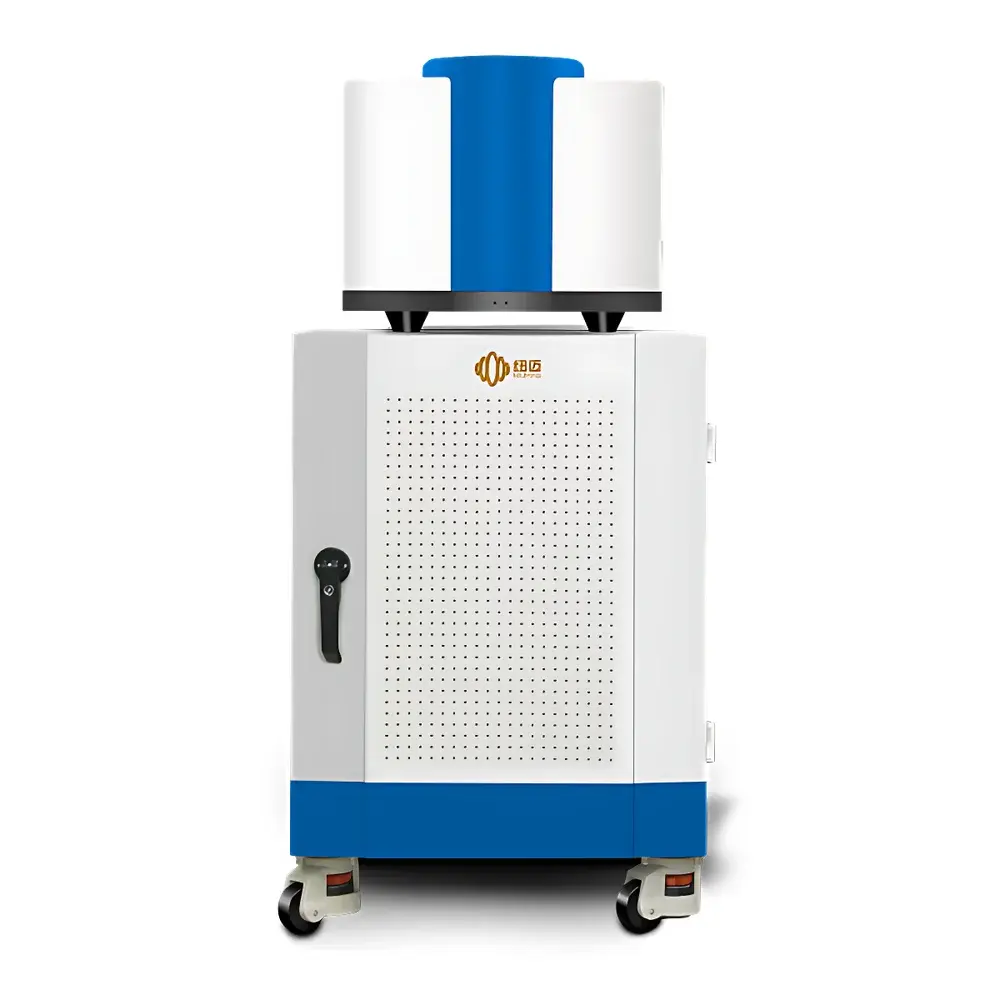
NIUMAG PQ001-6 Low-Field Pulsed Nuclear Magnetic Resonance (TD-NMR) Hydrogen Content Analyzer for Fuels
| Brand | NIUMAG |
|---|---|
| Origin | Jiangsu, China |
| Model | PQ001-6 |
| Instrument Type | Low-Field NMR Analyzer |
| Magnetic Field Strength | 0.5 T ± 0.03 T |
| Magnet Homogeneity | ≤30 ppm |
| Sample Tube Diameter | Ø8.5 mm × Height 20 mm |
| Probe Coil Diameter | 18 mm |
| Sample Volume | 2–6 mL |
| Sample Compatibility | Solid-Liquid Dual Mode |
| Standards Compliance | ASTM D7171, ASTM D4808, ASTM D3701, GB/T, SH/T series |
| Measurement Principle | Time-Domain Pulsed NMR (TD-NMR) |
Overview
The NIUMAG PQ001-6 Low-Field Pulsed Nuclear Magnetic Resonance (TD-NMR) Hydrogen Content Analyzer is engineered for rapid, non-destructive quantification of total hydrogen mass fraction in petroleum-derived liquid fuels and intermediate distillates. Unlike destructive or combustion-based methods, this instrument exploits the intrinsic magnetic resonance behavior of 1H nuclei under a stable 0.5 T permanent magnet field. The transverse relaxation decay (T2) and integrated echo amplitude are directly proportional to the number of mobile and bound hydrogen protons in the sample matrix—enabling linear calibration against reference standards with certified hydrogen content. Designed specifically for refinery QC labs, fuel blending facilities, and aviation fuel certification centers, the PQ001-6 delivers traceable, physics-based hydrogen determination without chemical reagents, high-temperature oxidation, or operator-dependent interpretation.
Key Features
- Permanent magnet system with field strength of 0.5 T ± 0.03 T and homogeneity ≤30 ppm over the active volume—ensuring baseline stability and signal reproducibility across extended operational cycles.
- Optimized RF probe coil (18 mm inner diameter) and sample geometry (Ø8.5 mm × 20 mm height) tailored for standard NMR tubes used in fuel analysis, minimizing susceptibility artifacts and eddy current distortion.
- Time-domain NMR pulse sequence architecture compliant with ASTM D7171 (Standard Test Method for Hydrogen Content of Middle Distillate Fuels by Low-Field Pulsed NMR), supporting full method validation and regulatory audit readiness.
- No consumables, no hazardous solvents, and zero sample degradation—ideal for repeated measurements on the same batch during process optimization or custody transfer verification.
- Minimal sample preparation: 2–6 mL of as-received fuel, filtered if necessary; no drying, dilution, or derivatization required.
- Embedded calibration workflow with multi-point standardization using reference oils of known hydrogen content (e.g., certified CRM materials traceable to NIST or CNAS).
Sample Compatibility & Compliance
The PQ001-6 accommodates both liquid and semi-solid hydrocarbon matrices within the defined sample geometry, including jet fuels (Jet A-1, JP-8), diesel fractions (EN 590, ASTM D975), kerosene, and other middle distillates boiling between 150 °C and 390 °C. Its solid-liquid dual-mode capability extends utility to wax-containing fuels or cold-flow improver formulations where phase heterogeneity may affect conventional techniques. All measurement protocols adhere to internationally recognized standards: ASTM D7171 (primary), ASTM D4808 (hydrogen index), ASTM D3701 (aromatic content correlation), and corresponding Chinese national standards (e.g., GB/T 11132, SH/T 0656). Data integrity meets GLP/GMP-aligned requirements, with optional 21 CFR Part 11-compliant software modules available for electronic signature, audit trail, and user access control.
Software & Data Management
The embedded NMR acquisition and analysis suite provides real-time signal processing, exponential T2 fitting, and integrated amplitude extraction. Calibration curves are stored with metadata (date, operator ID, standard lot numbers, temperature), and each measurement generates a timestamped report containing raw FID, processed T2 spectrum, hydrogen content result (% w/w), relative standard deviation (RSD), and pass/fail status against preset specification limits. Export formats include CSV, PDF, and XML for LIMS integration. Optional network-enabled versions support centralized data archiving, remote diagnostics, and automated report distribution via SMTP or API endpoints.
Applications
- Quality control of aviation turbine fuels per DEF STAN 91-91 and ASTM D1655 specifications, where hydrogen content correlates strongly with smoke point, thermal stability, and soot formation tendency.
- Blending optimization in refineries—quantifying hydrogen balance across feedstock cuts to minimize hydrogen consumption in hydrotreating units while maintaining product compliance.
- Monitoring hydrogen loss during storage or thermal aging of diesel fuels, supporting predictive maintenance and shelf-life modeling.
- Research into alternative hydrocarbon fuels (e.g., synthetic paraffinic kerosene, SPK) where traditional combustion methods yield inconsistent results due to oxygenate interference or incomplete oxidation.
- Verification of fuel adulteration—detecting dilution with low-hydrogen hydrocarbons (e.g., aromatic solvents) through statistically significant deviation from baseline T2 response profiles.
FAQ
What is the typical measurement time per sample?
A complete TD-NMR acquisition and analysis cycle—including shimming, pulse calibration, and echo train acquisition—requires 30–60 seconds under standard operating conditions.
Does the instrument require cryogens or external cooling?
No. The permanent magnet operates at ambient temperature; no liquid helium, nitrogen, or chiller systems are needed.
How is traceability ensured for hydrogen content reporting?
Calibration is performed using reference materials with certified hydrogen mass fraction, traceable to national metrology institutes; uncertainty budgets follow ISO/IEC 17025 guidelines.
Can the PQ001-6 be integrated into an automated laboratory workflow?
Yes—via RS-232, Ethernet, or optional PLC interface modules compatible with SCADA and MES platforms.
Is operator training mandatory for routine use?
Basic operation requires less than two hours of instruction; advanced method development and troubleshooting are supported by NIUMAG’s application engineering team under service contracts.





