
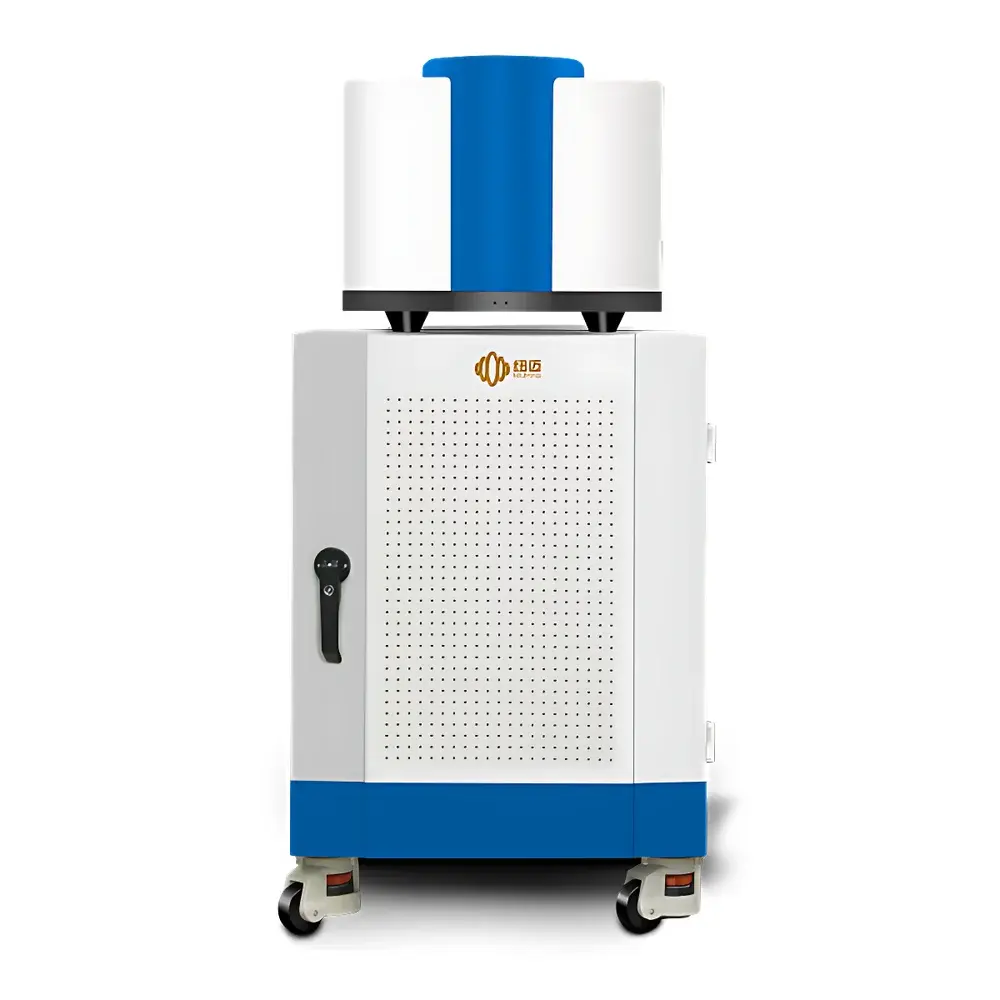
NIUMAG PQ001-7 Low-Field Nuclear Magnetic Resonance Analyzer for Battery Material Specific Surface Area
| Key | Brand: NIUMAG |
|---|---|
| Origin | Jiangsu, China |
| Manufacturer Type | Authorized Distributor |
| Instrument Type | Low-Field NMR Analyzer |
| Sample Compatibility | Solid-Liquid Dual-Phase |
| Magnet Type | Permanent Magnet |
| Field Strength | 0.5 T ± 0.03 T |
| Sample Tube Dimensions | Ø24.2 mm × H25 mm |
| Measurement Time | ≤3 min per sample |
| Application Scope | Specific Surface Area, Crosslink Density, Resin Content, Crystallinity (e.g., PE), Isotacticity (e.g., PP), Elastomer/PE Ratio in Copolymers, Oil/Water Content |
Overview
The NIUMAG PQ001-7 is a dedicated low-field nuclear magnetic resonance (LF-NMR) analyzer engineered for quantitative characterization of battery electrode materials and polymer-based functional materials. Unlike conventional gas adsorption techniques (e.g., BET nitrogen physisorption), this system leverages the physical principle of proton spin relaxation—specifically transverse relaxation time (T2) distribution—to non-invasively probe surface-area-related interactions between hydrogen-bearing fluids (e.g., electrolyte solvents or calibration oils) and solid matrix surfaces. In porous battery materials such as silicon anodes, mesoporous carbon, metal oxides, and composite cathodes, surface-bound fluid layers exhibit accelerated T2 decay relative to bulk fluid. By calibrating this relaxation behavior against reference standards with known specific surface area (SSA), the instrument computes SSA values in m²/g with high reproducibility and minimal sample preparation. Its 0.5 T permanent magnet architecture ensures operational stability, low power consumption, and immunity to external field fluctuations—critical for routine QC labs and R&D environments where benchtop footprint and uptime are prioritized.
Key Features
- Compact permanent-magnet design (0.5 T ± 0.03 T) optimized for long-term field homogeneity and thermal stability without cryogens or active shimming.
- Dual-phase sample compatibility: accommodates dry powders, slurry-coated electrodes, gel-state composites, and solvent-saturated materials within standardized 24.2 mm OD × 25 mm height tubes.
- Automated T2 echo train acquisition with customizable CPMG pulse sequences (90°–τ–180°–τ–echo…), enabling robust signal-to-noise ratio even at low proton density.
- Integrated hardware control and data processing: all acquisition parameters—including pulse spacing (τ), number of echoes, repetition time (TR), and scan averages—are programmable via intuitive GUI.
- Measurement completion in ≤3 minutes per sample, supporting throughput of >15 samples/hour under continuous operation.
- No sample destruction or vacuum conditioning required; specimens remain chemically and structurally intact for subsequent electrochemical or structural analysis.
Sample Compatibility & Compliance
The PQ001-7 accepts heterogeneous battery-relevant samples including graphite/silicon composites, LiFePO₄, NMC cathodes, binder-rich slurries, and polymer separators pre-wetted with carbonate-based electrolytes or deuterated calibration oils. It complies with core principles of GLP (Good Laboratory Practice) through audit-trail-enabled software logging (user ID, timestamp, parameter set, raw FID/T2 data). While not certified to ISO/IEC 17025 as a standalone testing laboratory, its measurement protocol aligns with ASTM D7264 (flexural properties of polymer composites) and ASTM D5229 (moisture absorption in composites) where NMR-derived surface metrics inform material qualification. For regulated battery development workflows, raw data export (ASCII, CSV) supports integration into LIMS and satisfies FDA 21 CFR Part 11 requirements when deployed with validated user access controls and electronic signature modules.
Software & Data Management
The proprietary NIUMAG NMR Analysis Suite provides a unified interface for instrument control, real-time signal monitoring, T2 inversion (using non-negative least squares with regularization), and quantitative modeling. Preloaded calibration curves map T2 distributions to specific surface area (m²/g), crosslink density (mol/cm³), crystallinity (%), or oil/water ratio (wt%). All processing steps are scriptable and repeatable; users can save method templates, apply batch processing across multi-sample runs, and generate PDF reports with embedded spectra, relaxation histograms, and statistical summaries (mean T2, standard deviation, peak amplitude). Raw FID data is stored in vendor-neutral formats compatible with third-party tools (e.g., MATLAB, Python NumPy) for advanced modeling or machine learning–driven feature extraction.
Applications
- Quantitative SSA determination of anode/cathode active materials to correlate surface accessibility with rate capability and SEI formation kinetics.
- Crosslink density mapping in PVDF or SBR binders to assess mechanical integrity during cycling-induced volume expansion.
- Crystallinity evaluation of polyolefin separators (e.g., PE, PP) influencing thermal shutdown behavior and wettability.
- Oil uptake quantification in electrode calendering studies to optimize porosity and electrolyte infiltration.
- Water content screening in Li-ion cell components to prevent HF generation and transition-metal dissolution.
- Batch-to-batch consistency verification for commercial cathode suppliers under IATF 16949-aligned quality protocols.
FAQ
What sample preparation is required prior to LF-NMR measurement?
Minimal preparation is needed: dry powders are equilibrated with a defined volume of proton-containing fluid (e.g., dibutyl phthalate or EC/DMC mixture); slurries or coated electrodes may be measured directly if geometrically compatible with the tube dimensions.
Can the PQ001-7 differentiate between micropores and mesopores?
No—unlike high-field NMR or gas sorption, LF-NMR does not resolve pore-size distribution by direct imaging; however, T2 distribution breadth correlates empirically with heterogeneity in surface-fluid interaction strength, offering indirect insight into pore hierarchy when calibrated against mercury intrusion or SAXS data.
Is external temperature control supported?
Yes—the system includes optional Peltier-based temperature staging (range: –10 °C to +60 °C) with ±0.5 °C stability, enabling kinetic studies of surface wetting or relaxation thermodynamics.
How is instrument calibration maintained over time?
Calibration is performed using traceable reference standards (e.g., silica gels with certified SSA); field homogeneity and RF coil Q-factor are verified quarterly using built-in diagnostic sequences and logged in the audit trail.
Does the software support automated pass/fail decision logic for production QA?
Yes—users define upper/lower specification limits for each output parameter (e.g., SSA = 12.5 ± 1.0 m²/g); the software flags outliers in real time and exports compliance status to CSV or SQL databases.





