
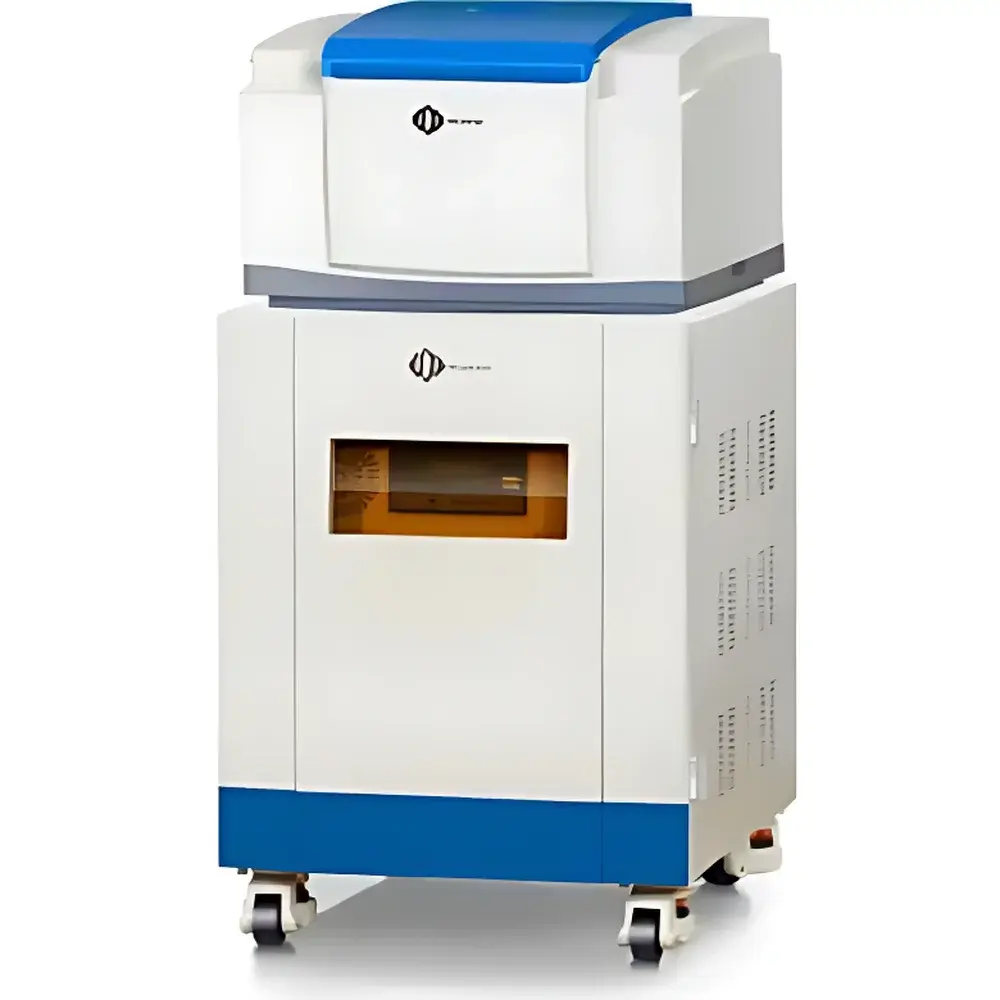
NIUMAG PQ001++ Benchtop Low-Field NMR Analyzer for Fluoride Quantification in Toothpaste
| Brand | NIUMAG |
|---|---|
| Origin | Jiangsu, China |
| Manufacturer Type | Authorized Distributor |
| Origin Category | Domestic |
| Model | PQ001++ |
| Instrument Type | Low-Field Nuclear Magnetic Resonance (NMR) Spectrometer |
| Sample Form | Solid-Liquid Hybrid (Toothpaste Paste) |
| Operating Frequency | 21.3 MHz |
| Data Acquisition Mode | Pulsed Fourier Transform (PFT-NMR) |
| Magnet Type | Permanent Magnet |
| Magnetic Field Strength | 0.5 ± 0.08 T |
| Probe Coil Diameter | 25 mm |
| Detection Nucleus | ¹⁹F |
| Calibration Range | 100–2000 ppm F⁻ |
| Typical Measurement Time | < 5 min per sample |
Overview
The NIUMAG PQ001++ is a dedicated benchtop low-field nuclear magnetic resonance (NMR) analyzer engineered for rapid, non-destructive quantification of fluoride (¹⁹F) in commercial toothpaste formulations. Unlike conventional wet-chemistry methods—such as ion-selective electrode (ISE) potentiometry or colorimetric SPADNS-based spectrophotometry—the PQ001++ leverages the intrinsic nuclear spin properties of fluorine-19, the only stable, 100% naturally abundant NMR-active isotope of fluorine. Operating at a Larmor frequency of 21.3 MHz (corresponding to a static magnetic field of 0.5 ± 0.08 T), the instrument employs pulsed Fourier transform (PFT) NMR methodology to acquire time-domain free induction decay (FID) signals from ¹⁹F nuclei in the sample. Signal amplitude is directly proportional to the number of resonant ¹⁹F spins present, enabling absolute quantification via external or internal calibration against certified reference standards traceable to NIST SRM 3011a (fluoride in toothpaste). This physical measurement principle eliminates matrix interference from surfactants, abrasives, humectants, and thickening agents commonly found in dentifrices—making it inherently robust for routine QC environments.
Key Features
- Permanent magnet architecture ensures long-term field stability with zero cryogen consumption or active shimming requirements.
- Optimized 25 mm diameter RF probe coil delivers high signal-to-noise ratio (SNR) for ¹⁹F detection in viscous, heterogeneous pastes without homogenization or solvent extraction.
- Minimal sample preparation: direct loading of 0.5–1.0 g of intact toothpaste into standard 10 mm OD NMR tubes; no acid digestion, derivatization, or filtration required.
- Automated pulse sequence execution (e.g., single-pulse 90° acquisition with variable recycle delay) supports GLP-compliant repeatability (RSD < 2.5% across n = 10 replicate measurements).
- Embedded temperature stabilization maintains probe thermal equilibrium within ±0.3 °C over 8-hour operation—critical for quantitative ¹⁹F signal fidelity.
- Low total cost of ownership: no consumables beyond reusable NMR tubes; annual maintenance limited to routine RF calibration and field homogeneity verification.
Sample Compatibility & Compliance
The PQ001++ accepts all major toothpaste formats—including gel, paste, and microbead-containing variants—without phase separation or signal distortion. Its solid-liquid hybrid capability accommodates suspensions with up to 45% w/w insoluble abrasives (e.g., hydrated silica, calcium carbonate) and viscosities ranging from 50 to 250 Pa·s. Method validation aligns with ISO 11608-3:2022 (Dentistry — Requirements for toothpastes — Part 3: Determination of fluoride content) and supports regulatory submission under FDA 21 CFR Part 11 when paired with NIUMAG’s audit-trail-enabled NMR Control Suite v4.2. All calibration curves are generated using certified reference materials compliant with ISO Guide 35, with uncertainty budgets documented per ISO/IEC 17025:2017 requirements for testing laboratories.
Software & Data Management
The integrated NMR Control Suite provides full instrument control, real-time spectral preview, automated peak integration (¹⁹F resonance at −118 ppm relative to CFCl₃), and linear regression calibration modeling. Raw FID data are stored in vendor-neutral JCAMP-DX format; processed results export to CSV, PDF, or LIMS-compatible XML. Software enforces user role-based access control (RBAC), electronic signatures, and immutable audit trails—including operator ID, timestamp, parameter settings, and raw data hash—for compliance with GMP Annex 11 and EU GMP Chapter 4. Batch reporting templates support IQ/OQ/PQ documentation frameworks used in pharmaceutical and oral care manufacturing QA departments.
Applications
- Routine QC release testing of fluoride concentration in finished toothpaste batches (target range: 1000–1500 ppm F⁻).
- Stability studies tracking fluoride leaching or degradation during accelerated aging (40 °C/75% RH).
- Raw material qualification of sodium monofluorophosphate (MFP), sodium fluoride (NaF), or amine fluoride (AmF) actives.
- Method transfer between R&D, pilot plant, and commercial manufacturing sites using identical hardware/software configuration.
- Supporting regulatory filings for OTC monograph compliance (US FDA 310.512) and EU Cosmetics Regulation (EC No 1223/2009 Annex V).
FAQ
Is the PQ001++ suitable for measuring fluoride in liquid mouthwashes?
Yes—the instrument accommodates low-viscosity aqueous solutions; however, dilution to match the dynamic range of the ¹⁹F calibration curve (100–2000 ppm) may be required.
Does the system require external cooling or compressed air?
No—permanent magnet design and solid-state RF electronics eliminate need for chillers, compressors, or external utilities.
Can the same NMR tube be reused across multiple samples?
Yes—cleaning protocol involves rinsing with deionized water followed by ethanol and nitrogen purge; validated for ≥200 cycles without signal drift.
How is method accuracy verified?
Via daily system suitability testing using a secondary standard (e.g., 1250 ppm F⁻ in glycerol/water matrix), with acceptance criteria: recovery 98–102%, RSD ≤ 2.0%.
Is ¹⁹F NMR susceptible to interference from other halogens?
No—¹⁹F has no natural background in toothpaste matrices; chlorine-35/37 and bromine-79/81 are NMR-inactive or possess negligible receptivity (<0.001× that of ¹⁹F).
Related Products




