
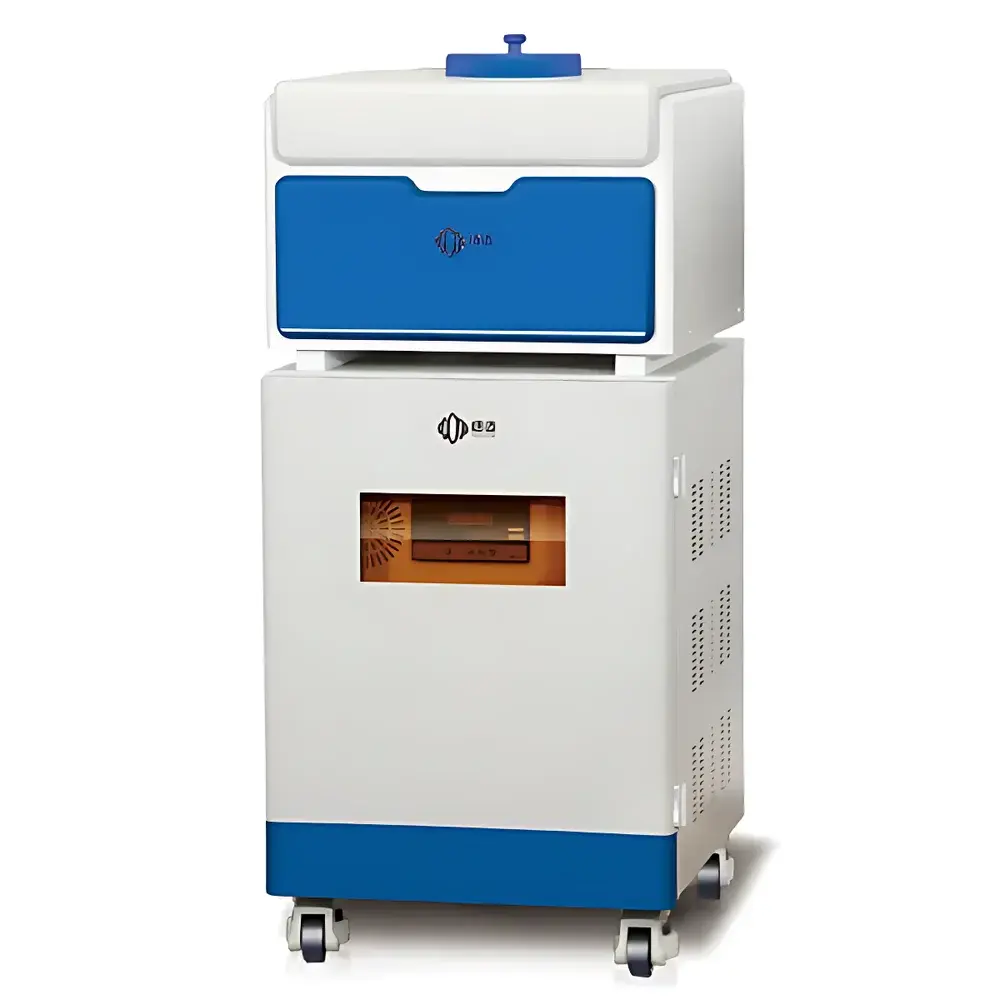
NIUMAG PQ001 Benchtop NMR Relaxometer for Contrast Agent Characterization
| Brand | NIUMAG |
|---|---|
| Origin | Jiangsu, China |
| Manufacturer Type | Authorized Distributor |
| Country of Origin | China |
| Model | PQ001 |
| Pricing | Upon Request |
Overview
The NIUMAG PQ001 is a dedicated benchtop nuclear magnetic resonance (NMR) relaxometer engineered for the precise, direct quantification of longitudinal (T₁) and transverse (T₂) relaxation times in magnetic resonance contrast agents. Unlike MRI-based indirect estimation methods—which rely on image intensity calibration and introduce propagation errors—the PQ001 employs pulsed NMR spectroscopy (e.g., inversion-recovery for T₁ and Carr–Purcell–Meiboom–Gill for T₂) to measure relaxation dynamics at the molecular level in solution or ex vivo tissue samples. This direct acquisition approach delivers high reproducibility (<±1.5% RSD for repeated T₂ measurements under controlled temperature), essential for regulatory-compliant characterization of paramagnetic and superparamagnetic contrast agents used in preclinical research and formulation development.
Key Features
- 0.5 Tesla Permanent Magnet System: Optimized for stability (drift < 0.01 ppm/h over 8 h) and homogeneity (≤10 ppm over 20 mm DSV), enabling robust baseline consistency across multi-day experiments.
- Dual-Mode RF Architecture: Integrated solenoid transmit/receive coil with high B₁ uniformity (>92% over sample volume) and built-in low-noise preamplifier (noise figure < 1.8 dB), minimizing signal degradation during weak echo detection.
- Fully Digital Spectrometer: Based on FPGA-accelerated signal generation and digitization (16-bit ADC, 50 MHz sampling rate), supporting customizable pulse sequences and real-time data streaming.
- Benchtop Ergonomics: Compact footprint (480 × 360 × 320 mm), integrated temperature control (25–40 °C, ±0.2 °C), and vibration-damped base—designed for shared lab environments without cryogen or shielded room requirements.
- Regulatory-Ready Operation: Firmware supports audit trail logging, user access levels, and electronic signature capability—aligned with GLP and FDA 21 CFR Part 11 principles for non-clinical laboratory studies.
Sample Compatibility & Compliance
The PQ001 accommodates standard 10 mm or 15 mm outer diameter NMR tubes (up to 3 mL volume), compatible with aqueous suspensions of Gd³⁺-chelates (e.g., Gd-DTPA, Gd-DOTA), iron oxide nanoparticles (SPIONs), Mn²⁺ complexes, and biological matrices including excised tumor tissues and centrifuged cell lysates. All measurements comply with ASTM E2719-19 (Standard Practice for Determining Relaxivity of MRI Contrast Agents) and ISO/IEC 17025:2017 requirements for testing laboratories. Sample handling protocols support traceable calibration using reference standards (e.g., NiCl₂ aqueous solutions with certified T₁/T₂ values).
Software & Data Management
The proprietary Delphi-based acquisition and analysis suite provides guided workflows for relaxation time fitting (mono- and bi-exponential decay models), relaxivity (r₁/r₂) calculation per mM metal concentration, and batch processing of multi-sample datasets. Raw FID and echo train data are stored in vendor-neutral formats (ASCII, CSV) with embedded metadata (pulse sequence, temperature, field strength, operator ID). The software includes export modules for integration with MATLAB, Python (via NumPy-compatible readers), and LIMS platforms. Audit logs record all parameter changes, analysis revisions, and user logins—supporting full traceability in QA/QC and regulatory submissions.
Applications
- Quantitative relaxivity profiling of novel contrast agent candidates during pharmaceutical development
- Stability assessment of nanoparticle suspensions under accelerated aging conditions
- Correlation of cellular uptake efficiency (e.g., via ICP-MS quantification) with measured r₂ enhancement in labeled cell pellets
- Ex vivo validation of tumor tissue contrast enhancement mechanisms prior to in vivo MRI trials
- Quality control of commercial contrast agent batches against pharmacopeial specifications (e.g., USP )
FAQ
Does the PQ001 require liquid helium or external cooling?
No—the system uses a self-shielded permanent magnet operating at ambient temperature; no cryogens or chiller units are needed.
Can it measure both r₁ and r₂ relaxivities in a single session?
Yes—automated sequence switching between inversion-recovery (T₁) and CPMG (T₂) modes enables full relaxivity characterization within one instrument setup.
Is the software compliant with 21 CFR Part 11 for regulated labs?
It supports electronic signatures, role-based access control, and immutable audit trails—meeting core technical requirements for Part 11 adherence when deployed in validated environments.
What sample volume is required for reliable T₂ measurement?
Minimum recommended volume is 0.8 mL in a 10 mm OD tube; optimal signal-to-noise is achieved with 1.5–2.5 mL homogeneous suspension.
Does NIUMAG provide application support for method development?
Yes—application scientists offer remote protocol optimization, custom pulse sequence implementation, and data interpretation guidance as part of extended service agreements.





