
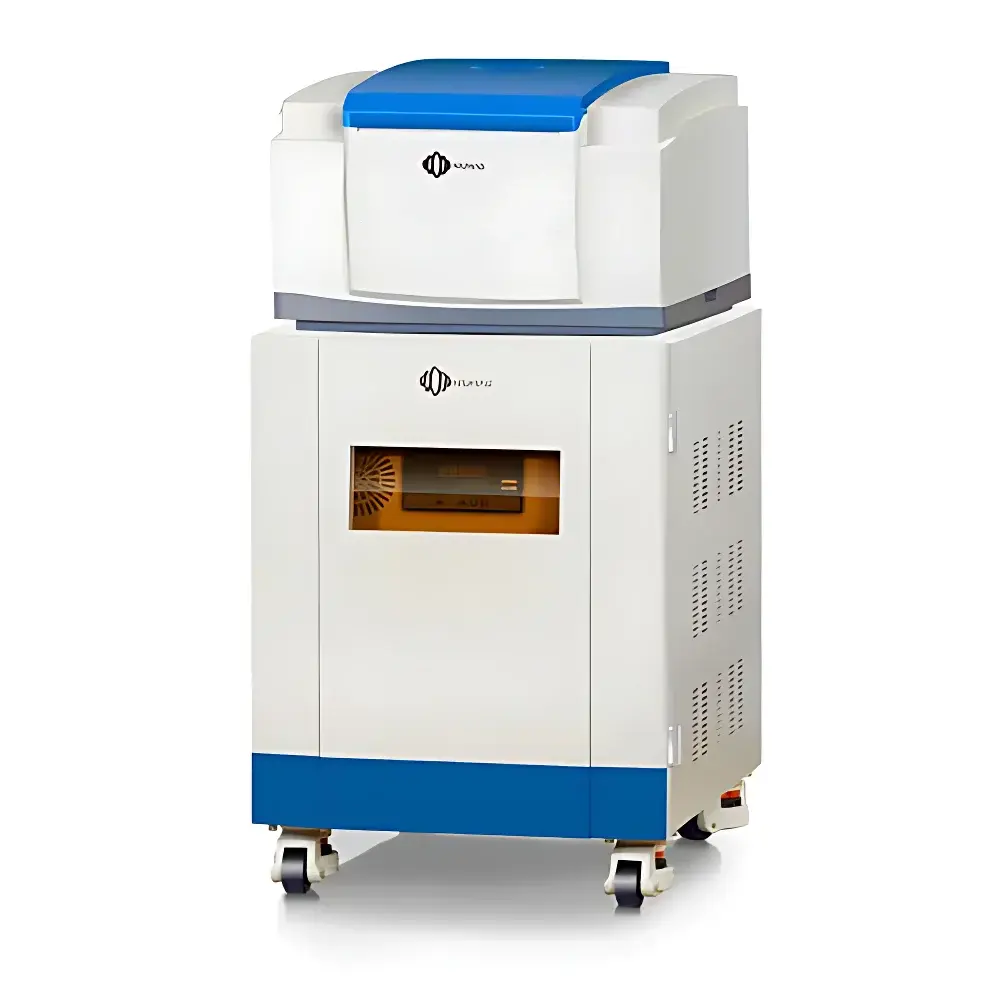
NIUMAG PQ001-t Benchtop Time-Domain Nuclear Magnetic Resonance Analyzer
| Brand | NIUMAG |
|---|---|
| Origin | Jiangsu, China |
| Instrument Type | Low-Field TD-NMR Analyzer |
| Magnet Type | Permanent Magnet |
| Static Magnetic Field Strength | 0.5 ± 0.08 T |
| Sample Compatibility | Solid-Liquid Dual-Mode |
| Probe | Custom-Built RF Coil |
| Dimensions | Benchtop Form Factor |
| Operational Mode | Automated & Manual Acquisition |
| Compliance | Designed for GLP/QC environments per ISO/IEC 17025 principles |
Overview
The NIUMAG PQ001-t is a compact, permanent-magnet-based time-domain nuclear magnetic resonance (TD-NMR) analyzer engineered for rapid, non-invasive quantification of molecular mobility and phase distribution in heterogeneous materials. Unlike high-field Fourier-transform NMR spectrometers, the PQ001-t operates in the time domain by measuring spin relaxation dynamics—primarily transverse (T₂) and longitudinal (T₁) relaxation times—following pulsed radiofrequency excitation. This principle enables direct correlation between relaxation behavior and physicochemical properties such as oil/water content, solid fat fraction, polymer crosslink density, moisture binding states, and pore-size distribution in porous media. Its 0.5 T permanent magnet delivers stable field homogeneity over extended operational periods without cryogenic support or shimming infrastructure, making it suitable for routine laboratory and production-floor deployment where reliability, low total cost of ownership, and minimal infrastructure requirements are critical.
Key Features
- Permanent magnet architecture ensures zero liquid helium consumption, eliminating cryogen logistics and associated safety protocols.
- Benchtop footprint (≤ 600 × 450 × 350 mm) enables flexible placement in QA labs, pilot plants, or R&D workstations without dedicated shielding rooms.
- Dual-mode sample handling supports both solid and liquid samples—including bulk seeds, polymer pellets, food emulsions, fiber bundles, and hydrated gels—without hardware modification.
- Integrated pulse sequence library includes CPMG (for T₂), inversion-recovery (for T₁), and saturation-recovery modules, configurable via intuitive GUI.
- Automated calibration routines maintain signal-to-noise consistency across operator shifts and ambient temperature fluctuations (15–30 °C operating range).
- RF probe optimized for 21.3 MHz Larmor frequency (¹H) with adjustable Q-factor and impedance matching for variable sample geometries and dielectric loads.
Sample Compatibility & Compliance
The PQ001-t accommodates cylindrical samples up to Ø25 mm × H50 mm and accepts standard NMR tubes (Ø10–18 mm). It has been validated for use in regulated industrial workflows aligned with ISO 16591 (solid fat content), ASTM D7420 (polymer crosslinking assessment), and AOAC 984.27 (oilseed analysis). While not certified under FDA 21 CFR Part 11 out-of-the-box, its software architecture supports audit trail logging, user access levels, and electronic signature readiness when deployed on validated Windows OS platforms compliant with GxP documentation standards. All measurements adhere to fundamental NMR metrology principles defined in IUPAC Technical Report “NMR Data Reporting Standards” (Pure Appl. Chem., 2020).
Software & Data Management
The proprietary NMIView™ acquisition and analysis suite provides real-time signal visualization, exponential decay fitting (mono-/bi-/multi-exponential models), and customizable report generation in PDF/CSV formats. Built-in chemometric tools include PCA and PLS regression for correlating relaxation spectra with reference methods (e.g., gravimetric oil extraction, DSC-based SFC). Raw FID data is stored in vendor-neutral JCAMP-DX format. The system supports networked operation via Ethernet; remote monitoring and batch scheduling are enabled through optional LabManager™ extension module, compatible with LIMS integration via RESTful API endpoints.
Applications
- Food Science: Quantitative solid fat content (SFC) profiling across temperature ramps; edible oil adulteration screening via T₂ distribution fingerprinting.
- Agriculture & Seed Technology: Non-destructive oil and moisture content mapping in intact rapeseed, soybean, and sunflower kernels.
- Fibers & Textiles: Surface oil concentration measurement on synthetic fibers (e.g., PET, nylon) post-spinning and drawing processes.
- Polymers & Elastomers: Crosslink density estimation via T₂ relaxation mapping; aging studies tracking chain mobility degradation.
- Pharmaceuticals: Excipient hydration state analysis; lyophilized cake pore structure characterization.
- Materials Research: Swelling kinetics in hydrogels; water diffusion anisotropy in cementitious composites.
FAQ
What is the typical measurement time per sample?
Acquisition time ranges from 30 seconds to 5 minutes depending on required SNR, sample type, and selected pulse sequence—optimized for throughput in QC environments.
Does the PQ001-t require external cooling or power conditioning?
No. It operates on standard 100–240 V AC, 50/60 Hz input and generates negligible heat load; no air conditioning or voltage stabilizers are mandated.
Can T₁ and T₂ be measured simultaneously on the same sample?
Not concurrently—but sequential acquisition is supported within a single workflow, with automated parameter switching and co-registered data export.
Is method transfer possible from high-field NMR instruments?
Yes. Relaxation time trends and relative distributions show strong correlation; absolute values require empirical calibration against reference techniques due to field-dependent relaxation mechanisms.
How is instrument performance verified over time?
A built-in reference sample (doped water/glycerol mixture) enables daily T₂ stability checks; annual field homogeneity verification is recommended using a calibrated Hall probe.
Related Products




