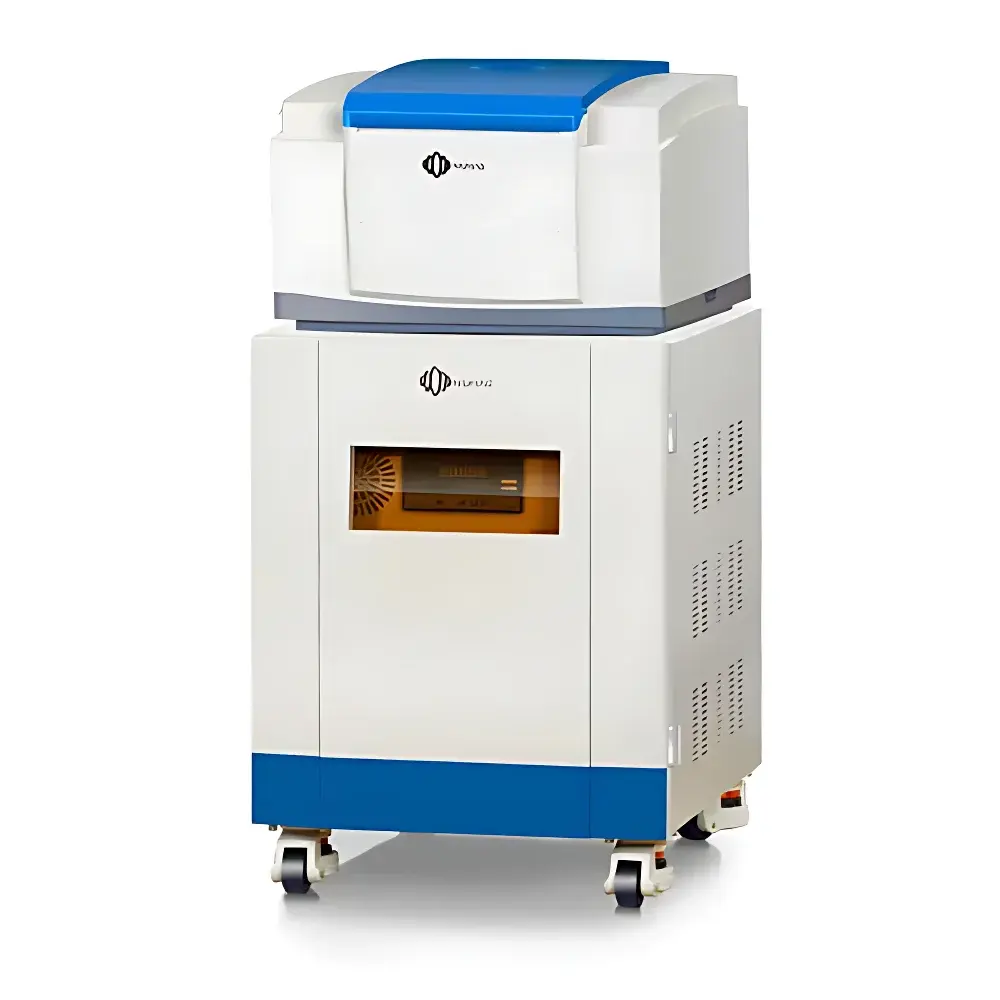
NIUMAG PQ001-fhl Low-Field Nuclear Magnetic Resonance Fluorine Content Analyzer
| Brand | NIUMAG |
|---|---|
| Origin | Jiangsu, China |
| Manufacturer Type | Authorized Distributor |
| Origin Category | Domestic (China-made) |
| Model | PQ001-fhl |
| Pricing | Upon Request |
Overview
The NIUMAG PQ001-fhl is a dedicated low-field nuclear magnetic resonance (LF-NMR) analyzer engineered for quantitative fluorine-19 (19F) content determination in solid, powdered, and liquid samples. Unlike conventional analytical techniques relying on wet chemistry or ion separation, this instrument leverages the intrinsic magnetic moment of the 19F nucleus—the only stable, 100% naturally abundant fluorine isotope with high gyromagnetic ratio (γ = 40.05 MHz/T). Under a homogeneous static magnetic field of 0.5 ± 0.08 T (corresponding to a Larmor frequency of 21.3 MHz), the instrument detects the integrated echo amplitude of the 19F spin signal, which exhibits direct linear proportionality to fluorine mass concentration in the sample volume within the 25 mm diameter RF coil. This first-principles-based quantification eliminates matrix interference, avoids chemical derivatization, and requires no calibration against reference standards containing non-fluorinated analogs—making it particularly suitable for routine QC in rubber compounding, dental product manufacturing, pharmaceutical excipient verification, and polymer quality assurance.
Key Features
- Permanent magnet architecture ensures long-term field stability without cryogens or active shimming—reducing total cost of ownership and enabling benchtop deployment in production labs.
- Optimized 19F-tuned RF probe with 25 mm inner diameter coil delivers high signal-to-noise ratio (SNR) for trace-level detection, supporting reliable quantification down to sub-0.1 wt% fluorine in heterogeneous matrices.
- Single-pulse spin-echo acquisition sequence minimizes T2 decay bias and enables robust integration across diverse relaxation times typical of fluorinated elastomers (e.g., FKM, FFKM), dental pastes, and inorganic fluorides.
- Calibration protocol requires only five to six certified reference materials spanning the expected fluorine concentration range—fully compliant with ASTM E29 and ISO/IEC 17025 method validation guidelines.
- No consumables beyond reusable NMR tubes; no hazardous reagents, no acid digestion, no column degradation—fully aligned with green chemistry principles and OSHA-compliant workplace safety protocols.
- Intuitive touchscreen interface with guided workflow reduces operator dependency; training time under 30 minutes for qualified lab technicians.
Sample Compatibility & Compliance
The PQ001-fhl accommodates a broad spectrum of industrial materials without destructive preparation: uncured rubber compounds, vulcanized elastomer granules, toothpaste gels, aqueous NaF solutions, fluorinated gypsum slurries, surface-treated fibers, and fluoropolymer pellets. Sample volume requirement is 0.5–3 mL (liquid) or 0.2–2 g (solid/powder), loaded directly into standard 10 mm OD glass NMR tubes. The system meets electromagnetic compatibility (EMC) requirements per IEC 61326-1 and operates within Class II laser safety classification (IEC 60825-1) for its embedded optical alignment subsystem. Data integrity complies with ALCOA+ principles; audit trails, electronic signatures, and user-access controls are configurable to satisfy FDA 21 CFR Part 11 and EU Annex 11 requirements when integrated with validated LIMS environments.
Software & Data Management
Acquisition and analysis are performed via NIUMAG’s proprietary NMI-Fluoro v3.2 software, running on embedded Windows IoT OS. The software provides real-time spectral preview, automatic baseline correction, peak integration with manual override, and calibration curve generation using weighted linear regression (R² ≥ 0.9995 typical). All raw FID data, processed spectra, calibration logs, and measurement reports are stored in vendor-neutral HDF5 format with embedded metadata (sample ID, operator, timestamp, instrument serial, pulse sequence parameters). Export options include CSV, PDF, and XML for traceability in GLP/GMP audits. Remote monitoring and diagnostic support are enabled via secure TLS 1.2 encrypted connection.
Applications
- Quality control of fluorocarbon elastomers (FKM, FFKM) during mixing and curing stages—verifying fluorine retention after high-temperature processing.
- Routine assay of sodium monofluorophosphate (MFP) and amine fluoride in dentifrices per ISO 11609 and USP .
- Quantification of residual fluorinating agents (e.g., CoF3, AgF2) in catalyst recovery streams from fluorochemical synthesis.
- Verification of fluorine doping homogeneity in lithium-ion battery cathode precursors (e.g., LiNi0.8Co0.15Al0.05O2−xFx).
- Stability testing of fluorinated surfactants in agrochemical formulations under accelerated aging conditions.
FAQ
Does the PQ001-fhl require liquid nitrogen or helium cooling?
No. It employs a temperature-stabilized permanent magnet operating at ambient conditions—zero cryogen dependency.
Can it distinguish between organic and inorganic fluorine species?
No. It measures total 19F signal intensity; speciation requires complementary techniques such as 19F MAS-NMR or XPS.
Is method transfer possible between different PQ001-fhl units?
Yes. Inter-instrument reproducibility is maintained within ±1.2% RSD (n=10) for identical samples when calibrated using traceable reference materials.
What sample preparation is required for rubber compounds?
Minimal: cut into ≤3 mm fragments and load directly—no solvent extraction, grinding, or pressing needed.
How often does the system require recalibration?
Annual calibration verification is recommended; daily system suitability checks using a built-in fluorinated reference standard are advised per ISO/IEC 17025 Clause 7.7.