
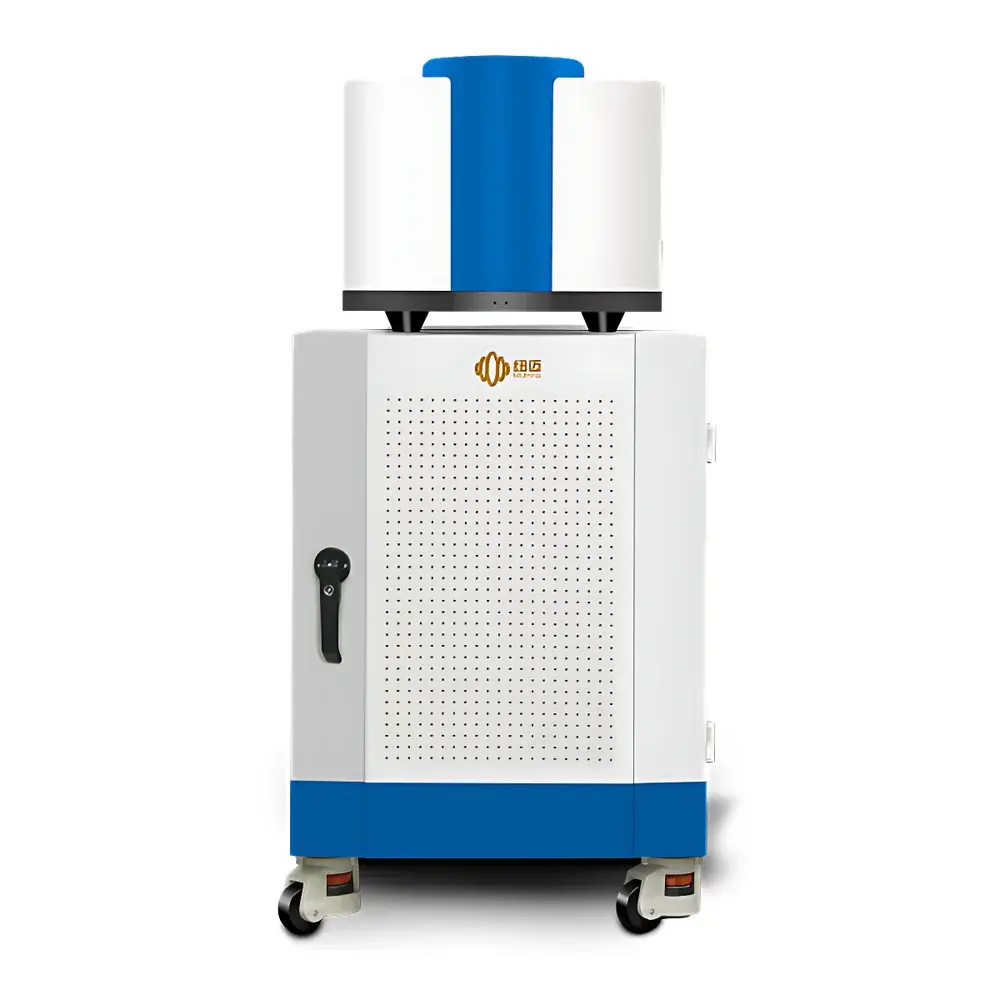
NIUMAG PQ001-GU-1 Low-Field Nuclear Magnetic Resonance Analyzer for Sodium Hyaluronate Crosslinking Density Measurement
| Brand | NIUMAG |
|---|---|
| Origin | Jiangsu, China |
| Instrument Type | Low-Field NMR Spectrometer |
| Model | PQ001-GU-1 |
| Sample Compatibility | Solid-Liquid Dual-Phase |
| Magnetic Field Strength | 0.5 T ± 0.03 T |
| Sample Tube Diameter × Height | Ø24.2 mm × 25 mm |
| Measurement Time | ≤3 min per sample |
| Core Application | Quantitative Crosslinking Density Analysis of Sodium Hyaluronate (HA) |
Overview
The NIUMAG PQ001-GU-1 is a purpose-built low-field nuclear magnetic resonance (LF-NMR) spectrometer engineered for quantitative, non-invasive assessment of crosslinking density in sodium hyaluronate (NaHA) hydrogels and related biomaterials. Unlike conventional destructive assays—such as enzymatic digestion coupled with HPLC or rheological extrapolation—the PQ001-GU-1 leverages the physical principle of proton spin relaxation (T₂ and T₁–T₂ correlation) to probe molecular mobility constraints imposed by covalent or physical crosslinks within the HA network. In crosslinked NaHA systems, increased crosslink density restricts segmental motion of polymer chains, shortening transverse relaxation times (T₂) and altering the distribution of relaxation components. By calibrating relaxation parameters against reference standards with known crosslinking ratios (e.g., BDDE-crosslinked HA gels validated via FTIR or SEC-MALS), the instrument delivers traceable, reproducible quantification of crosslink density—expressed as moles of crosslinker per mole of disaccharide unit or as effective mesh size (ξ). Designed for routine use in QC laboratories, R&D centers, and regulatory-compliant environments, the PQ001-GU-1 operates at a stable 0.5 T permanent magnet field optimized for high signal-to-noise ratio in aqueous and semi-solid HA formulations.
Key Features
- Permanent magnet system with field homogeneity <0.1 ppm over 20 mm DSV, enabling robust T₂ decay curve acquisition without active shimming.
- Dedicated pulse sequence suite: CPMG (for T₂ distribution), inversion-recovery (for T₁), and 2D T₁–T₂ correlation for resolving bound vs. free water populations in hydrated HA networks.
- Integrated temperature-controlled sample chamber (range: 10–45 °C, ±0.5 °C stability) to assess thermal dependence of crosslink dynamics.
- Pre-validated calibration protocols for common HA crosslinking chemistries: BDDE, DVS, and carbodiimide-mediated coupling—each linked to ISO 13485-aligned reference material datasets.
- Compact benchtop footprint (W×D×H: 420 × 350 × 280 mm) with CE-marked electrical safety and RF emission compliance (EN 61326-1).
Sample Compatibility & Compliance
The PQ001-GU-1 accepts standard 24.2 mm OD glass NMR tubes accommodating both liquid-phase HA solutions (0.5–5 wt%) and pre-formed hydrogels (thickness ≤25 mm). Its solid–liquid dual-phase capability supports analysis of heterogeneous systems—including HA–collagen composites, HA–nanocellulose blends, and microsphere-encapsulated formulations—without sample homogenization or solvent extraction. Data acquisition and reporting align with GLP and GMP documentation requirements: audit trails record operator ID, timestamp, pulse sequence parameters, and raw FID/T₂ data; all outputs are exportable in ASCII and CSV formats compatible with LIMS integration. The system satisfies key regulatory expectations for analytical instrumentation under FDA 21 CFR Part 11 (electronic records/signatures) when deployed with validated user access control and data integrity configurations.
Software & Data Management
The proprietary MesoMR Studio software provides a modular, workflow-driven interface compliant with ICH Q5C and USP analytical instrument qualification guidelines. Key modules include: (i) Auto-calibration wizard for field homogeneity and RF power optimization; (ii) Multi-component T₂ fitting engine using non-negative least-squares (NNLS) deconvolution; (iii) Crosslink density prediction model builder, supporting linear and polynomial regression against orthogonal reference methods (e.g., swelling ratio, compressive modulus); (iv) Batch processing mode for up to 96 samples with automated report generation (PDF/Excel) including pass/fail flags against user-defined specification limits. All software binaries undergo annual cybersecurity patching per NIST SP 800-53 Rev. 5 controls.
Applications
- Quantitative release of crosslink density specifications in HA dermal filler manufacturing (per ISO 22716 and ASTM F2573).
- In-process monitoring of crosslinking reaction kinetics during batch synthesis—enabling real-time endpoint determination.
- Stability assessment of HA-based drug delivery matrices under accelerated aging (40 °C/75% RH) via longitudinal T₂ mapping.
- Comparative evaluation of enzymatic degradation profiles across HA formulations using time-resolved relaxation parameter tracking.
- Supporting regulatory submissions (e.g., FDA 510(k), CE-IVDR Class C) with documented method validation per ICH Q2(R2): specificity, linearity (r² ≥0.995), accuracy (recovery 95–105%), precision (RSD ≤3.5% intra-day).
FAQ
What sample preparation is required prior to LF-NMR measurement?
Minimal preparation is needed: HA gels are loaded directly into standard NMR tubes; solutions require no filtration unless particulates exceed 5 µm. No deuteration or contrast agents are necessary.
Can the PQ001-GU-1 differentiate between chemical and physical crosslinks?
Yes—through temperature-variable T₁–T₂ correlation experiments: physical (hydrogen-bonded) crosslinks show pronounced T₂ shortening below 30 °C but reversible behavior upon heating, whereas covalent crosslinks exhibit temperature-independent relaxation signatures.
Is method transfer feasible between different PQ001-GU-1 units?
Yes—inter-unit reproducibility is maintained via factory-installed field mapping and daily lock-and-tune routines; inter-laboratory validation studies demonstrate <2.1% RSD in crosslink density values across five instruments.
Does the system support IQ/OQ/PQ documentation packages?
Yes—NIUMAG provides full GxP-compliant qualification kits, including URS, DQ, IQ/OQ protocols, and PQ test scripts aligned with ASTM E2500-22.
How is data integrity ensured during long-term deployment?
Raw FID data is written directly to encrypted local storage with SHA-256 hashing; database backups occur hourly to redundant NAS drives with versioned archive retention (≥12 months).
Related Products




