
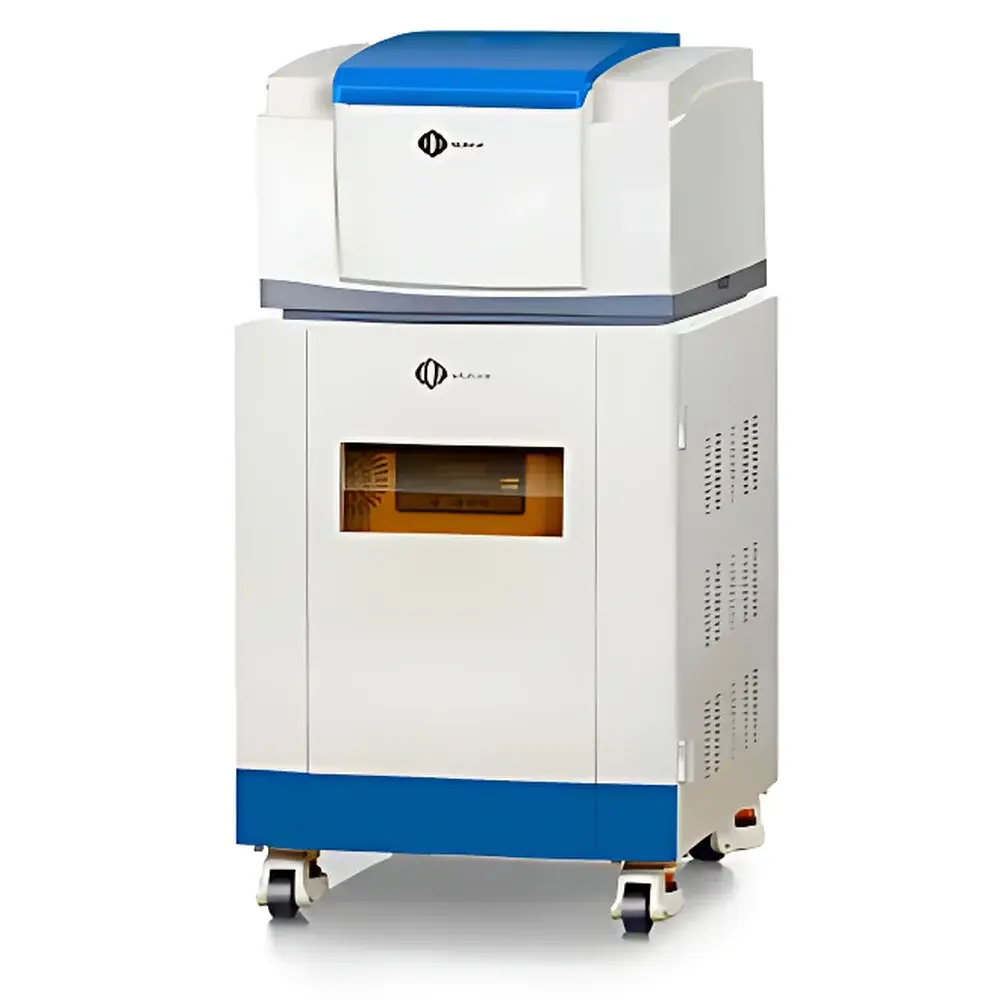
NIUMAG PQ001 High-Performance Low-Field Nuclear Magnetic Resonance Relaxometry Analyzer
| Brand | NIUMAG |
|---|---|
| Origin | Jiangsu, China |
| Model | PQ001 |
| Instrument Type | Low-Field NMR Relaxometer |
| Sample Compatibility | Solid-Liquid Dual-Phase |
| Magnetic Field Strength | 0.5 T |
| RF Coil | Solenoid-Type Transmit/Receive |
| Signal Acquisition | Digitally Controlled Pulsed NMR Spectrometer with Integrated Low-Noise Preamp |
| Software Platform | Delphi-Based NMR Control & Relaxation Analysis Suite |
Overview
The NIUMAG PQ001 is a dedicated low-field nuclear magnetic resonance (NMR) relaxometer engineered for precise, non-invasive quantification of longitudinal (T₁) and transverse (T₂) relaxation times in contrast agents and biological samples. Unlike clinical MRI systems that infer relaxation parameters indirectly from image contrast, the PQ001 employs direct time-domain pulsed NMR detection—based on the principles of spin echo (CPMG for T₂) and inversion recovery (for T₁)—to deliver high-reproducibility, absolute relaxation rate measurements. Operating at a stable 0.5 Tesla permanent magnet field, the system balances sensitivity, portability, and robustness for routine laboratory use in pharmaceutical development, biomaterial characterization, and preclinical contrast agent evaluation. Its compact, benchtop architecture eliminates cryogenic requirements while maintaining field homogeneity sufficient for quantitative relaxometry across heterogeneous sample matrices.
Key Features
- 0.5 T Permanent Magnet System: Engineered for long-term field stability (< ±0.01% drift over 24 h) and minimal passive shielding; optimized for high signal-to-noise ratio (SNR) in aqueous and semi-solid samples without superconducting infrastructure.
- Dual-Mode Solenoid RF Probe: Integrated transmit/receive solenoid coil with uniform B₁ field distribution (>92% homogeneity over 25 mm diameter), enabling consistent excitation and detection across variable sample geometries and viscosities.
- Low-Noise Signal Chain: On-coil low-noise preamplifier (NF < 0.8 dB) minimizes thermal noise contribution and preserves dynamic range during weak-signal acquisition from dilute contrast agents or ex vivo tissues.
- Full-Digital Pulse Programmer: FPGA-based spectrometer platform supporting customizable pulse sequences (e.g., IR, CPMG, saturation recovery), variable inter-pulse delays, and real-time data streaming to host PC via Gigabit Ethernet.
- Benchtop Portability: Compact footprint (W × D × H: 420 × 380 × 310 mm), integrated power conditioning, and vibration-damped base facilitate deployment in QC labs, shared instrumentation cores, and regulated GMP/GLP environments.
Sample Compatibility & Compliance
The PQ001 accommodates standard 10–15 mm OD NMR tubes, custom vials (up to 5 mL volume), and solid-liquid composite specimens—including lyophilized powders reconstituted in buffer, nanoparticle suspensions, excised tumor tissue slices (≤3 mm thickness), and cell lysates. It supports ISO/IEC 17025-aligned measurement protocols for relaxivity (r₁, r₂) determination per ASTM E2871-22 (Standard Practice for Determining Relaxivity of MRI Contrast Agents). Data integrity complies with FDA 21 CFR Part 11 requirements through software-enforced user authentication, electronic signatures, and immutable audit trails for all acquisition parameters, processing steps, and report exports.
Software & Data Management
The Delphi-based NMR console software provides guided workflow automation—from probe tuning and shimming to sequence selection, acquisition, and multi-exponential T₂/T₁ decay fitting using non-negative least squares (NNLS) algorithms. Raw FID and echo train data are stored in vendor-neutral HDF5 format. Batch processing supports statistical comparison across sample sets; export options include CSV, Excel, and PDF reports with embedded metadata (field strength, temperature, pulse widths, SNR metrics). Optional API integration enables linkage to LIMS and ELN platforms via RESTful endpoints.
Applications
- Quantitative relaxivity profiling (r₁, r₂ in mM⁻¹s⁻¹) of Gd³⁺-, Fe³⁺-, and Mn²⁺-based contrast agents under physiological pH and temperature conditions.
- Stability assessment of nanoparticle contrast agents via longitudinal monitoring of T₂ dispersion shifts during aggregation or protein corona formation.
- Ex vivo relaxometric fingerprinting of tumor biopsies to correlate T₂ heterogeneity with histopathological grade and hypoxia markers.
- Cellular uptake kinetics studies using intracellular T₁ shortening as a proxy for metal ion accumulation in macrophages or stem cells.
- Formulation screening of liposomal, polymeric, or silica-based delivery vehicles for controlled contrast release and biodistribution prediction.
FAQ
What relaxation parameters does the PQ001 directly measure?
It acquires raw time-domain NMR signals to compute T₁ (spin-lattice) and T₂ (spin-spin) relaxation times, from which r₁ and r₂ relaxivities are derived using standardized molar concentration inputs.
Can the system accommodate temperature-controlled measurements?
Yes—optional air-flow or Peltier-based sample temperature control modules (range: 5–60 °C, ±0.5 °C stability) are available for thermally sensitive contrast agent studies.
Is the software validated for regulated environments?
The current software version includes configurable audit trail logging, role-based access control, and electronic signature support compliant with ALCOA+ principles for GLP/GMP applications.
How is magnet homogeneity ensured during daily operation?
Passive shimming is performed during installation; routine field mapping is supported via built-in gradient-assisted shim routines, with automated lock-and-tune prior to each acquisition sequence.
Does the PQ001 support multi-frequency or multi-field relaxometry?
No—it operates exclusively at 0.5 T (21.3 MHz for ¹H); however, its modular RF architecture allows future hardware upgrades to support dual-field configurations upon customer request and regulatory review.





