
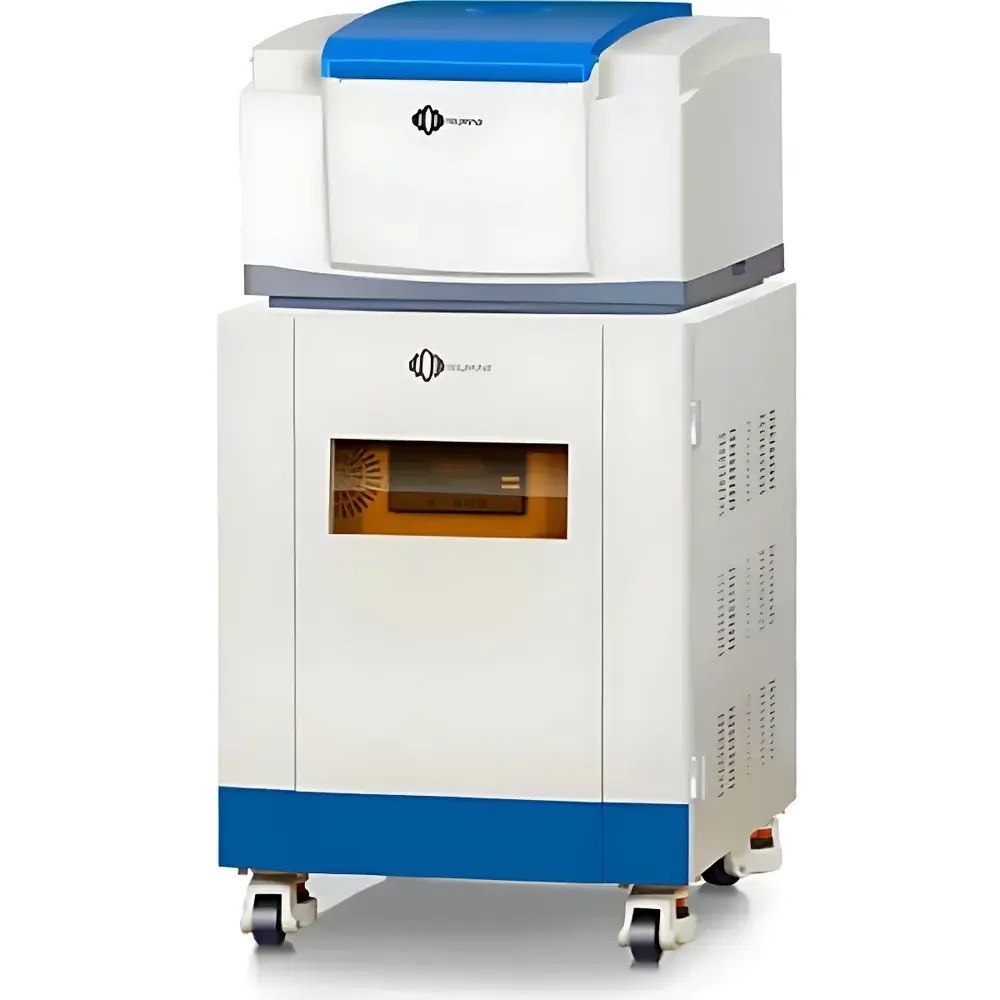
NIUMAG PQ001 Low-Field NMR Surface Grafting Density Analyzer
| Brand | NIUMAG |
|---|---|
| Origin | Jiangsu, China |
| Manufacturer Type | Authorized Distributor |
| Country of Origin | China |
| Model | PQ001 |
| Pricing | Available Upon Request |
Overview
The NIUMAG PQ001 Low-Field NMR Surface Grafting Density Analyzer is a purpose-engineered benchtop nuclear magnetic resonance (NMR) system designed for quantitative determination of surface grafting density on nanoscale silica particles and other functionalized inorganic nanoparticles. Unlike high-field NMR spectrometers requiring cryogenic magnets and specialized infrastructure, the PQ001 operates at low magnetic field strengths (typically 0.5–2 T, corresponding to 1H Larmor frequencies of ~21–85 MHz), enabling robust, cost-effective, and operator-friendly characterization in routine QC and R&D laboratories. Its core measurement principle relies on spin-echo-based pulse sequences—specifically the Multi-Spin-Echo (MSE) acquisition protocol—which minimizes dead-time artifacts and maximizes signal capture from protons bound to grafted organic moieties (e.g., PEG, silanes, alkyl chains) immobilized on particle surfaces. By resolving the distinct transverse relaxation behavior (T2) of mobile (unbound) versus restricted (grafted) proton populations, the instrument enables selective quantification without chemical derivatization or destructive sample preparation.
Key Features
- Optimized MSE pulse sequence for sub-millisecond dead-time signal acquisition, critical for detecting short-T2 components from surface-bound protons
- Benchtop permanent magnet architecture with active temperature stabilization (±0.1 °C), ensuring long-term field homogeneity and measurement reproducibility
- Dedicated 10 mm OD glass tube sample holder, accommodating up to 2 cm sample height; compatible with standard NMR-compatible solvents (e.g., D2O, CDCl3, acetone-d6)
- Integrated quantitative analysis workflow using external calibration standards (e.g., known concentrations of reference compounds with identical proton environments)
- No requirement for ferromagnetic-free sample handling—strict exclusion of iron, nickel, cobalt, or paramagnetic contaminants is enforced per ISO/IEC 17025-compliant SOPs
- Minimal operator dependency: fully automated shimming, tuning, and data processing; no NMR spectroscopy expertise required for routine operation
Sample Compatibility & Compliance
The PQ001 is validated for colloidal and dry-powder samples of amorphous silica nanoparticles (primary particle size: 5–100 nm), including fumed, precipitated, and Stöber-synthesized variants. It supports functional groups commonly introduced via silanization (e.g., –CH3, –C8H17, –OCH2CH2OCH3, –NH2) and polymer grafting (e.g., PEG, PMMA, PS). The system complies with electromagnetic compatibility (EMC) requirements per IEC 61326-1 and meets safety standards under IEC 61010-1 for laboratory electrical equipment. While not certified for GMP production environments, its software architecture supports audit trails, user access control, and electronic signature functionality aligned with FDA 21 CFR Part 11 readiness when deployed with validated IT infrastructure.
Software & Data Management
The proprietary NIUMAG NMR Studio v4.x software provides full control over pulse sequence parameters (echo spacing, number of echoes, repetition time), real-time T2 distribution fitting (using non-negative least squares inversion), and grafting density calculation based on calibrated proton signal integration. All raw FID data, processed T2 spectra, and quantitative reports are stored in vendor-neutral HDF5 format with embedded metadata (sample ID, operator, timestamp, instrument configuration). Export options include CSV, PDF, and PNG. Software validation documentation (IQ/OQ protocols) is available upon request for GLP-regulated research settings.
Applications
- Quantitative assessment of silane coupling agent coverage on SiO2 fillers used in rubber compounding and epoxy composites
- Batch-to-batch consistency verification of PEGylated silica nanoparticles intended for drug delivery or diagnostic imaging
- Optimization of surface grafting reaction kinetics and stoichiometry during functionalization process development
- Correlation of grafting density with macroscopic properties: dispersion stability in non-polar media, rheological response in nanocomposite melts, and interfacial adhesion strength in laminates
- Method transfer from high-field NMR to production-scale quality control labs seeking faster turnaround and lower operational overhead
FAQ
What sample volume and concentration range is recommended for accurate grafting density measurement?
A minimum of 0.5 mL suspension (or equivalent dry mass ≥10 mg) in deuterated solvent is required; optimal signal-to-noise is achieved at solid loadings of 1–5 wt% relative to solvent mass.
Can the PQ001 distinguish between mono-, di-, and tri-substituted silane grafting configurations?
No—the instrument quantifies total proton signal attributable to grafted species but does not resolve molecular conformation or substitution pattern; such structural details require high-resolution 29Si or 13C NMR.
Is calibration transfer possible between different PQ001 units?
Yes—cross-instrument calibration is supported via standardized reference samples and factory-provided sensitivity normalization coefficients traceable to NIST SRM 1921b.
Does the system support temperature-controlled measurements?
Not natively; ambient-temperature operation only (20–25 °C). For variable-temperature studies, external thermostatted probe inserts must be validated separately.
How is data integrity ensured during long-term deployment in regulated environments?
All user actions, parameter changes, and report generations are logged with timestamps and operator IDs; raw data files are write-protected after acquisition and checksum-verified upon export.
Related Products



