
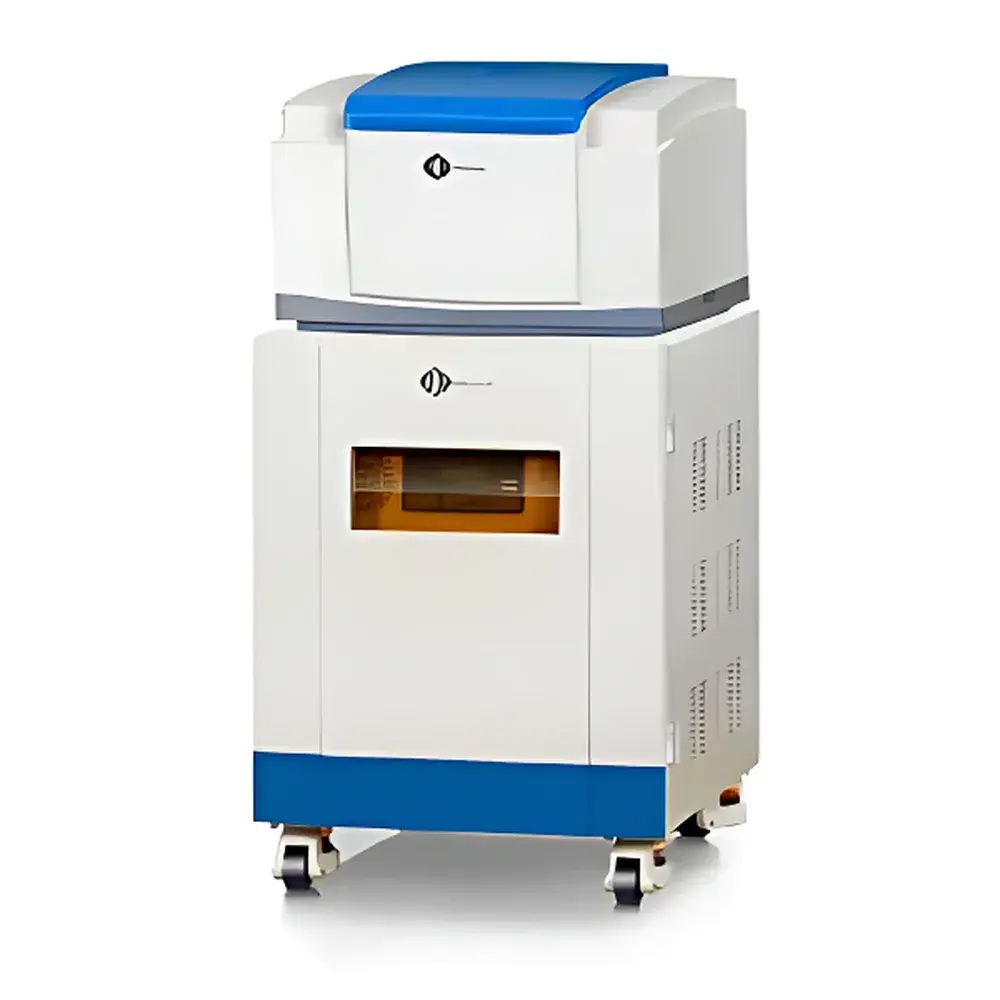
NIUMAG PQ001 Low-Field Nuclear Magnetic Resonance Analyzer
| Brand | NIUMAG |
|---|---|
| Origin | Jiangsu, China |
| Manufacturer Type | Authorized Distributor |
| Product Category | Domestic |
| Model | PQ001 |
| Instrument Type | Low-Field NMR Analyzer |
| Nucleus Detected | ¹H |
| Operating Frequency Range | 1–30 MHz |
| Magnet Type | Permanent Magnet |
| Power Supply | 220 V, 50 Hz |
| Sample Compatibility | Solid-Liquid Dual-Phase |
| Measurement Time | 1–3 min per test |
| Primary Relaxation Parameters | T₁ and T₂ |
Overview
The NIUMAG PQ001 is a benchtop low-field nuclear magnetic resonance (LF-NMR) analyzer engineered for quantitative characterization of molecular mobility, phase distribution, and physical state in heterogeneous materials. Unlike high-field superconducting NMR systems, the PQ001 operates at a stable Larmor frequency range of 1–30 MHz—corresponding to static magnetic fields of approximately 0.023–0.705 T—enabling robust, cost-effective, and maintenance-free analysis of hydrogen-rich samples. Its core measurement principle relies on pulsed NMR spectroscopy, specifically spin-echo sequences (e.g., CPMG for T₂ and inversion-recovery for T₁), to extract relaxation time distributions that correlate directly with pore structure, bound/free fluid ratios, polymer chain dynamics, and solid–liquid interface interactions. Designed for routine industrial and academic laboratories, the system delivers reproducible, non-destructive, and calibration-free quantification of moisture content, oil saturation, fat crystallinity, and crosslink density—without chemical labeling, vacuum requirements, or sample dehydration.
Key Features
- Permanent magnet architecture ensuring zero cryogen consumption, minimal drift, and long-term field homogeneity (<±0.05% over 24 h)
- Dedicated ¹H detection channel optimized for signal-to-noise ratio in low-field regimes, with built-in RF shielding and temperature-stabilized probe housing
- Integrated pulse programmer supporting standard and user-defined sequences—including CPMG, IR, and saturation recovery—for full T₁/T₂ mapping
- Intuitive graphical interface with dual-panel layout: left-side parameter configuration (pulse width, echo spacing, scan number, wait time) and right-side real-time FID/decay curve visualization
- Pre-calibrated hardware timing resolution ≤100 ns, enabling accurate multi-exponential decay fitting using SVD or NNLS algorithms
- Compact footprint (600 × 450 × 380 mm) and standard 220 V / 50 Hz input compatibility for global deployment in QC labs, pilot plants, and field-mobile units
Sample Compatibility & Compliance
The PQ001 accommodates a broad spectrum of solid–liquid composite samples without pretreatment: intact food matrices (cheese, meat, grains), porous media (soil cores, catalysts, concrete), emulsions (mayonnaise, pharmaceutical suspensions), polymers (rubber, hydrogels), and petroleum rock fragments. Sample tubes range from 10 mm to 25 mm OD (standard 15 mm glass or PTFE inserts). The system complies with IEC 61000-6-3 (EMC emission standards) and meets mechanical safety requirements per ISO 13857. While not certified for clinical diagnostics, its measurement protocols align with ASTM D8143–21 (Standard Practice for Low-Field NMR Analysis of Hydrocarbon Fluids in Porous Media) and ISO 17892-12 (Geotechnical investigation and testing — Laboratory testing of soil — Part 12: Determination of water content by low-field NMR). Data integrity supports GLP-compliant workflows through audit-trail-enabled software logging.
Software & Data Management
Control and analysis are performed via NIUMAG’s proprietary NMIQ v3.2 software suite, running on Windows 10/11 platforms. The software provides automated baseline correction, exponential fitting (mono-, bi-, and tri-exponential models), T₂ distribution inversion (non-negative least squares), and customizable report generation (PDF/CSV/XLSX export). All raw FID data, acquisition parameters, and processing history are stored in encrypted .nmiq project files with timestamped metadata. For regulated environments, optional 21 CFR Part 11 compliance modules include electronic signatures, role-based access control, and immutable audit trails—fully traceable to individual operators and instrument sessions.
Applications
- Food Science: Quantifying free/bound water in dried fruits, monitoring starch gelatinization kinetics, assessing oil migration in chocolate, and detecting adulteration in edible oils
- Petroleum Engineering: Estimating porosity, permeability, and irreducible water saturation in core plugs; distinguishing movable vs. capillary-bound hydrocarbons
- Materials Research: Characterizing curing degree in epoxy resins, evaluating filler dispersion in rubber composites, and probing hydration evolution in cementitious systems
- Agriculture & Soil Science: Measuring water-holding capacity, clay-bound water fraction, and root-zone moisture dynamics in undisturbed soil monoliths
- Pharmaceutical Development: Monitoring polymorphic transitions in amorphous solid dispersions and quantifying residual solvent in lyophilized products
FAQ
What is the typical measurement time for a T₂ relaxation experiment?
A complete CPMG acquisition with sufficient signal averaging typically requires 1–3 minutes, depending on sample signal strength and desired SNR.
Does the PQ001 require liquid nitrogen or helium cooling?
No—the permanent magnet design eliminates all cryogenic dependencies, reducing operational overhead and total cost of ownership.
Can the system analyze powdered or highly viscous samples?
Yes; the RF coil geometry and pulse sequence flexibility accommodate low-mobility ¹H populations, including immobilized protons in gels, polymers, and adsorbed phases.
Is external calibration with reference standards necessary?
Not for relative comparisons or trend analysis; absolute quantification (e.g., % water) requires a single-point calibration using a known standard matching the sample matrix.
How is data security ensured during networked operation?
Local data storage is default; optional network configurations support TLS 1.2–encrypted transfers and integration with enterprise LIMS via RESTful API endpoints.




