
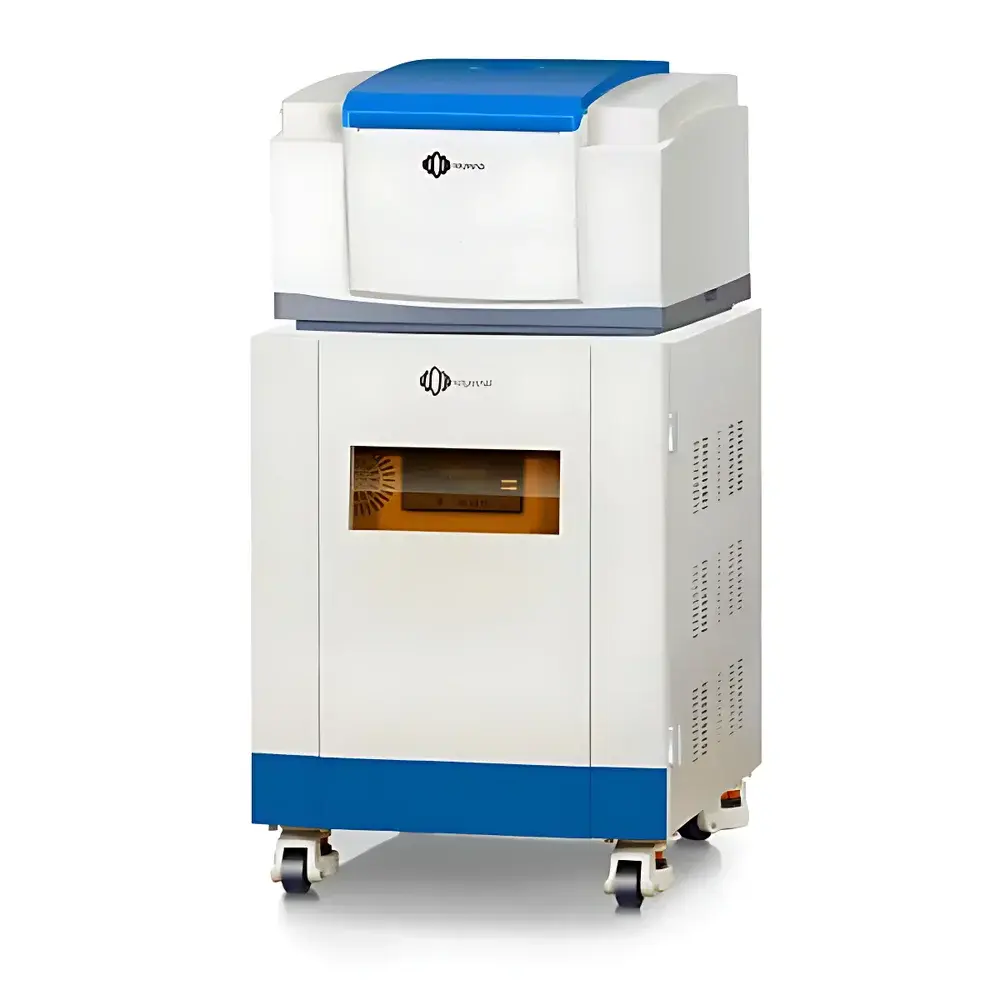
NIUMAG PQ001 Low-Field Nuclear Magnetic Resonance Analyzer for Solid–Liquid Interface Interaction Analysis
| Brand | NIUMAG |
|---|---|
| Origin | Jiangsu, China |
| Manufacturer Type | Authorized Distributor |
| Product Category | Domestic |
| Model | PQ001 |
| Instrument Type | Low-Field NMR Analyzer |
| Sample Type | Solid–Liquid Composite Systems |
| Operating Mode | Pulsed Fourier Transform (PFT-NMR) |
Overview
The NIUMAG PQ001 is a dedicated low-field nuclear magnetic resonance (LF-NMR) analyzer engineered for quantitative characterization of interfacial interactions between solid and liquid phases. Unlike conventional surface-area analyzers or optical scattering instruments, the PQ001 leverages the physical principle of transverse relaxation time (T2) distribution analysis to probe molecular mobility gradients at solid–liquid boundaries. In heterogeneous dispersions—such as colloidal suspensions, slurries, and nanoparticle-laden electrolytes—the differential relaxation behavior of bound versus bulk solvent protons provides direct insight into surface hydration layers, adsorption kinetics, and interfacial wettability. This non-invasive, non-destructive methodology eliminates sample preparation artifacts associated with drying, coating, or vacuum exposure, preserving native dispersion state integrity. The system operates at a fixed static field strength (typically 0.05–0.3 T), enabling robust signal acquisition under ambient conditions while maintaining sufficient spectral resolution to resolve multi-exponential decay components arising from distinct proton populations.
Key Features
- Optimized pulse sequence architecture supporting CPMG (Carr–Purcell–Meiboom–Gill) acquisition for high-fidelity T2 mapping across heterogeneous solid–liquid systems
- Integrated temperature-controlled sample chamber (±0.1 °C stability) to assess thermal dependence of interfacial hydration and desorption dynamics
- Dual-mode probe design accommodating both sealed glass tubes (5–25 mm OD) and custom flow cells for in-line slurry monitoring
- Automated calibration routines traceable to NIST-certified reference standards for longitudinal (T1) and transverse (T2) relaxation benchmarks
- Ruggedized magnet assembly with passive shimming and active field stabilization, ensuring long-term measurement reproducibility (<0.5% RSD over 72 h)
- Compliance with IEC 61000-4 electromagnetic immunity standards for laboratory integration in industrial QC environments
Sample Compatibility & Compliance
The PQ001 accepts a broad spectrum of solid–liquid composite samples without requiring derivatization or labeling: aqueous and organic suspensions (e.g., SiO2, TiO2, carbon black, metal oxides), polymer nanocomposites, battery electrode slurries (NMC, LFP), CMP slurries, pharmaceutical API suspensions, and functionalized nanofibers. It supports ISO 13321 (particle size by NMR), ASTM D8293-20 (low-field NMR for emulsion stability), and aligns with FDA 21 CFR Part 11 requirements through optional audit-trail-enabled software configuration. All hardware modules conform to CE marking directives (2014/30/EU EMC, 2014/35/EU LVD) and are validated per GLP Annex 15 for regulated analytical workflows.
Software & Data Management
Acquisition and analysis are managed via NIUMAG’s proprietary NMIQ v4.2 platform, featuring a modular GUI with role-based access control (RBAC). Core functionalities include automated T2 inversion using non-negative least squares (NNLS), diffusion-relaxation (D–T2) correlation mapping, and quantitative surface-area estimation via the SDR (Surface-to-Diffusion Ratio) model. Raw FID data are stored in vendor-neutral HDF5 format with embedded metadata (pulse sequence parameters, temperature logs, operator ID). The software supports batch processing, statistical process control (SPC) charting, and export to CSV, MATLAB (.mat), or ASTM E1447-compliant report templates. Optional 21 CFR Part 11 compliance package includes electronic signatures, change history logging, and secure user authentication via LDAP/Active Directory integration.
Applications
- Ceramics & Advanced Manufacturing: Quantifying dispersion homogeneity in wet-processed alumina/zirconia slips; optimizing ball-milling duration via real-time T2 shift tracking
- Nanomaterials R&D: Mapping surface ligand desorption kinetics on quantum dots or Fe3O4 nanoparticles through time-resolved hydration-layer thickness modeling
- Electronics Slurries: Correlating CMP slurry stability (via bound-water fraction) with post-polish surface roughness (Ra) and defect density
- Energy Materials: Assessing binder–carbon black interaction in Li-ion anode slurries; predicting electrode calendering response from interfacial proton mobility profiles
- Pharmaceutical Formulation: Differentiating polymorphic API wetting behavior in excipient suspensions; quantifying moisture sorption hysteresis without gravimetric interference
- Ink & Coating Development: Optimizing pigment dispersant dosage by monitoring changes in T2 distribution skewness and modal separation
FAQ
What distinguishes PQ001 from high-field NMR spectrometers?
The PQ001 prioritizes robustness, throughput, and interface-specific contrast over spectral resolution. Its low-field design enables direct T2 quantification in opaque, viscous, or conductive samples where high-field systems suffer from susceptibility broadening or RF penetration limits.
Can the PQ001 measure absolute surface area?
Yes—when calibrated against reference materials with known BET surface area, the SDR model converts T2 distributions into quantitative m²/g values with ±8% uncertainty (n ≥ 5 replicates, certified standards).
Is method validation support available?
NIUMAG provides IQ/OQ documentation templates, system suitability test protocols, and on-site installation qualification services aligned with ISO/IEC 17025 requirements.
Does the instrument require cryogens or external cooling?
No—permanent magnet architecture eliminates liquid helium or nitrogen dependency; only standard 230 V AC power and ambient lab ventilation are required.
How is data integrity ensured during extended unattended runs?
Hardware-level watchdog timers, automatic FID quality flagging, and redundant RAID-1 storage prevent data corruption; all acquisitions are timestamped and digitally signed in real time.




