
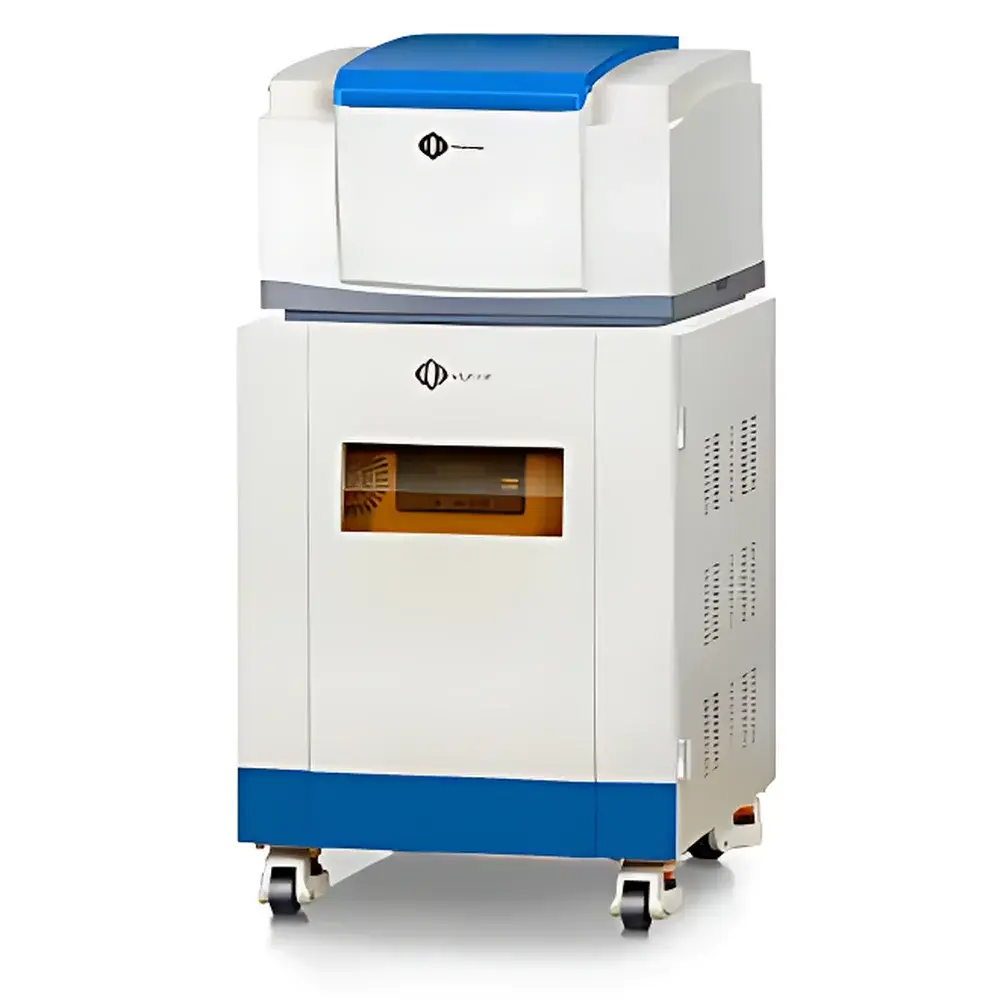
NIUMAG PQ001 Low-Field Nuclear Magnetic Resonance Relaxometry Analyzer for Contrast Agent r1/r2 Quantification
| Brand | NIUMAG |
|---|---|
| Origin | Jiangsu, China |
| Manufacturer Type | Authorized Distributor |
| Product Category | Domestic |
| Model | PQ001 |
| Instrument Type | Low-Field NMR Relaxometer |
| Sample Compatibility | Solid-Liquid Dual-Phase Samples |
| Magnetic Field Strength | 0.5 T |
| RF Coil Configuration | Solenoid Transmit/Receive |
| Signal Detection | Digitally Integrated Spectrometer with On-Coil Low-Noise Preamplifier |
| Software Platform | Delphi-Based NMR Control & Relaxometry Analysis Suite |
Overview
The NIUMAG PQ001 is a dedicated low-field nuclear magnetic resonance (NMR) relaxometer engineered for the precise, direct quantification of longitudinal (T1) and transverse (T2) relaxation rates—r1 (s−1·mM−1) and r2 (s−1·mM−1)—of MRI contrast agents. Unlike clinical MRI systems that estimate relaxivity indirectly from image intensity differences, the PQ001 employs inversion-recovery (IR) and Carr–Purcell–Meiboom–Gill (CPMG) pulse sequences to acquire raw free induction decay (FID) and spin-echo train data under controlled field homogeneity and temperature conditions. This direct measurement approach eliminates imaging-related artifacts and partial volume effects, delivering high reproducibility in relaxivity determination essential for preclinical formulation development, regulatory documentation, and structure–activity relationship (SAR) studies.
Key Features
- Stable 0.5 T permanent magnet system with passive shimming, achieving field homogeneity better than 10 ppm over a 20 mm DSV (diameter spherical volume), optimized for consistent relaxometry across sample batches.
- Solenoid-type RF transmit/receive coil architecture ensures uniform B1 excitation and high signal-to-noise ratio (SNR) across diverse sample geometries—including aqueous suspensions, nanoparticle dispersions, tissue homogenates, and cell lysates.
- Integrated low-noise preamplifier mounted directly within the coil housing minimizes cable-induced signal attenuation and thermal noise, preserving fidelity of weak echo trains critical for accurate T2 fitting.
- Fully digital spectrometer platform based on FPGA-controlled timing, 16-bit ADC sampling, and real-time digital signal processing (DSP), supporting variable repetition times (TR), echo spacing (TE), and number of echoes (Necho) without hardware reconfiguration.
- Modular probe design accommodates standard 10 mm or 15 mm outer-diameter glass tubes, enabling rapid sample exchange while maintaining thermal equilibrium via optional air-cooled sample holder.
Sample Compatibility & Compliance
The PQ001 supports quantitative relaxometry of paramagnetic and superparamagnetic contrast agents—including Gd3+-chelates (e.g., Gd-DTPA, Gd-DOTA), iron oxide nanoparticles (SPIONs), manganese-based complexes (e.g., MnDPDP), and novel metal-free alternatives. It further enables ex vivo analysis of biological matrices such as excised tumor tissues, cell pellets, and intracellular fluid extracts—provided samples are non-ferromagnetic and within the instrument’s RF penetration depth. Data acquisition and reporting workflows comply with GLP principles; audit trails, user access control, and electronic signature support can be enabled through optional software modules aligned with FDA 21 CFR Part 11 requirements. All pulse sequences adhere to ISO/IEC 17025 traceability frameworks when calibrated using reference standards (e.g., NiCl2 aqueous solutions with certified r1/r2 values).
Software & Data Management
The Delphi-based NMR console software provides an intuitive, wizard-driven interface for sequence setup, real-time signal monitoring, and automated T1/T2 fitting. Built-in algorithms apply nonlinear least-squares regression (Levenberg–Marquardt) to mono- and multi-exponential decay models, with residual diagnostics and confidence interval estimation. Export formats include CSV, ASCII, and HDF5 for downstream statistical analysis in MATLAB, Python (SciPy), or commercial packages such as OriginPro. Raw FID and echo train datasets are stored with full metadata (field strength, temperature, coil Q-factor, pulse widths), ensuring full experimental reproducibility. Batch processing mode allows unattended acquisition of up to 96 samples per run with auto-calibration between entries.
Applications
- Preformulation screening of r1/r2 ratios for targeted contrast agent optimization.
- Stability assessment of nanoparticle colloids under physiological pH and ionic strength conditions.
- Quantitative comparison of relaxivity across synthetic analogues in SAR studies.
- Ex vivo validation of contrast enhancement mechanisms in murine tumor models.
- Quality control testing of GMP-manufactured contrast agents against pharmacopoeial specifications (e.g., USP ).
- Teaching laboratories for hands-on instruction in NMR physics, relaxation theory, and biomedical instrumentation.
FAQ
What is the minimum sample volume required for reliable r1/r2 measurement?
A minimum of 0.5 mL is recommended for 10 mm OD tubes; lower volumes may be accommodated using custom micro-coils (optional accessory).
Does the PQ001 support variable temperature measurements?
Yes—via external air- or gas-circulating temperature controller (−10 °C to +60 °C range), with integrated PT100 sensor feedback and software-setpoint regulation.
Can T1 and T2 be measured simultaneously on the same sample?
No—sequential acquisition is required due to fundamental differences in pulse sequence design; however, automated workflow scripts minimize total turnaround time.
Is calibration traceable to international standards?
Yes—NIUMAG provides NIST-traceable relaxivity reference materials (e.g., aqueous MnCl2 and NiCl2 solutions) with uncertainty budgets compliant with ISO Guide 98-3.
How is data integrity maintained during long-term studies?
All acquisitions generate SHA-256 checksums; raw data files are write-protected post-acquisition, and metadata logs record operator ID, timestamp, instrument configuration, and environmental parameters.






