
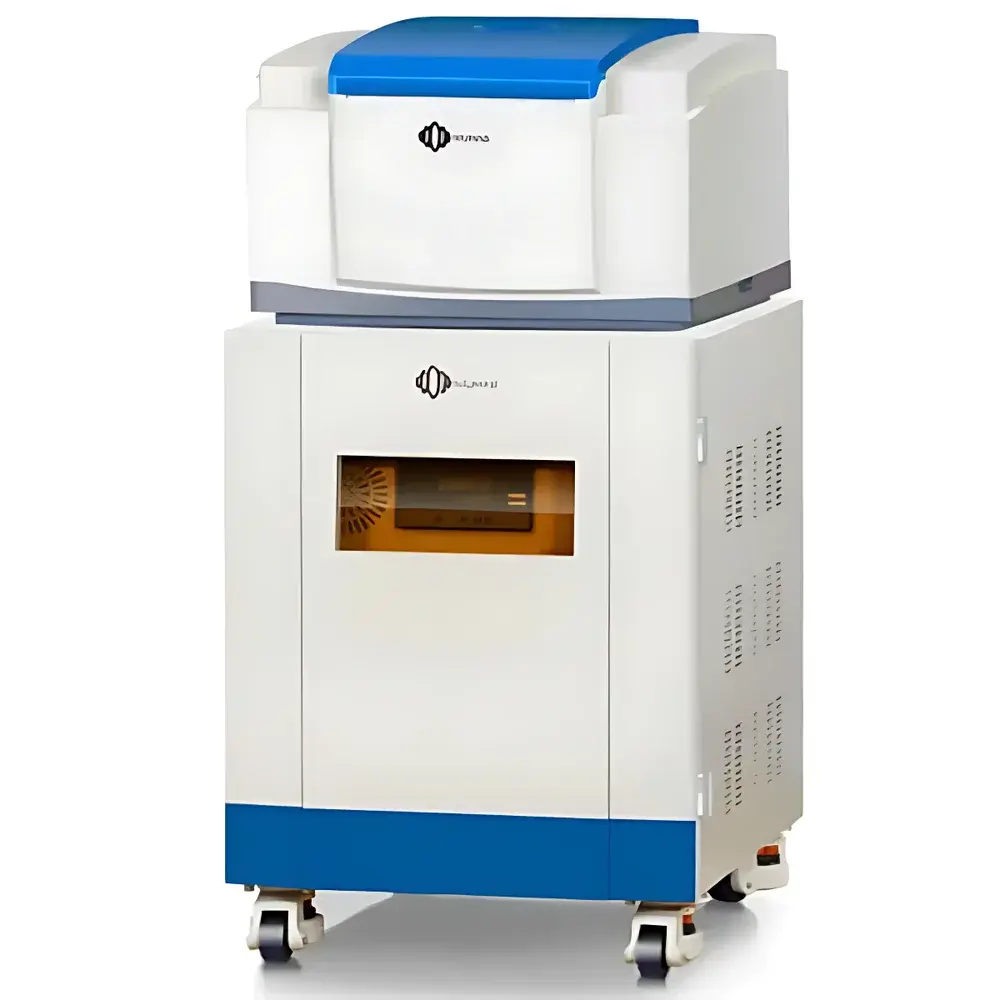
NIUMAG PQ001 Low-Field Nuclear Magnetic Resonance Relaxometry Analyzer for Contrast Agent T₁/T₂ Relaxivity Testing
| Brand | NIUMAG |
|---|---|
| Origin | Jiangsu, China |
| Manufacturer Type | Authorized Distributor |
| Country of Origin | China |
| Model | PQ001 |
| Pricing | Available Upon Request |
Overview
The NIUMAG PQ001 is a dedicated low-field nuclear magnetic resonance (NMR) relaxometer engineered for precise, non-invasive quantification of longitudinal (T₁) and transverse (T₂) relaxation times in magnetic resonance contrast agents and biological samples. Unlike clinical MRI systems that infer relaxivity indirectly from image intensity differences—introducing variability due to sequence parameters, field inhomogeneity, and post-processing artifacts—the PQ001 performs direct, quantitative relaxometry using standardized pulse sequences (e.g., inversion recovery for T₁ and Carr–Purcell–Meiboom–Gill or spin-echo trains for T₂). Operating at a stable 0.5 T permanent magnet field, the system delivers high reproducibility for relaxivity (r₁, r₂) determination under controlled temperature and sample positioning conditions. Its compact, benchtop architecture supports routine use in academic laboratories, pharmaceutical R&D departments, and preclinical imaging core facilities where rapid, traceable, and method-validated relaxivity assessment is required for agent development, quality control, and regulatory documentation.
Key Features
- 0.5 T permanent magnet with long-term field stability (< ±0.01% over 24 h), enabling consistent T₁/T₂ measurements without cryogen dependency
- Optimized solenoid-type RF transmit/receive coil assembly offering uniform B₁ excitation and high signal-to-noise ratio (SNR) across standard 10–15 mm OD NMR tubes
- Integrated low-noise preamplifier mounted directly within the receive coil housing, minimizing cable-induced signal degradation and thermal noise
- Fully digital spectrometer platform built on FPGA-based pulse generation and high-speed ADC acquisition, supporting flexible sequence programming and real-time data streaming
- Delphi-based control software with guided workflow modules for contrast agent relaxivity testing—including automated T₁/T₂ fitting, concentration-dependent r₁/r₂ calculation, and batch processing of multi-sample datasets
Sample Compatibility & Compliance
The PQ001 accommodates aqueous suspensions and solutions of paramagnetic (e.g., Gd³⁺-, Mn²⁺-based chelates) and superparamagnetic (e.g., iron oxide nanoparticle) contrast agents, as well as ex vivo biological specimens including homogenized tumor tissues, isolated cell lysates, and centrifuged cellular supernatants. Sample volumes range from 0.3 mL to 2.0 mL in standard cylindrical glass NMR tubes. The system supports compliance with method validation requirements outlined in ISO/IEC 17025 for testing laboratories and aligns with analytical principles referenced in USP (Relaxivity Determination of MRI Contrast Agents) and ICH Q5C (Quality of Biotechnological Products). While not FDA-cleared as a medical device, its measurement outputs are suitable for GLP-compliant preclinical studies and regulatory submission dossiers.
Software & Data Management
The proprietary software provides intuitive, step-by-step protocols for T₁ and T₂ mapping, including automatic curve fitting using mono- or bi-exponential decay models, outlier rejection, and uncertainty estimation based on residual analysis. All raw FID/echo train data, processed relaxation curves, and metadata (pulse sequence parameters, temperature, sample ID) are stored in vendor-neutral HDF5 format. Audit trails record user actions, parameter changes, and calibration events—supporting 21 CFR Part 11 readiness when deployed with appropriate IT infrastructure and access controls. Export options include CSV, Excel, and image-ready PNG/PDF for inclusion in manuscripts, SOPs, and regulatory reports.
Applications
- Quantitative relaxivity profiling (r₁, r₂, r₂/r₁ ratio) of novel contrast agent candidates during lead optimization
- Batch-to-batch consistency testing for Gd-DTPA, Fe₃O₄ nanoparticles, MnCl₂ formulations, and other MR-active compounds
- Stability assessment under physiological conditions (e.g., serum incubation, pH variation, chelate dissociation kinetics)
- Ex vivo relaxometry of tumor xenograft tissues to correlate relaxivity changes with histopathological features
- Cellular uptake quantification via T₂ shortening in labeled macrophages or stem cells
- Method development for relaxivity standardization across multi-center preclinical imaging consortia
FAQ
What is the minimum detectable concentration for Gd-based contrast agents?
Detection sensitivity depends on agent relaxivity and measurement time; typical limits of quantitation (LOQ) range from 0.01–0.05 mM for high-r₁ agents (e.g., Gd-DOTA) with 32–64 averages.
Can the PQ001 measure both T₁ and T₂ in a single run?
No—T₁ and T₂ require separate pulse sequences and acquisition setups; however, automated switching between protocols minimizes operator intervention.
Is temperature control available?
Yes, an optional Peltier-based sample temperature module maintains setpoints from 10 °C to 45 °C with ±0.3 °C stability.
Does the system support custom pulse sequence development?
The FPGA-based spectrometer allows advanced users to implement custom sequences via vendor-provided SDK and MATLAB interface.
How is data integrity ensured during long-term studies?
All acquisitions include embedded timestamps, hardware checksums, and configurable auto-backup to network drives—fully traceable per ALCOA+ principles.




