
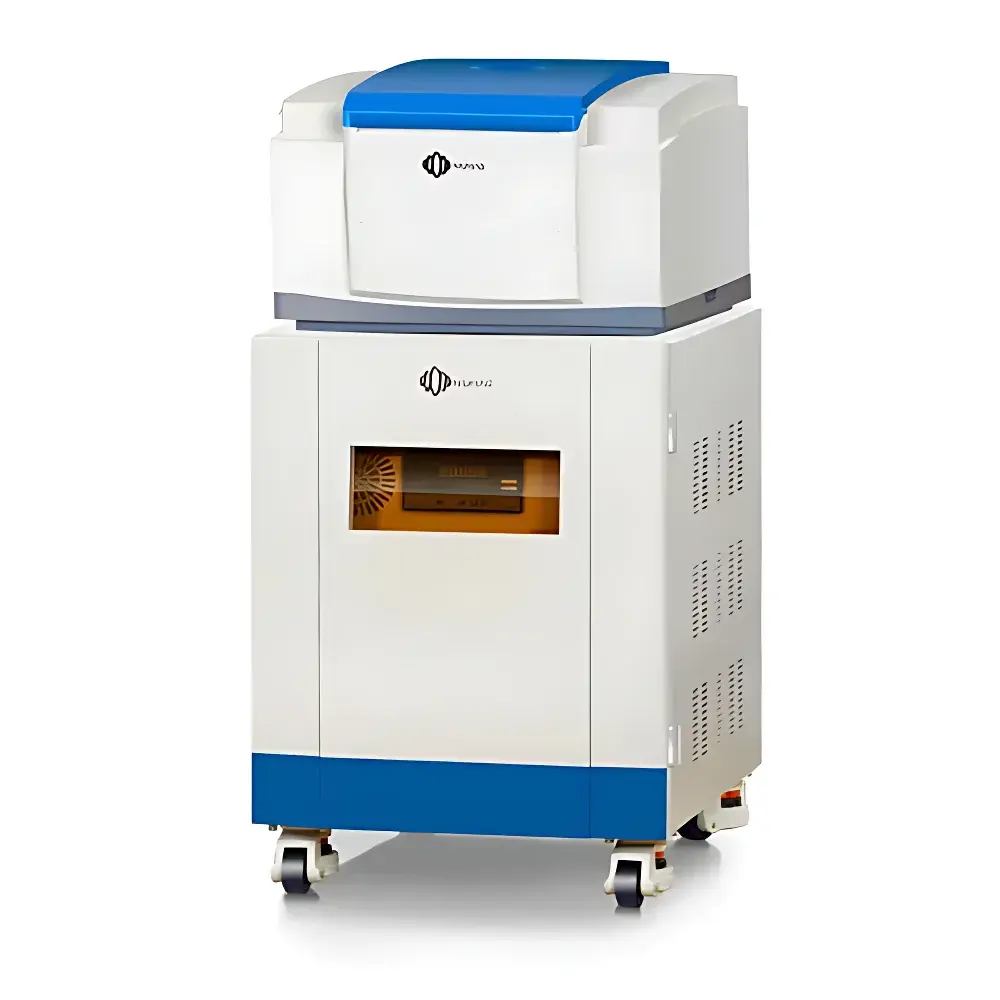
NIUMAG PQ001 Nuclear Magnetic Resonance-Based Specific Surface Area and Particle Surface Characterization Analyzer
| Brand | NIUMAG |
|---|---|
| Origin | Shanghai, China |
| Model | PQ001 |
| Instrument Type | Specific Surface Area and Pore Size Analyzer |
| Measurement Principle | Low-Field NMR Relaxometry (Dynamic/Static Adsorption Equilibrium Method) |
| Number of Analysis Stations | 5 |
| Minimum Detectable Surface Area | >0.1 m²/g |
| Pressure Range | Ambient Pressure |
| Theoretical Basis | Proton Spin–Lattice (T₁) and Spin–Spin (T₂) Relaxation Response to Surface-Bound vs. Bulk Fluid Phases |
Overview
The NIUMAG PQ001 Nuclear Magnetic Resonance-Based Specific Surface Area and Particle Surface Characterization Analyzer is a dedicated benchtop instrument engineered for rapid, non-destructive quantification of particle surface properties in colloidal and concentrated suspension systems. Unlike conventional gas adsorption (BET) or mercury intrusion porosimetry methods—both requiring vacuum conditions, sample drying, and inert gas handling—the PQ001 leverages low-field pulsed nuclear magnetic resonance (NMR) relaxometry to probe the physical state of hydrogen-bearing fluids (e.g., water, alcohols, hydrocarbons) at solid–liquid interfaces. It measures the differential relaxation behavior (T₁ and T₂) of protons in surface-bound fluid layers versus bulk-phase fluid, enabling direct calculation of specific surface area, particle dispersion stability, and interfacial affinity without sample dehydration, degassing, or chemical derivatization. Designed for routine QC and R&D environments—including battery slurry labs, CMP formulation centers, and pharmaceutical dispersion development suites—the PQ001 delivers reproducible surface characterization under ambient pressure and temperature, with no consumables or hazardous gases required.
Key Features
- Five independent analysis stations enable parallel testing of multiple samples or replicates, significantly improving throughput in high-volume quality control workflows.
- Low-field NMR platform (operating at 0.5 T) ensures robust signal-to-noise performance for aqueous and organic suspensions, with optimized pulse sequences for fast T₁/T₂ mapping (typical acquisition time ≤ 180 seconds per sample).
- Integrated temperature-controlled sample compartment (±0.1 °C stability) supports studies of thermal effects on dispersion stability and surface hydration dynamics.
- Modular hardware architecture allows field-upgradable RF coils and gradient options for future expansion into diffusion-weighted or spatially resolved surface mapping modes.
- Self-calibrating system with built-in reference standards eliminates daily recalibration; NMR signal drift is monitored continuously via internal lock channel.
Sample Compatibility & Compliance
The PQ001 accommodates opaque, highly viscous, and optically dense suspensions—including battery cathode slurries (solid loading >60 wt%), CMP slurries, ceramic pastes, carbon nanotube dispersions, and pharmaceutical nanosuspensions—without dilution or filtration. Its NMR-based methodology complies with ASTM E3127–21 (Standard Guide for NMR Characterization of Nanomaterials) and supports GLP-compliant data integrity through audit-trail-enabled software (21 CFR Part 11 ready). All measurement protocols are fully documented and exportable as PDF reports with raw FID data, relaxation decay curves, and parameter fitting metadata.
Software & Data Management
The proprietary PQ-Analyzer Suite provides an intuitive, role-based interface with three operational modes: Quick Test (single-click surface area), Stability Mode (time-resolved T₂ distribution tracking over hours/days), and Affinity Mapping (multi-solvent comparative analysis). Data files conform to HDF5 format for long-term archival and third-party analysis (e.g., MATLAB, Python). Software includes automated outlier detection, batch report generation, and secure user authentication with permission levels (Operator, Supervisor, Administrator). All processing algorithms—including multi-exponential T₂ inversion and surface-area calibration models—are transparent, traceable, and configurable per ISO/IEC 17025 validation requirements.
Applications
- Battery Materials: Quantifying carbon black or SiO₂ surface area changes during slurry aging; correlating T₂ shortening with binder–particle interaction strength.
- Electronics Manufacturing: Optimizing dispersant dosage in Cu/CMP slurries by monitoring dispersion half-life via real-time T₂ distribution shifts.
- Pharmaceutical Development: Assessing API wettability and excipient compatibility through solvent exchange experiments (e.g., water → ethanol transitions).
- Nanomaterial R&D: Tracking graphene oxide reduction kinetics via progressive loss of surface-bound water signal; evaluating surfactant desorption thresholds.
- Ceramic Processing: Validating wet-milling efficiency in alumina/zirconia slips by correlating median T₂ with particle size distribution from laser diffraction.
FAQ
Does the PQ001 require sample drying or vacuum degassing prior to analysis?
No. The instrument operates exclusively on liquid-phase NMR signals and is designed for as-received suspensions.
Can it differentiate between chemisorbed and physisorbed solvent layers?
Yes—through combined T₁/T₂ contrast analysis and variable-temperature relaxation profiling, enabling semi-quantitative assignment of binding energy regimes.
Is method transfer possible between different PQ001 units?
Yes. All instruments ship with factory-matched RF coil calibration profiles and standardized pulse sequence libraries, ensuring <±2% inter-unit repeatability for identical samples.
What sample volume is required per analysis station?
0.8–1.2 mL of homogeneous suspension, loaded into standard 10 mm OD NMR tubes.
Does the system support IQ/OQ/PQ documentation packages for regulated industries?
Yes—NIUMAG provides GxP-compliant qualification templates, including installation verification (IQ), operational verification (OQ), and performance verification (PQ) protocols aligned with USP and ISO/IEC 17025.



