
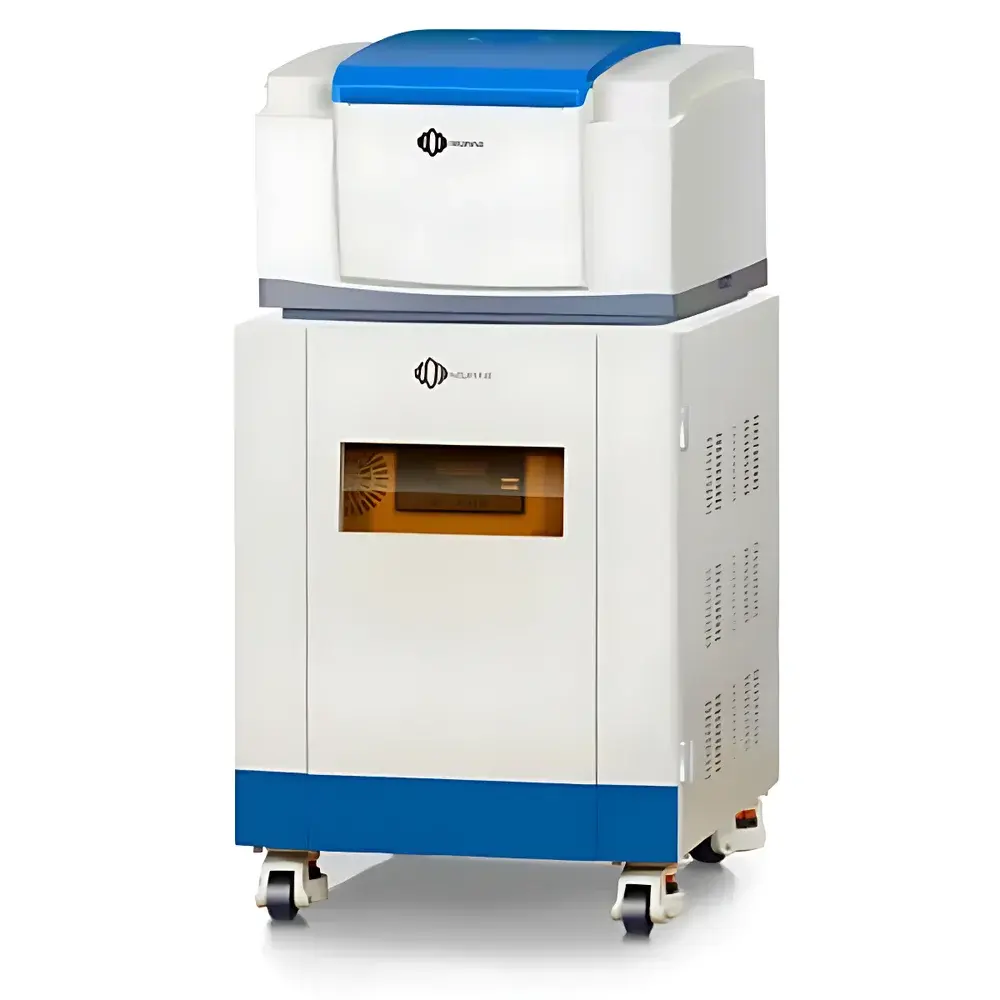
NIUMAG PQ001 Prussian Blue Analogue Crystalline Water Analyzer
| Brand | NIUMAG |
|---|---|
| Origin | Jiangsu, China |
| Manufacturer Type | Authorized Distributor |
| Origin Category | Domestic (China) |
| Model | PQ001 Prussian Blue Analogue Crystalline Water Analyzer |
| Pricing | Upon Request |
| Magnetic Field Strength | 0.5 T |
| Probe Coil Diameter | 10 mm |
| Sample Requirement | Ferromagnetic Content < 5% |
| Measurement Principle | Low-Field Nuclear Magnetic Resonance (LF-NMR) targeting hydrogen signal from crystalline water |
| Analysis Time | ≤ 2 minutes per sample |
Overview
The NIUMAG PQ001 Prussian Blue Analogue Crystalline Water Analyzer is a purpose-built low-field nuclear magnetic resonance (LF-NMR) instrument engineered for rapid, non-invasive quantification of crystalline water content in Prussian blue analogue (PBA) cathode materials used in sodium-ion batteries. Unlike conventional thermal or gravimetric methods—which risk dehydration artifacts, require calibration standards, and lack spatial or temporal resolution—the PQ001 exploits the intrinsic NMR sensitivity of hydrogen nuclei (¹H) in structurally bound water molecules. Crucially, PBAs contain no intrinsic hydrogen atoms in their lattice framework; therefore, all detectable ¹H NMR signal originates exclusively from crystalline water (H₂O), enabling unambiguous, matrix-independent quantification without chemical derivatization or sample digestion. The system operates at a stable, homogeneous 0.5 T permanent magnet field, optimized to maximize signal-to-noise ratio for water protons while maintaining compact footprint and operational robustness in QC laboratories and R&D environments.
Key Features
- Low-field NMR platform with 0.5 T permanent magnet—designed for long-term field stability and minimal maintenance
- 10 mm diameter radiofrequency probe coil—optimized for small-volume PBA powder samples (typical mass: 100–300 mg)
- Full automation of pulse sequence execution, signal acquisition, and T₂ decay fitting—reducing operator dependency
- Two-minute analysis cycle time—from sample loading to quantitative water content report (wt%)
- Non-destructive measurement—preserves sample integrity for downstream electrochemical testing or structural characterization
- In situ compatibility—enables monitoring of hydration/dehydration kinetics under controlled temperature or humidity conditions (with optional environmental chamber integration)
- Calibration-free quantification—based on proton density normalization against reference water standards traceable to NIST SRM 2890
Sample Compatibility & Compliance
The PQ001 is validated for use with Prussian blue analogues including but not limited to Na₂MnFe(CN)₆, Na₂CoFe(CN)₆, and K₂NiFe(CN)₆. Samples must exhibit ferromagnetic impurity content below 5 wt%, as higher concentrations distort local magnetic homogeneity and degrade T₂ relaxation fidelity. The analyzer complies with IEC 61000-6-3 (EMC emission standards) and meets mechanical safety requirements per ISO 13857. While not certified for GMP production environments, its data acquisition architecture supports audit-ready operation: all raw FID data, processing parameters, and user metadata are timestamped and stored in immutable binary format (NIUMAG .nmd extension), satisfying foundational ALCOA+ principles for research-grade data integrity. Optional software modules enable partial alignment with FDA 21 CFR Part 11 requirements via electronic signature logging and role-based access control.
Software & Data Management
The PQ001 runs NIUMAG’s proprietary NMIQ v4.2 software suite, featuring a modular GUI with dedicated workflows for calibration, batch analysis, and kinetic modeling. Raw time-domain data undergo mono- or bi-exponential T₂ inversion using non-negative least-squares (NNLS) algorithms, with automatic baseline correction and outlier rejection. Quantitative results are exported in CSV, Excel, and PDF formats—with embedded metadata including instrument ID, operator name, date/time stamp, and measurement parameters. All data files are stored in a hierarchical project-based directory structure with SHA-256 checksum validation. Remote monitoring and data backup are supported via secure SFTP or cloud-sync (AWS S3-compatible) configurations—enabling centralized data governance across multi-site battery development programs.
Applications
- Quantitative screening of crystalline water content across PBA synthesis batches to correlate hydration state with electrochemical performance metrics (e.g., initial Coulombic efficiency, voltage hysteresis, capacity retention)
- Accelerated aging studies—tracking water loss/gain during thermal stress (40–85 °C) or ambient storage to inform packaging and handling protocols
- Process optimization support—evaluating impact of washing, drying temperature, and atmosphere (Ar vs. air) on final hydrate stoichiometry
- Reference method validation—benchmarking against Karl Fischer titration or thermogravimetric analysis (TGA) under ISO 8587 and ASTM E2550 guidelines
- Academic and industrial R&D—supporting DOE-funded sodium-ion battery initiatives requiring high-throughput, reproducible hydration metrology
FAQ
What physical principle enables selective detection of crystalline water in PBAs?
The PQ001 relies on low-field ¹H NMR: since PBAs contain no endogenous hydrogen, all detected NMR signal arises solely from H₂O protons, allowing direct, stoichiometric quantification without spectral overlap or interference.
Can the PQ001 measure bound vs. adsorbed water separately?
Yes—via T₂ relaxation time distribution analysis: crystalline water typically exhibits longer T₂ (>10 ms) than surface-adsorbed water (<2 ms), enabling deconvolution when sample preparation and instrument SNR permit.
Is method validation documentation available?
NIUMAG provides a comprehensive Validation Guide (PQ001-VG-2024) covering specificity, linearity (0.1–15 wt%), precision (RSD < 2.1% intra-day), and robustness per ICH Q2(R2) principles.
Does the system require liquid nitrogen or cryogens?
No—the 0.5 T permanent magnet operates at ambient temperature with zero cryogenic consumption, eliminating infrastructure complexity and operational cost.
How is data traceability ensured for regulatory submissions?
All acquisitions generate immutable audit logs; optional 21 CFR Part 11 module adds electronic signatures, change history tracking, and locked e-record archiving compliant with GLP/GMP-aligned workflows.




