
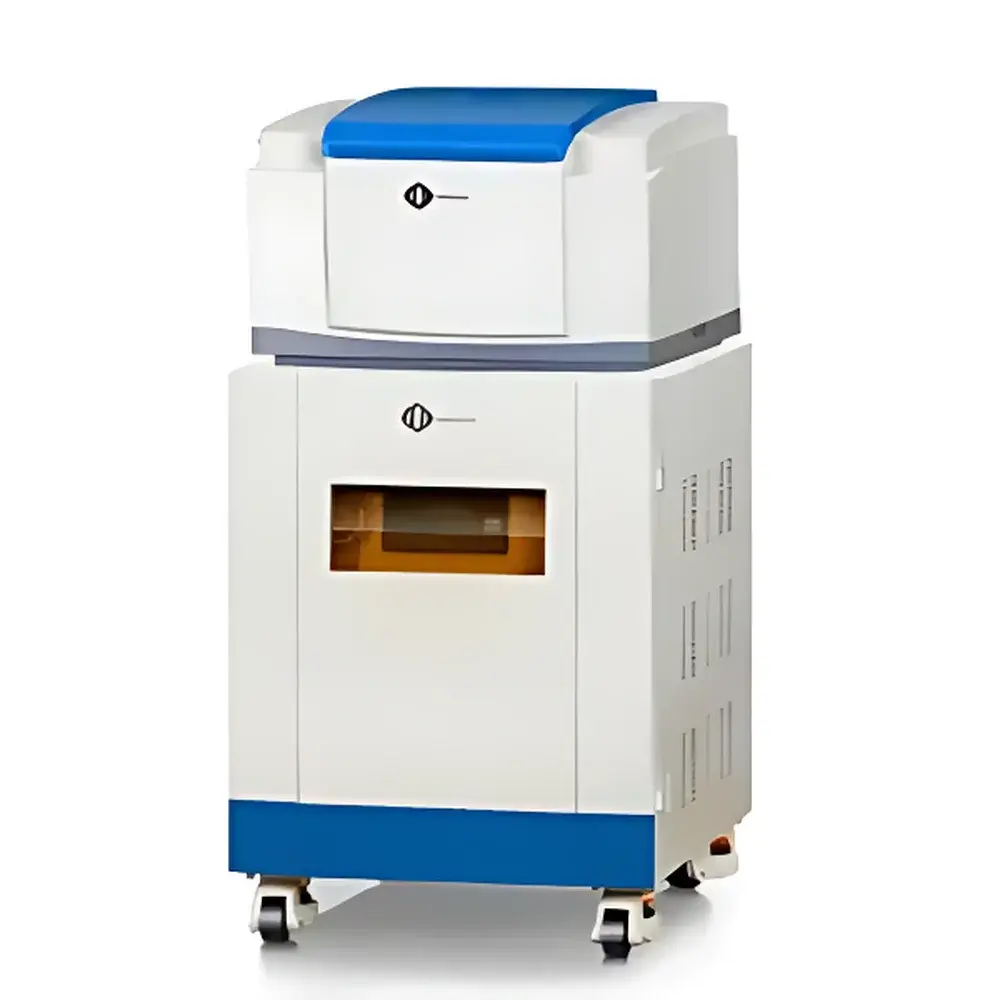
NIUMAG PQ001GU Petroleum Hydrogen Content Analyzer
| Brand | NIUMAG |
|---|---|
| Origin | Jiangsu, China |
| Manufacturer Type | Authorized Distributor |
| Product Origin | Domestic (China) |
| Model | PQ001GU |
| Pricing | Available Upon Request |
| Magnet Type | Permanent Magnet |
| Magnetic Field Strength | 0.5 ± 0.08 T |
| Probe Coil Diameter | 18 mm |
Overview
The NIUMAG PQ001GU Petroleum Hydrogen Content Analyzer is a benchtop nuclear magnetic resonance (NMR)-based instrument engineered for rapid, non-destructive quantification of total hydrogen content in hydrocarbon feedstocks and process streams associated with catalytic hydrocracking, hydrotreating, and refinery hydrogen management workflows. It operates on the fundamental principle of 1H NMR signal intensity detection: the integrated area under the free induction decay (FID) curve is directly proportional to the number of hydrogen nuclei present in the active sample volume. Unlike combustion-based or gas chromatographic methods—which require sample derivatization, calibration against reference standards per matrix, or destructive oxidation—the PQ001GU leverages intrinsic proton density as a stable, matrix-independent physical property. This enables direct correlation between raw NMR response and hydrogen mass fraction (wt%), provided calibration is performed using traceable reference materials with certified hydrogen content. The system is optimized for routine use in refinery QC laboratories, pilot plant monitoring, and catalyst evaluation units where real-time hydrogen stoichiometry informs process optimization, sulfur/nitrogen removal efficiency, and coke suppression strategies.
Key Features
- Permanent magnet architecture delivering stable 0.5 ± 0.08 T field—no cryogens, no power consumption for field generation, minimal thermal drift.
- 18 mm diameter RF probe coil designed for high sensitivity and uniform excitation across typical petroleum liquid samples (e.g., vacuum gas oil, hydroprocessed naphtha, coker distillates).
- Single-pulse spin-echo acquisition sequence with user-adjustable repetition time (TR) and echo time (TE), enabling robust signal averaging and suppression of molecular mobility effects.
- Integrated temperature-stabilized sample chamber (±0.5 °C control) to minimize viscosity-induced relaxation time variations during sequential measurements.
- Pre-configured calibration protocols compliant with ASTM D7171 (Standard Test Method for Hydrogen Content of Middle Distillate Fuels by Low-Resolution NMR Spectroscopy) and ISO 13700 (Petroleum products — Determination of hydrogen content — Low-resolution NMR method).
- Touchscreen interface with embedded firmware; no external PC required for basic operation, data acquisition, or report generation.
Sample Compatibility & Compliance
The PQ001GU accepts liquid hydrocarbon samples in standard 10–15 mL glass NMR tubes (OD 18 mm). It accommodates viscous feeds (up to 500 cSt at 40 °C) without pre-dilution, provided sample homogeneity is ensured via gentle agitation prior to loading. Solid or semi-solid residues (e.g., spent catalyst slurries) are excluded due to restricted RF penetration and signal attenuation. All measurement procedures adhere to GLP principles: audit trails record operator ID, timestamp, calibration status, and raw FID parameters. Data export supports CSV and PDF formats compatible with LIMS integration. Instrument design conforms to IEC 61010-1 (Safety Requirements for Electrical Equipment for Measurement, Control, and Laboratory Use) and electromagnetic compatibility (EMC) directives EN 61326-1.
Software & Data Management
The embedded analysis suite includes automated baseline correction, exponential line-broadening compensation, and peak integration using adaptive thresholding algorithms. Calibration curves support multi-point linear regression with R² ≥ 0.9995 across 0.5–14.5 wt% H range. Each measurement session logs full metadata—including pulse sequence parameters, signal-to-noise ratio (SNR), T2 distribution width, and residual water peak amplitude—for traceability. Optional software module enables FDA 21 CFR Part 11 compliance: electronic signatures, role-based access control, and immutable audit logs with tamper-evident hashing. Raw FID files are stored in vendor-neutral format (NMR-Data Exchange Standard v2.0) for third-party spectral reprocessing.
Applications
- Real-time monitoring of hydrogen uptake during fixed-bed hydrocracking trials to assess catalyst activity decay.
- Verification of hydrogen saturation levels in hydrotreated diesel to ensure compliance with ultra-low-sulfur diesel (ULSD) specifications (ASTM D975, EN 590).
- Quantitative assessment of dehydrogenation side reactions in fluid catalytic cracking (FCC) feed pretreatment units.
- Batch-to-batch consistency verification of synthetic crude blends prior to upgrading.
- Supporting R&D studies on novel bifunctional catalysts by correlating hydrogen content shifts with nitrogen/oxygen heteroatom removal kinetics.
FAQ
What sample volume is required for a valid measurement?
A minimum of 8 mL of homogeneous liquid sample is recommended to ensure complete filling of the sensitive volume within the 18 mm probe coil.
Can the instrument differentiate between aliphatic and aromatic hydrogen?
No—the PQ001GU reports total hydrogen content only; it does not resolve chemical shift information. For speciation, high-field NMR or FTIR is required.
Is daily recalibration necessary?
Calibration stability exceeds 72 hours under constant ambient conditions; verification using a check standard is recommended before each analytical batch.
Does the instrument require shielding or special installation?
No ferromagnetic shielding is needed; however, placement away from strong AC magnetic sources (e.g., transformers, motors) is advised to maintain spectral fidelity.
How is measurement uncertainty determined?
Typical repeatability (within-run) is ±0.08 wt% H at 95% confidence; reproducibility (between-laboratory) follows ISO 5725-2 guidelines and is validated annually using NIST SRM 2723b (hydrocarbon mixture standard).





