
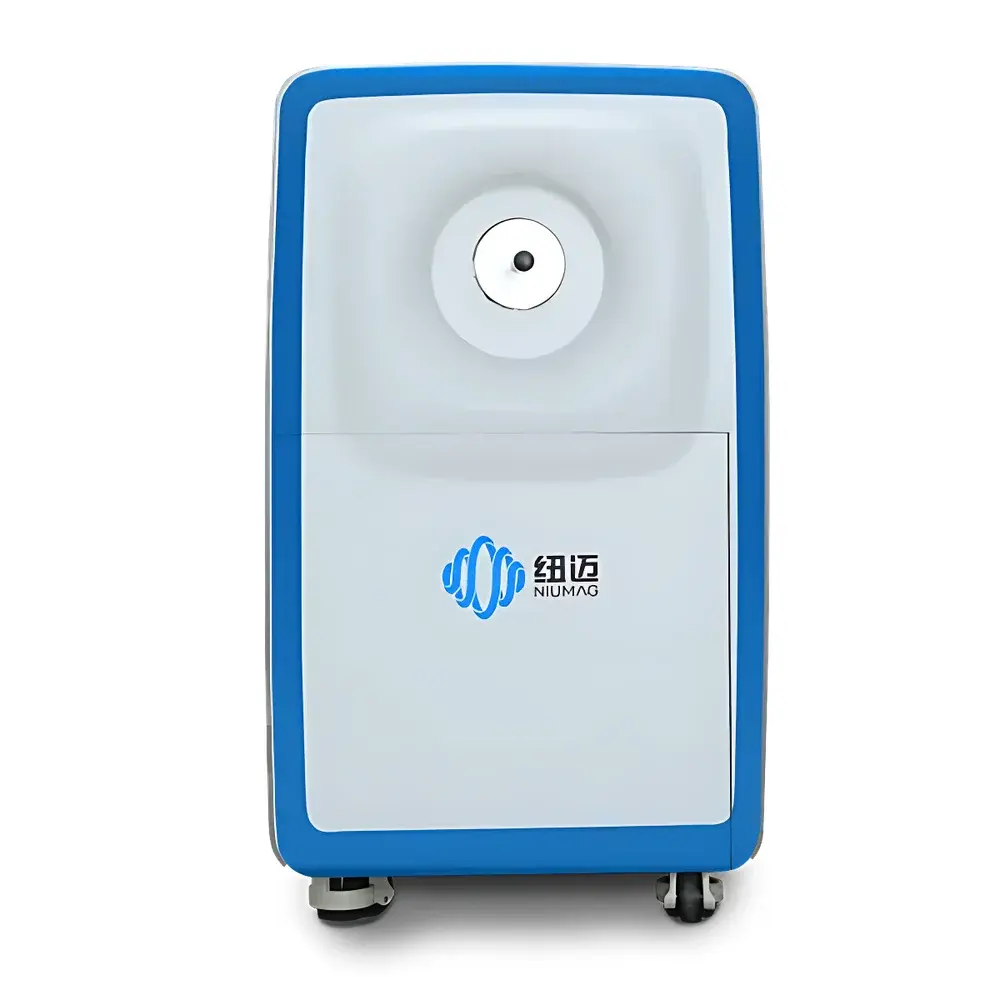
NIUMAG QMR06-090H-PRO Low-Field Nuclear Magnetic Resonance Analyzer for Live Small Animal Body Composition
| Brand | NIUMAG |
|---|---|
| Origin | Jiangsu, China |
| Model | QMR06-090H-PRO-5 |
| Instrument Type | Low-Field NMR Analyzer |
| Sample Type | Solid-Liquid Dual Mode (Live Small Animals & Excised Tissues) |
| Magnetic Field Strength | 0.15 ± 0.015 T |
| Magnet Uniformity | ≤300 ppm |
| Sample Weight Range | 10–800 g (live rodents), 0.1–6 g (excised tissues) |
| Measurement Time | <80 s per acquisition |
| Magnet Type | Permanent Magnet |
Overview
The NIUMAG QMR06-090H-PRO is a dedicated low-field nuclear magnetic resonance (LF-NMR) analyzer engineered for non-invasive, quantitative in vivo body composition analysis of small laboratory animals—primarily mice and rats—under conscious, unrestrained conditions. Unlike high-field MRI systems requiring anesthesia and complex infrastructure, this instrument leverages time-domain NMR (TD-NMR) principles based on spin-echo relaxation measurements (e.g., CPMG sequences) to resolve proton signal decay kinetics from fat, lean tissue, and free water compartments. The 0.15 T permanent magnet provides stable, homogeneous field conditions (≤300 ppm over DSV), enabling reproducible T₂ relaxation profiling without cryogens or RF shielding rooms. Its core application lies in longitudinal metabolic phenotyping: quantifying adipose mass, lean body mass, and total body water with high inter-session repeatability—critical for preclinical studies in obesity, diabetes, sarcopenia, nutritional intervention, and pharmacodynamic evaluation of metabolic therapeutics.
Key Features
- Non-invasive & Conscious-State Operation: Eliminates anesthesia-induced physiological artifacts; enables repeated measurements on the same animal across days/weeks with minimal stress.
- Rapid Quantitative Analysis: Full-body composition results—including fat mass, lean mass, and free water content—delivered in under 80 seconds per acquisition, supporting high-throughput screening.
- Flexible Sample Compatibility: Accommodates live rodents (10–800 g) and excised tissue samples (0.1–6 g), facilitating correlative ex vivo validation and organ-specific analysis.
- Modular Architecture: Designed for future expansion to 3D NMR imaging (up to 512 × 512 × 128 matrix resolution) via optional gradient coil and reconstruction software modules.
- Robust Permanent Magnet System: Zero helium consumption, minimal maintenance, and stable field output—ideal for core facilities and resource-constrained laboratories.
Sample Compatibility & Compliance
The QMR06-090H-PRO supports standardized protocols for ISO/IEC 17025-aligned preclinical research environments. While not an imaging device per se, its TD-NMR methodology complies with ASTM E2857 (Standard Practice for Quantitative Analysis by Low-Field NMR) and aligns with NIH guidelines for longitudinal animal monitoring. Data acquisition adheres to GLP-relevant traceability standards: each measurement includes timestamped metadata (operator ID, sample ID, pulse sequence parameters, temperature log), and raw FID/echo train data are stored in vendor-neutral formats (e.g., ASCII, HDF5). The system is compatible with standard IACUC-approved restraint tubes and positioning fixtures, ensuring consistent anatomical orientation across sessions without physical compression artifacts.
Software & Data Management
The proprietary NMReDATA™ software suite provides full control over pulse sequence selection (CPMG, inversion recovery, diffusion-weighted variants), real-time signal visualization, and automated multi-component T₂ distribution fitting using non-negative least squares (NNLS) algorithms. All processed outputs—fat fraction (%), lean mass (g), total body water (mL), and T₂ relaxation times—are exportable to CSV, Excel, or MATLAB-compatible formats. Audit trail functionality logs all user actions, parameter modifications, and calibration events, satisfying FDA 21 CFR Part 11 requirements for electronic records when configured with role-based access control and digital signature modules. Remote data synchronization and cloud backup options are available through optional enterprise licensing.
Applications
- Longitudinal monitoring of diet-induced obesity models and anti-obesity drug efficacy
- Assessment of muscle wasting in cancer cachexia or aging-related sarcopenia
- Quantification of hepatic steatosis and ectopic fat deposition
- Evaluation of fluid balance shifts in renal disease or heart failure models
- Validation of molecular imaging biomarkers (e.g., PET/MRI correlates)
- Nutritional intervention studies tracking macronutrient partitioning dynamics
FAQ
Is anesthesia required for measurement?
No. The system is designed for conscious, awake animal scanning using acoustically quiet pulse sequences and ergonomic restraint tubes.
Can the instrument differentiate between subcutaneous and visceral fat?
Not directly—this is a whole-body composition analyzer. Spatial fat localization requires optional 3D NMR imaging capability.
What calibration standards are used?
Factory-calibrated against NIST-traceable reference phantoms containing known triglyceride/water ratios; routine verification uses internal water/fat reference vials.
Does the system support regulatory submission data packages?
Yes—when deployed with Part 11-compliant configuration, raw data, processing scripts, and audit logs meet documentation requirements for IND-enabling toxicology and PK/PD studies.
Is service support available outside mainland China?
NIUMAG provides remote diagnostics globally; on-site engineering support is currently available in APAC regions via authorized partners, with documentation and training delivered in English.



