
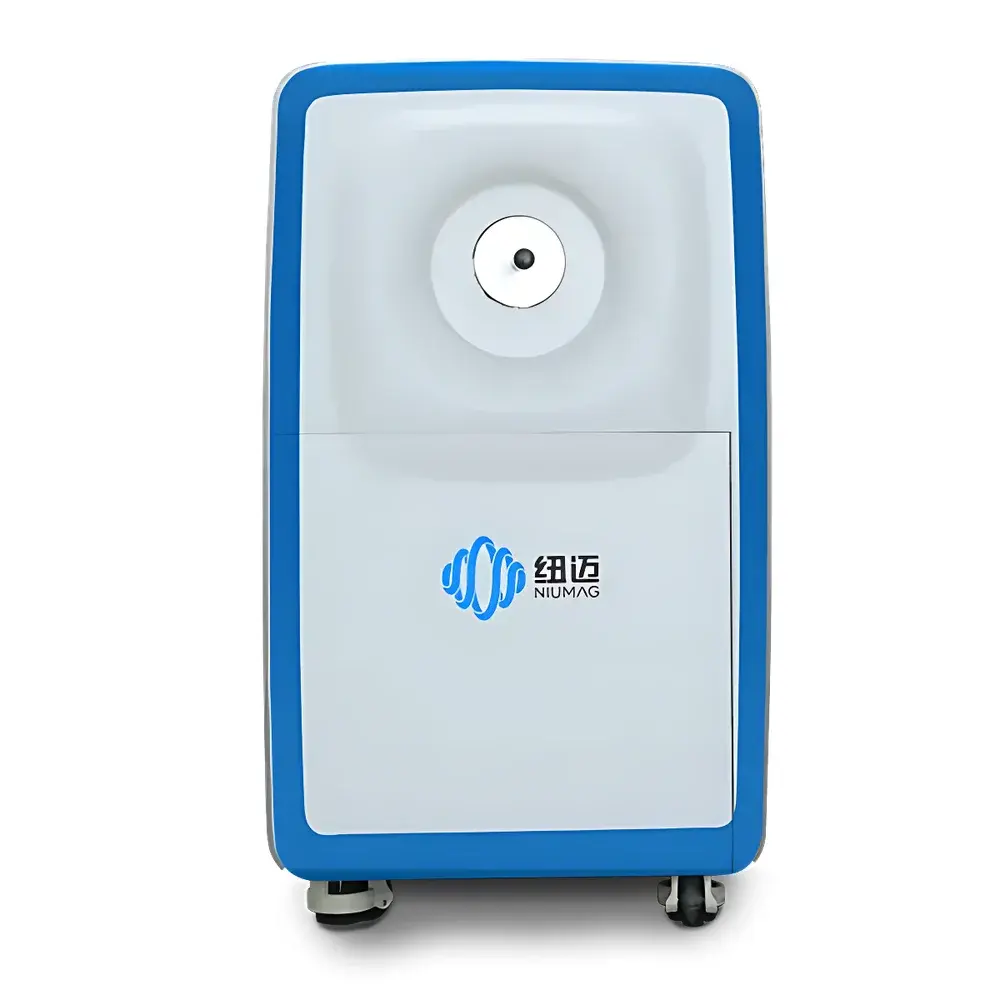
NIUMAG QMR06-090H-PRO Low-Field Nuclear Magnetic Resonance Analyzer for In Vivo Animal Body Composition Quantification
| Brand | NIUMAG |
|---|---|
| Origin | Jiangsu, China |
| Instrument Type | Low-Field NMR Analyzer |
| Magnetic Field Strength | 0.15 ± 0.015 T |
| Magnet Uniformity | ≤300 ppm |
| Sample Capacity | 0.1–6 g (ex vivo tissue) or 10–800 g (live small rodents) |
| Measurement Mode | Solid-Liquid Dual-State NMR Relaxometry |
| Acquisition Time | ≤80 s per quantitative assay |
Overview
The NIUMAG QMR06-090H-PRO is a benchtop low-field nuclear magnetic resonance (LF-NMR) analyzer engineered for non-invasive, quantitative assessment of body composition in live small animal models and excised biological tissues. Unlike destructive gravimetric or solvent-extraction methods, this system leverages the differential transverse relaxation times (T2) of proton populations in adipose tissue, lean mass, and free water to discriminate and quantify fat, lean, and fluid fractions in situ—without anesthesia, radiation, or sample preparation. Operating at a stable 0.15 T permanent magnet field, it delivers high reproducibility (<2% CV across repeated measurements) under ambient laboratory conditions, making it suitable for longitudinal metabolic phenotyping in preclinical research settings compliant with OECD Test Guidelines 407 and 408.
Key Features
- Non-invasive in vivo analysis: Enables repeated measurements on conscious, unrestrained rodents—eliminating confounding effects of anesthesia, fasting, or surgical intervention.
- Multi-compartment quantification: Simultaneously resolves fat mass, lean body mass, and total body water via multi-exponential T2 decay fitting using constrained non-linear least-squares algorithms.
- Optimized hardware architecture: Integrated temperature-controlled RF probe (±0.1 °C stability), shielded gradient coil assembly, and digital signal processing unit ensure robust signal-to-noise ratio (SNR > 45 dB at 100 mg fat standard).
- Modular expandability: Supports optional MRI upgrade path—including 3D spin-echo imaging (512 × 512 × 128 matrix), multi-angle positioning stage, and respiratory gating interface for motion-insensitive acquisition.
- Regulatory-ready software: Built-in 21 CFR Part 11 compliance modules including role-based access control, electronic signatures, audit trail logging, and raw data immutability verification.
Sample Compatibility & Compliance
The QMR06-090H-PRO accommodates a broad range of biological specimens: live C57BL/6 mice (18–35 g), Sprague-Dawley rats (150–300 g), New Zealand white rabbits (≤2 kg), and excised tissues including liver, skeletal muscle, adipose depots (epididymal, inguinal, perirenal), and tumor xenografts. All measurement protocols adhere to ISO/IEC 17025:2017 requirements for testing laboratories, with instrument performance validated against NIST-traceable reference standards (SRM 1921b). System calibration follows ASTM E2874-22 for LF-NMR relaxometry accuracy verification. Full documentation packages—including IQ/OQ/PQ protocols, SOP templates, and validation reports—are provided to support GLP and GCP study submissions.
Software & Data Management
Control and analysis are executed through NIUMAG’s proprietary MesoMR Studio v5.2, a Windows-based platform featuring dual-mode operation: automated batch mode for high-throughput screening and interactive mode for method development. The software includes FDA-validated algorithms for T2 distribution deconvolution, compartmental volume calculation, and longitudinal trend visualization. Raw FID data is stored in vendor-neutral HDF5 format with embedded metadata (timestamp, operator ID, pulse sequence parameters, environmental logs). Export options include CSV, Excel, and DICOM-compliant outputs for integration with ELN systems (e.g., LabArchives, Benchling) and statistical platforms (R, Python pandas, GraphPad Prism).
Applications
- Metabolic disease modeling: Quantifying dynamic changes in visceral adiposity, ectopic lipid deposition, and lean mass preservation during diet-induced obesity, diabetes, or aging interventions.
- Pharmacodynamic evaluation: Monitoring time-resolved efficacy of anti-obesity therapeutics (e.g., GLP-1 analogs, AMPK activators) with endpoint precision equivalent to DEXA but without ionizing exposure.
- Oncology research: Correlating tumor-associated cachexia progression with systemic fat/lean partitioning shifts; supporting combination therapy optimization.
- Neurodegenerative studies: Assessing whole-body energy substrate utilization patterns in transgenic Alzheimer’s or Parkinson’s models.
- Toxicology screening: Detecting early-onset lipotoxicity or myotoxicity following chronic compound administration—prior to histopathological manifestation.
FAQ
What sample preparation is required for in vivo mouse scans?
None—animals are placed directly into the ergonomic restraint tube; no fasting, sedation, or shaving is needed.
Can the system differentiate between subcutaneous and visceral fat depots?
Not anatomically; it reports total fat mass. For regional differentiation, MRI upgrade with slice-selective excitation is required.
Is the instrument compatible with existing laboratory information management systems (LIMS)?
Yes—via configurable REST API and HL7-compliant data export modules for bidirectional integration.
How often does the magnet require recalibration?
Permanent magnet design ensures drift <0.001% per year; annual verification using built-in reference phantoms satisfies ISO 13485 maintenance requirements.
Does the system support multi-site collaborative studies?
Yes—centralized cloud-based data repository option enables cross-institutional dataset harmonization with version-controlled analysis pipelines.





