
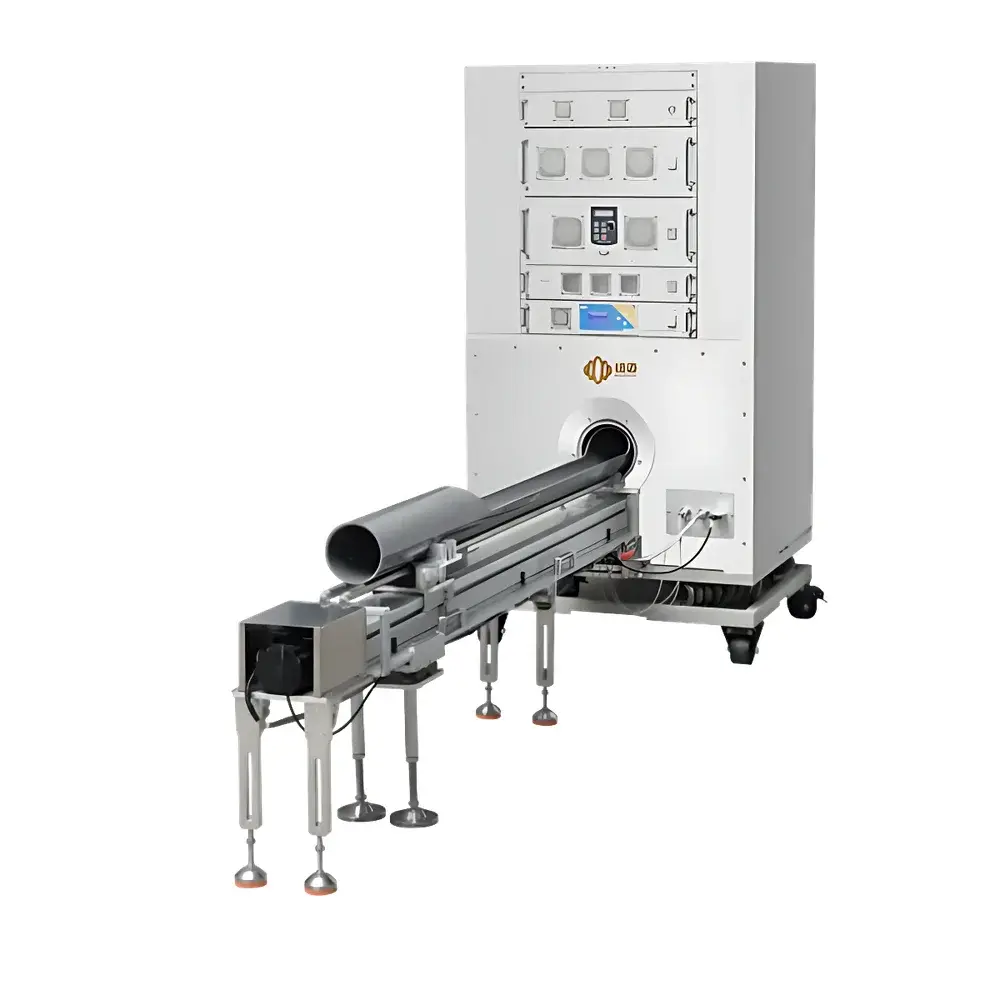
NIUMAG Shale Gas Content Analyzer – Full-Diameter Core NMR Spectrometer
| Brand | NIUMAG |
|---|---|
| Origin | Jiangsu, China |
| Manufacturer Type | Authorized Distributor |
| Origin Category | Domestic |
| Model | Full-Diameter Core Analyzer-1 |
| Instrument Type | Low-Field Nuclear Magnetic Resonance (LF-NMR) Spectrometer |
| Sample Type | Solid-Liquid Dual-Phase (Intact Shale Cores under In-Situ Pressure) |
| Operating Frequency | 6.2 MHz |
| Minimum Echo Time (TE) | 0.1 ms |
| Longitudinal Spatial Resolution | 1 cm |
| Maximum Core Length | 3.4 cm |
| Maximum Core Diameter | 115 mm |
| Relaxometry Modes | T₁, T₂, and T₁–T₂ Two-Dimensional Correlation Spectroscopy |
Overview
The NIUMAG Shale Gas Content Analyzer – Full-Diameter Core NMR Spectrometer is a purpose-built low-field nuclear magnetic resonance (LF-NMR) system engineered for in-situ pressure-retained measurement of gas content in intact shale core samples. Unlike conventional desorption-based methods that rely on extrapolated loss-gas estimation—and thus suffer from systematic uncertainty—this instrument enables direct, non-invasive quantification of methane phase distribution (adsorbed, capillary-confined, and free gas) within preserved cores recovered via pressurized coring. Its operational principle leverages spin relaxation dynamics (T₁ and T₂) and diffusion-relaxation coupling in porous media, calibrated against adsorption isotherms and pore-scale fluid mobility models. Designed specifically for field-deployable use in complex terrains—including mountainous and remote exploration sites—the system integrates a compact Halbach-array permanent magnet (reducing total mass by ~50% vs. conventional designs), enabling rapid deployment without cryogens or high-power infrastructure.
Key Features
- Pressurized core compatibility: Supports analysis of full-diameter shale cores maintained at reservoir-equivalent confining pressure (up to 70 MPa, per optional pressure vessel integration)
- Ultra-short echo time (TE) capability: 0.1 ms minimum TE enables detection of ultra-fast relaxing signals from clay-bound water and microporous adsorbed methane—critical for accurate kerogen-hosted gas quantification
- High longitudinal resolution: 1 cm spatial resolution achieved via optimized gradient encoding and slice-selective excitation—enabling stratified porosity and gas saturation profiling along core axis
- Automated full-core acquisition: Complete T₂ distribution and T₁–T₂ 2D mapping of a 3.4 cm × 115 mm core in ≤18 minutes, with minimal operator intervention
- Non-destructive workflow: Preserves sample integrity for subsequent geochemical, SEM, or mercury intrusion porosimetry validation
- Modular hardware architecture: Field-serviceable magnet, RF probe, and console modules; compliant with IP54 environmental rating for outdoor operation
Sample Compatibility & Compliance
The analyzer accepts cylindrical shale cores up to 115 mm in diameter and 3.4 cm in length—matching standard full-diameter core barrel dimensions used in pressurized coring operations (e.g., Wireline Pressure Core Barrel, WPCB). Samples are analyzed in native state—no drying, crushing, or solvent extraction required. The system adheres to ASTM D7169 (Standard Test Method for High Temperature Distillation of Heavy Hydrocarbons and Asphaltics) for thermal stability context, and supports data traceability aligned with GLP/GMP principles: audit trails for pulse sequence parameters, temperature logs, and pressure history (when integrated with external transducers) are stored in ISO/IEC 17025-compliant metadata format. While not FDA 21 CFR Part 11 certified out-of-box, the software architecture permits configuration for electronic signature and data integrity controls per laboratory SOP requirements.
Software & Data Management
Control and analysis are performed via NIUMAG’s proprietary NMI-Scan v4.2 platform, running on Windows 10 IoT Enterprise. The software provides real-time visualization of FID decay, T₂ spectra, and T₁–T₂ correlation maps. Built-in inversion algorithms (non-negative least squares with regularization) ensure robustness across heterogeneous shale matrices. Export formats include ASCII, HDF5, and CSV—with embedded metadata conforming to the IUPAC NMR Data Exchange Standard (NMR-DE). Batch processing supports multi-core comparative analysis, including normalized porosity partitioning (clay-bound vs. capillary-bound vs. free fluid volume), Langmuir parameter fitting, and permeability estimation via Timur-Coates correlations. All raw data and processing logs are timestamped and checksum-verified for regulatory review readiness.
Applications
- Quantitative partitioning of methane into adsorbed, pore-confined, and free phases using T₁–T₂ correlation and diffusion-weighted sequences
- Vertical heterogeneity assessment: Layer-by-layer porosity, pore size distribution, and gas saturation profiling at 1 cm resolution
- Calibration of basin modeling inputs—especially Langmuir volume (VL) and pressure-dependent sorption kinetics
- Post-fracturing evaluation: Comparison of pre- and post-stimulation core NMR responses to assess fracture-induced fluid redistribution
- Integration with digital rock physics workflows: Input for lattice-Boltzmann simulation of gas transport in reconstructed pore networks
- Quality control of pressurized coring operations: Rapid verification of core preservation efficacy prior to lab-based analysis
FAQ
Does this system require liquid helium or cryogenic cooling?
No. It employs a permanent Halbach magnet operating at ambient temperature, eliminating cryogen dependency and associated logistical constraints.
Can it distinguish between adsorbed methane and residual formation water?
Yes—via combined T₁–T₂–D (diffusion) correlation and temperature-controlled measurements (20–80 °C range), enabling separation of hydrogen signals based on molecular mobility and surface interaction timescales.
Is the 1 cm spatial resolution applicable to all shale lithofacies?
Resolution is consistent across lithologies; however, signal-to-noise ratio varies with organic richness and paramagnetic mineral content—optimized pulse sequences are provided for siliceous, calcareous, and mixed facies.
How is pressure integrity maintained during NMR measurement?
The system interfaces with third-party high-pressure core holders (e.g., Hassler-type cells); NMR-compatible pressure seals and RF-transparent endcaps ensure uninterrupted signal acquisition at reservoir pressure conditions.
What validation standards are recommended for routine calibration?
NIUMAG supplies reference phantoms with known T₂ distributions (e.g., doped water/glycerol mixtures, glass bead packs), traceable to NIST SRM 1900 series for relaxation time metrology.





