
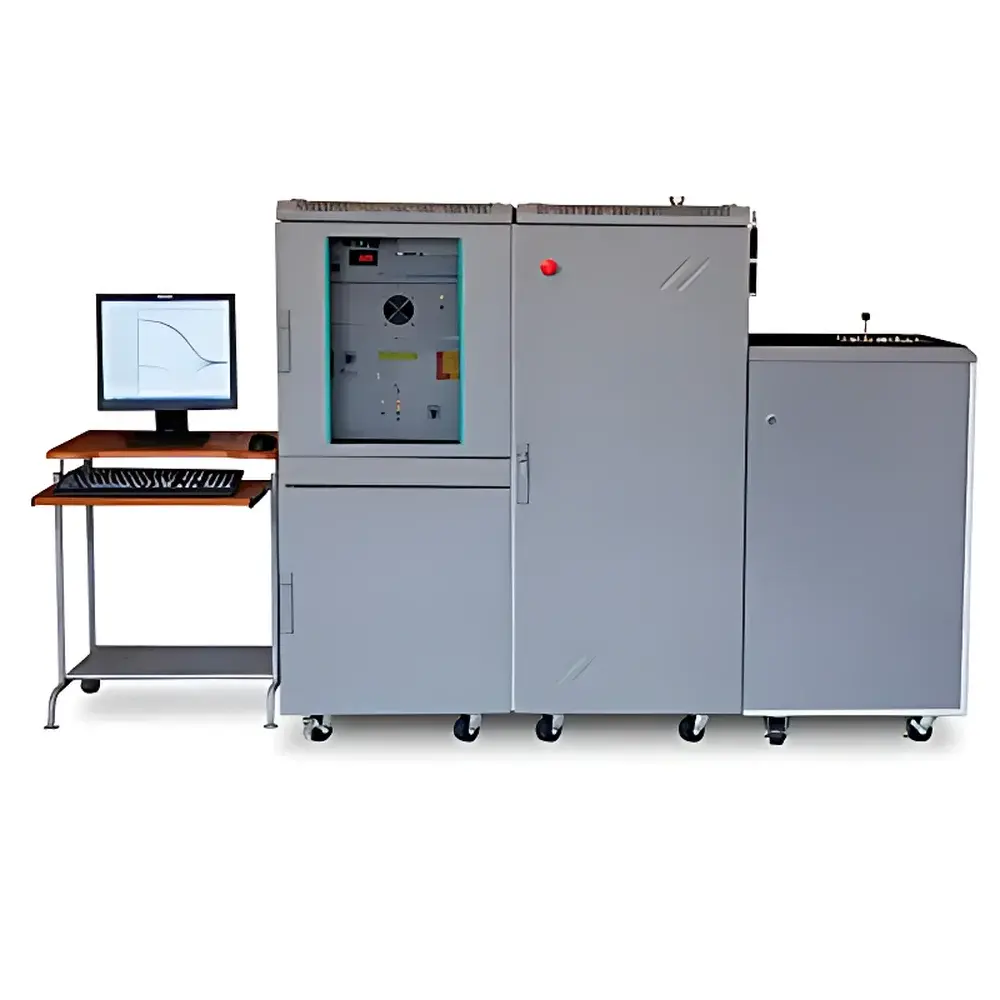
NIUMAG SPINMASTER FFC2000 1T C/DC Research-Grade Fast Field-Cycling Nuclear Magnetic Resonance Analyzer
| Brand | NIUMAG |
|---|---|
| Origin | Italy |
| Manufacturer Type | Authorized Distributor |
| Instrument Category | Imported Low-Field NMR Analyzer |
| Model | SPINMASTER FFC2000 1T C/DC |
| NMR Frequency Range (¹H) | 0.1 kHz – 42.6 MHz |
| Temperature Control Range | −140 °C to +140 °C (0.1 °C resolution) |
| Sample Compatibility | Solid–Liquid Hybrid, Colloids, Liquid Crystals, Porous Media, Polymers, Biological Tissues |
| Multinuclear Capability | ¹H, ²H, ¹³C, ¹⁹F, ⁷Li |
| Relaxation Time Range | Sub-millisecond to several seconds (T₁ and T₂) |
Overview
The NIUMAG SPINMASTER FFC2000 1T C/DC is a research-grade fast field-cycling (FFC) nuclear magnetic resonance analyzer engineered for quantitative characterization of molecular dynamics across variable magnetic fields. Unlike conventional static-field NMR spectrometers, the SPINMASTER FFC2000 employs active magnetic field modulation—ramping the B₀ field from near-zero (<0.1 mT) up to 1 T (42.6 MHz for ¹H)—to acquire nuclear magnetic relaxation dispersion (NMRD) profiles. This capability enables direct measurement of longitudinal (T₁) and transverse (T₂) relaxation times as continuous functions of Larmor frequency, providing unique insights into rotational correlation times, chemical exchange rates, paramagnetic interactions, and microviscosity in heterogeneous or constrained environments. The system operates at low-field conditions where dipolar and quadrupolar couplings remain resolvable, making it especially valuable for soft matter, porous media, pharmaceutical formulations, and battery electrolyte studies where high-field signal averaging obscures dynamic heterogeneity.
Key Features
- Fast field-cycling architecture with programmable field ramping (0.1 mT to 1 T) and precise timing control (sub-millisecond resolution)
- Simultaneous acquisition of T₁ and T₂ relaxation spectra across 0.1 kHz–42.6 MHz (¹H), supporting full NMRD curve generation
- Multinuclear operation natively supported for ¹H, ²H, ¹³C, ¹⁹F, and ⁷Li via broadband probe tuning and dedicated RF amplifiers
- Integrated cryogenic temperature stage enabling operation from −140 °C to +140 °C with ±0.1 °C stability and real-time PID feedback
- Low operational overhead: no liquid helium or nitrogen required; permanent magnet design ensures stable field homogeneity without cryogenic infrastructure
- Minimal sample preparation: compatible with native-state solids, gels, emulsions, rock cores (with optional wide-bore 0.5 T Stelar magnet configuration), and intact biological tissues
- Automated pulse sequence execution, hardware-triggered data acquisition, and real-time relaxation fitting using Levenberg–Marquardt algorithms
Sample Compatibility & Compliance
The SPINMASTER FFC2000 accommodates diverse physical states—including powders, granular solids, polymer melts, colloidal dispersions, lyotropic liquid crystals, hydrogels, and saturated rock cores—without requiring dissolution, deuteration, or isotopic labeling. Its open-access probe geometry supports custom sample holders and in situ cells for pressure- or gas-controlled experiments. From a regulatory standpoint, instrument control software complies with audit-trail requirements per FDA 21 CFR Part 11 when configured with user authentication, electronic signatures, and immutable data logging. Data output formats (e.g., ASCII, HDF5) support traceability under GLP and GMP frameworks. All electromagnetic emissions conform to IEC 61326-1:2013 for laboratory equipment, and magnetic stray field profiles meet ISO/IEC 17025:2017 environmental specification thresholds.
Software & Data Management
The SPINMASTER Control Suite provides a Windows-based GUI with modular workflow configuration: pulse sequence editor, field profile scheduler, temperature ramp manager, and real-time relaxation map visualization. Raw FID and inversion-recovery datasets are stored in vendor-neutral HDF5 containers with embedded metadata (field history, temperature log, RF power calibration, shimming parameters). Batch processing supports parallel fitting of multi-exponential T₁/T₂ decays using constrained non-linear least-squares optimization. Export modules generate publication-ready plots (T₁ vs. frequency, Arrhenius activation plots, Cole–Cole diagrams) and tabular reports compliant with ASTM D8143–20 (Standard Guide for Low-Field NMR Characterization of Polymer Dynamics). Remote access is enabled via secure SSH tunneling; data integrity is preserved through SHA-256 checksum validation on all exported archives.
Applications
- Characterization of molecular mobility in lithium-ion battery separators and solid polymer electrolytes under thermal stress
- Quantification of bound vs. free water fractions and pore-size distribution in shale, sandstone, and cementitious materials
- Monitoring protein folding intermediates and aggregation kinetics in crowded physiological buffers
- Discrimination of amorphous and crystalline phases in pharmaceutical co-formulations via T₁ρ dispersion analysis
- Studying ion hydration dynamics and solvent reorientation in ionic liquids using ²H and ⁷Li NMRD
- Mapping cross-link density gradients in vulcanized rubber networks through multi-frequency T₂ mapping
FAQ
What distinguishes fast field-cycling NMR from conventional pulsed NMR?
FFC-NMR actively modulates B₀ between measurements to resolve field-dependent relaxation mechanisms—unlike fixed-field systems that infer dynamics indirectly from spectral linewidths or diffusion coefficients.
Can the SPINMASTER FFC2000 be used for quantitative moisture imaging?
Yes—when coupled with gradient coils and spatial encoding modules (optional), it supports 1D/2D relaxometry imaging for moisture distribution mapping in heterogeneous samples such as food matrices or building materials.
Is method validation support available for regulated environments?
NIUMAG provides IQ/OQ documentation templates aligned with ISO/IEC 17025 and offers third-party qualification services for laboratories operating under GxP compliance mandates.
How is magnet stability maintained during rapid field cycling?
The 1 T resistive-permanent hybrid magnet incorporates active current compensation and passive thermal shielding to limit field drift to <±0.01% over 24 h, verified by onboard Hall-probe monitoring and real-time feedback correction.
Does the system support user-defined pulse sequences?
Yes—the control software includes a Python API (PySPIN) for scripting custom acquisition protocols, including multi-pulse trains, adiabatic sweeps, and segmented field-ramp experiments.





