
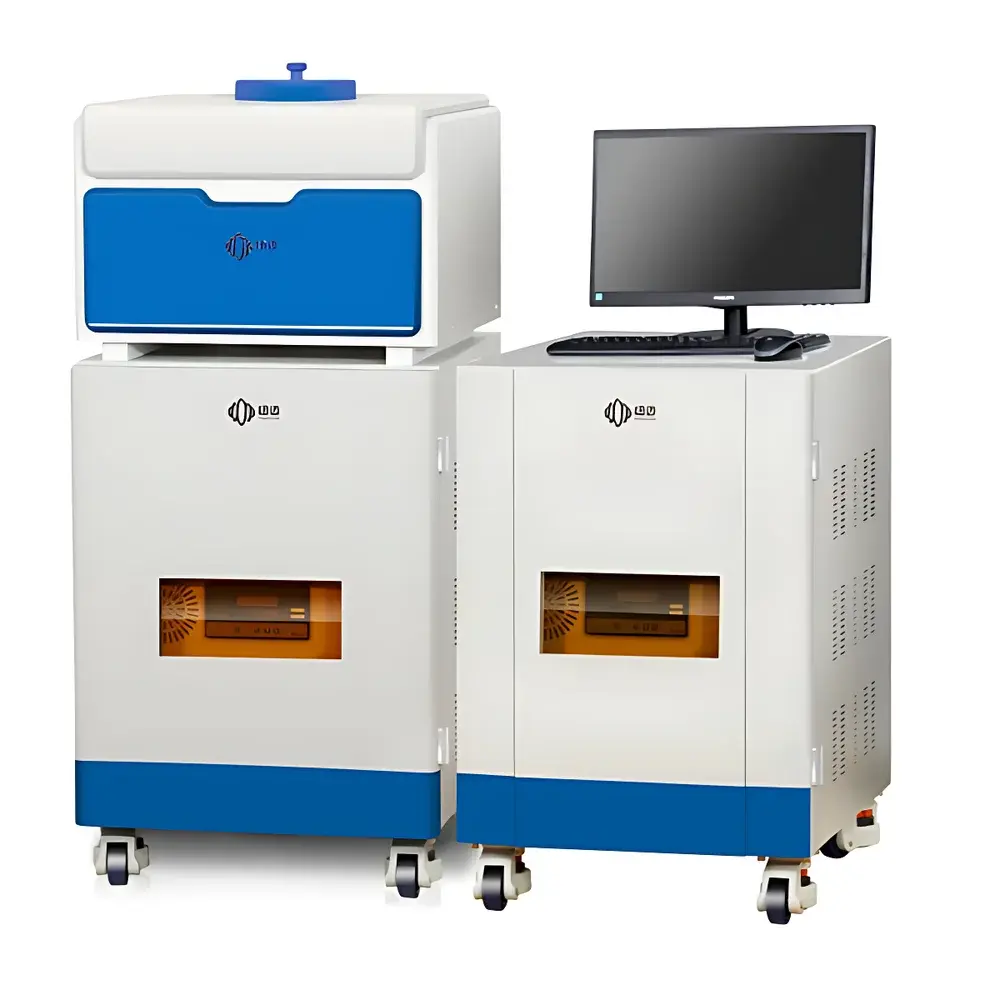
NIUMAG VTMR Series Low-Field Nuclear Magnetic Resonance Analyzer for Polyurethane Soft-Hard Segment Quantification
| Brand | NIUMAG |
|---|---|
| Origin | Jiangsu, China |
| Manufacturer Type | Authorized Distributor |
| Product Category | Domestic |
| Model | VTMR Series |
| Instrument Type | Low-Field NMR Analyzer |
| Sample Compatibility | Solid-Liquid Dual-Phase |
| Operating Mode | Pulsed Fourier Transform |
Overview
The NIUMAG VTMR Series Low-Field Nuclear Magnetic Resonance Analyzer is an engineered solution for quantitative microstructural characterization of polyurethane (PU) elastomers and thermoplastic polyurethanes (TPUs). It leverages the fundamental principles of low-field pulsed NMR—specifically transverse relaxation time (T2) distribution analysis—to resolve the dynamic heterogeneity between soft segments (flexible polyol-based chains) and hard segments (rigid diisocyanate/chain extender domains) within the PU matrix. Unlike high-field NMR spectrometers optimized for molecular identification, this instrument operates at magnetic fields typically below 0.5 T and focuses on proton (1H) spin-spin relaxation behavior under controlled pulse sequences (e.g., CPMG), enabling direct correlation between T2 decay profiles and segmental mobility. The resulting T2 spectrum separates into distinct components: short-T2 peaks (0.1–10 ms) correspond to protons in highly restricted, glassy hard domains; longer-T2 signals (10–1000 ms) reflect mobile protons in rubbery soft segments. This physical separation allows non-invasive, bulk-phase quantification of soft/hard segment ratio—critical for structure–property optimization in R&D and QC environments.
Key Features
- Non-destructive, contactless measurement: No sample cutting, solvent extraction, or chemical labeling required—preserves sample integrity for repeated testing.
- Rapid acquisition: Full T2 distribution analysis completed in ≤2 minutes per sample, supporting high-throughput screening in production QA labs.
- Robust solid–liquid dual-phase capability: Accommodates uncured prepolymers, cured elastomers, foams, gels, and composite systems without modification.
- Quantitative segmental resolution: Employs multi-exponential T2 inversion algorithms to deconvolve overlapping relaxation components with validated reproducibility (RSD < 3% across replicate runs).
- Temperature-controlled probe option (–40°C to +80°C): Enables dynamic studies of phase separation, vitrification, and thermal reversibility of physical crosslinks.
Sample Compatibility & Compliance
The VTMR analyzer accepts standard cylindrical NMR tubes (10–25 mm OD) and accommodates diverse PU morphologies—including thermoset elastomers, thermoplastic polyurethanes, hydrophilic PU membranes, and nanocomposite blends. It complies with ISO 17855:2016 (Rubber—Determination of crosslink density by nuclear magnetic resonance) and supports method validation per ASTM D6204 (Standard Test Method for Rubber Property—Measurement of Crosslink Density by Swelling and NMR Methods). While not a GLP-certified instrument per se, its audit-ready data logging architecture—including timestamped raw FID files, parameter metadata, and user-defined calibration records—facilitates alignment with internal QA protocols and FDA 21 CFR Part 11 requirements when integrated into validated laboratory information management systems (LIMS).
Software & Data Management
NIUMAG’s proprietary MesoMR software provides full control over pulse sequence selection (CPMG, IR-CPMG), hardware parameter tuning (echo spacing, number of echoes), and advanced spectral processing. Built-in T2 inversion routines utilize non-negative least-squares (NNLS) with regularization to generate stable, physically meaningful distributions. Quantitative outputs include soft/hard segment area ratios, mean T2 values per component, and relative mobility indices. All data are exported in ASCII-compatible formats (.csv, .txt) for traceability and third-party statistical analysis (e.g., JMP, MATLAB). Software versioning, user access levels, and electronic signature support align with basic data integrity expectations in regulated environments.
Applications
- Optimizing hard segment content during PU synthesis to balance tensile strength vs. elongation at break.
- Monitoring phase separation kinetics during solvent casting or thermal annealing processes.
- Correlating T2-derived hard domain fraction with mechanical hysteresis and compression set performance.
- Distinguishing chemically crosslinked networks from thermally reversible physical crosslinks (e.g., urea crystallites) in segmented PUs.
- Assessing moisture uptake effects on soft segment plasticization via T2 shift analysis in hydrophilic PU coatings.
- Supporting failure analysis of aged or fatigue-tested PU components by tracking hard domain degradation signatures.
FAQ
How does the VTMR differentiate soft and hard segments without chemical labeling?
It exploits intrinsic differences in proton mobility: hard segment protons exhibit rapid spin–spin relaxation (short T2) due to restricted motion in crystalline or hydrogen-bonded domains, while soft segment protons display slower relaxation (longer T2) owing to greater chain flexibility.
Can the system quantify absolute crosslink density in PU networks?
While primarily designed for soft/hard segment ratio, calibrated T2–crosslink correlations can be established using reference standards (e.g., vulcanized natural rubber) per ISO 17855 guidelines.
Is temperature control necessary for routine soft/hard segment analysis?
Not mandatory for comparative QC, but essential for studying thermal transitions (e.g., hard domain melting) or simulating service conditions.
What sample preparation is required?
Minimal: Samples must fit the probe diameter and be free of ferromagnetic contaminants. No drying, grinding, or solvent removal is needed unless volatile components interfere with signal stability.
Does the instrument require liquid helium or cryogens?
No—low-field permanent magnet design eliminates cryogenic dependency, reducing operational cost and infrastructure requirements.
Related Products





