
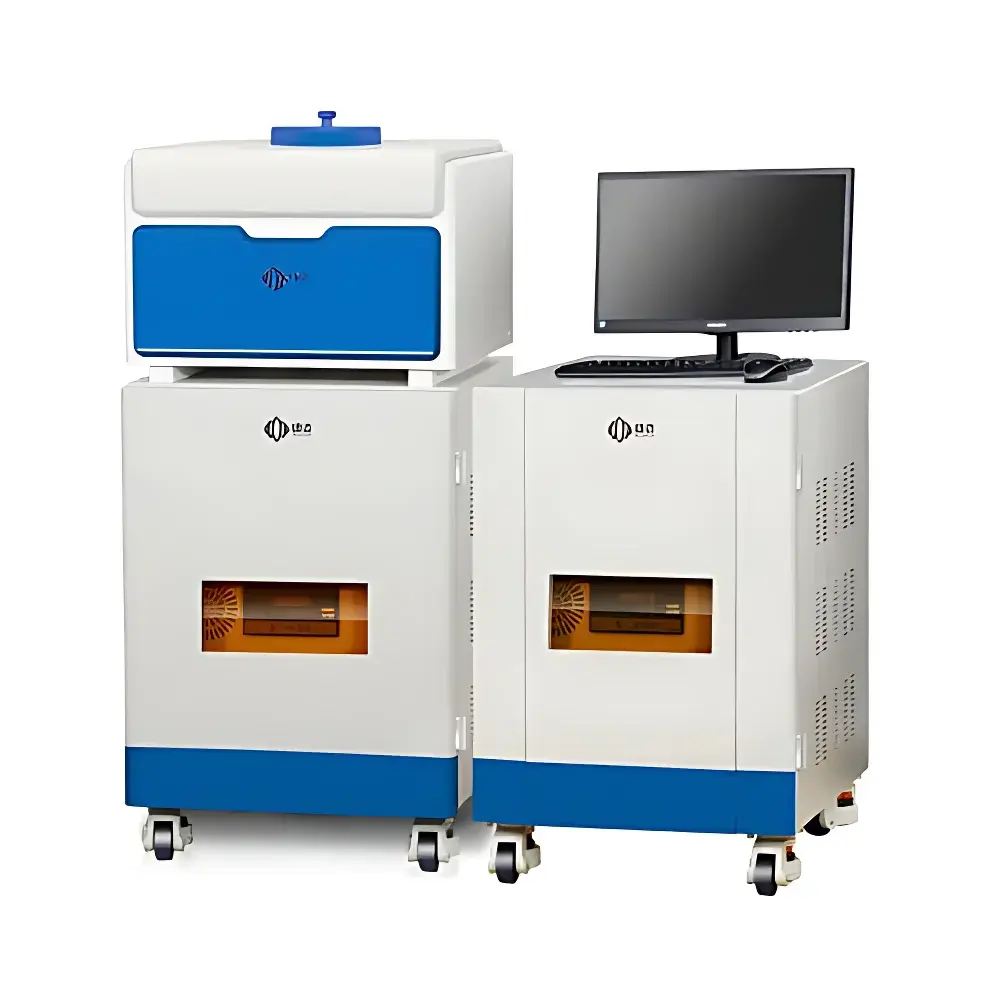
NIUMAG VTMR-Tg Low-Field Nuclear Magnetic Resonance Analyzer for Glass Transition Temperature (Tg) Measurement
| Brand | NIUMAG |
|---|---|
| Origin | Jiangsu, China |
| Manufacturer Type | Authorized Distributor |
| Origin Category | Domestic |
| Model | VTMR-Tg |
| Instrument Type | Low-Field NMR Spectrometer |
| Sample Type | Solid-Liquid Dual-Mode |
| Operating Mode | Pulsed Fourier Transform |
| Sensitivity | Signal-to-Noise Ratio (SNR) Optimized |
| Resolution | Sub-millimeter Spatial Resolution (Imaging Mode, Optional) |
| Magnet Type | Permanent Magnet |
| Static Field Strength | 0.5 ± 0.05 T |
| Effective Sample Volume | Ø8.5 mm × H20 mm |
| Temperature Control Range | Ambient to 130 °C (Standard) |
| Imaging Capability | Optional MRI-Enabled Configuration |
Overview
The NIUMAG VTMR-Tg is a purpose-engineered low-field nuclear magnetic resonance (NMR) analyzer designed specifically for the non-destructive, quantitative determination of glass transition temperature (Tg) in amorphous and semi-crystalline materials. Unlike thermal techniques such as DSC or DMA, this instrument leverages the intrinsic sensitivity of proton (1H) spin relaxation dynamics to molecular mobility—providing direct, physics-based insight into segmental motion onset during the glass-rubber transition. The system operates on the principle that transverse relaxation time (T2) exhibits a distinct inflection point at Tg: in the glassy state, chain segments are immobilized, yielding short, temperature-invariant T2 values; upon crossing Tg, increased thermal energy activates cooperative segmental motion, resulting in a sharp, monotonic increase in T2. This T2–temperature profile is acquired via CPMG (Carr–Purcell–Meiboom–Gill) pulse sequences, enabling high reproducibility and minimal sample preparation.
Key Features
- Stable 0.5 T permanent magnet system with field homogeneity < 10 ppm over the active volume—engineered for long-term operational stability without cryogen consumption.
- Integrated precision temperature control unit with ±0.1 °C accuracy across ambient to 130 °C (standard), expandable to 200 °C via optional high-temperature module compliant with IEC 61000-4-2 ESD immunity standards.
- Dual-mode sample compatibility: accommodates both solid powders (e.g., freeze-dried proteins, starches, polymers) and liquid dispersions (e.g., concentrated emulsions, hydrogels) within a single Ø8.5 mm × 20 mm cylindrical detection volume.
- Pulsed Fourier transform architecture supporting standard NMR sequences (90°–τ–180° echo, CPMG, inversion recovery) with configurable pulse widths (1–20 µs), repetition times (0.1–10 s), and echo spacing (10–2000 µs).
- Modular hardware design: optional MRI capability enables spatially resolved T2 mapping for heterogeneous samples—critical for food microstructure analysis and pharmaceutical dosage form characterization.
Sample Compatibility & Compliance
The VTMR-Tg supports regulatory-compliant analysis workflows for industries governed by USP , ISO 11357-2, and ASTM E1356. Its non-invasive measurement protocol eliminates sample degradation associated with thermal ramping, preserving structural integrity for subsequent orthogonal testing. Validated for use with food matrices (cereal starches, dairy powders, confectionery gels), biopharmaceutical formulations (lyophilized monoclonal antibodies, vaccine adjuvants), and synthetic polymers (PVP, PLA, ethyl cellulose). All temperature-controlled experiments adhere to GLP documentation requirements, with audit-trail-enabled parameter logging and electronic signature support per FDA 21 CFR Part 11 when paired with NIUMAG’s NMRStudio Pro software suite.
Software & Data Management
NIUMAG NMRStudio Pro v4.2 provides full sequence programming, real-time spectral visualization, automated T2 distribution deconvolution (using non-negative least squares), and derivative-based Tg identification algorithms. Raw FID data is stored in vendor-neutral HDF5 format, ensuring interoperability with MATLAB, Python (NumPy/SciPy), and commercial chemometrics platforms. The software includes built-in calibration routines traceable to NIST SRM 1921b (polyethylene glycol reference), and supports IQ/OQ/PQ documentation packages for laboratory accreditation (ISO/IEC 17025).
Applications
- Quantification of Tg in hygroscopic food systems under controlled water activity—enabling predictive shelf-life modeling per the Gordon–Taylor equation.
- Assessment of plasticizer efficacy (e.g., glycerol, sorbitol) in edible films and biopolymer coatings.
- Stability screening of lyophilized biologics: correlation of T2 inflection temperature with residual moisture content and collapse temperature (Tc).
- In-process monitoring of polymer melt processing parameters via rapid (< 90 s) T2 acquisition during extrusion or hot-melt extrusion development.
- Differentiation of amorphous and crystalline phases in API-excipient blends using multi-exponential T2 decay analysis.
FAQ
How does the VTMR-Tg differ from differential scanning calorimetry (DSC) for Tg measurement?
NMR detects molecular mobility onset directly through proton spin dynamics, whereas DSC measures heat capacity changes. NMR is insensitive to thermal history effects, requires no baseline correction, and works reliably in highly viscous or opaque systems where DSC signal-to-noise degrades.
Is calibration required before each analysis?
A one-time magnet shimming and RF probe tuning is performed during installation; daily verification uses a sealed polyethylene reference sample. No recalibration is needed between routine Tg runs.
Can the system quantify water mobility states (bound vs. free) in food matrices?
Yes—multi-component T2 decay analysis resolves at least three populations: immobilized (T2 < 1 ms), intermediate (1–10 ms), and bulk-like (T2 > 10 ms), corresponding to hydration layers, capillary water, and free water.
What safety certifications does the VTMR-Tg hold?
CE marked per EN 61000-6-3 (EMC) and EN 61000-6-2 (immunity); meets IEC 61010-1 for laboratory equipment safety; no ionizing radiation or high-voltage hazards present.
Is remote operation supported?
Yes—via secure TLS-encrypted VNC interface with role-based access control; compatible with institutional IT security policies and network segmentation requirements.



