
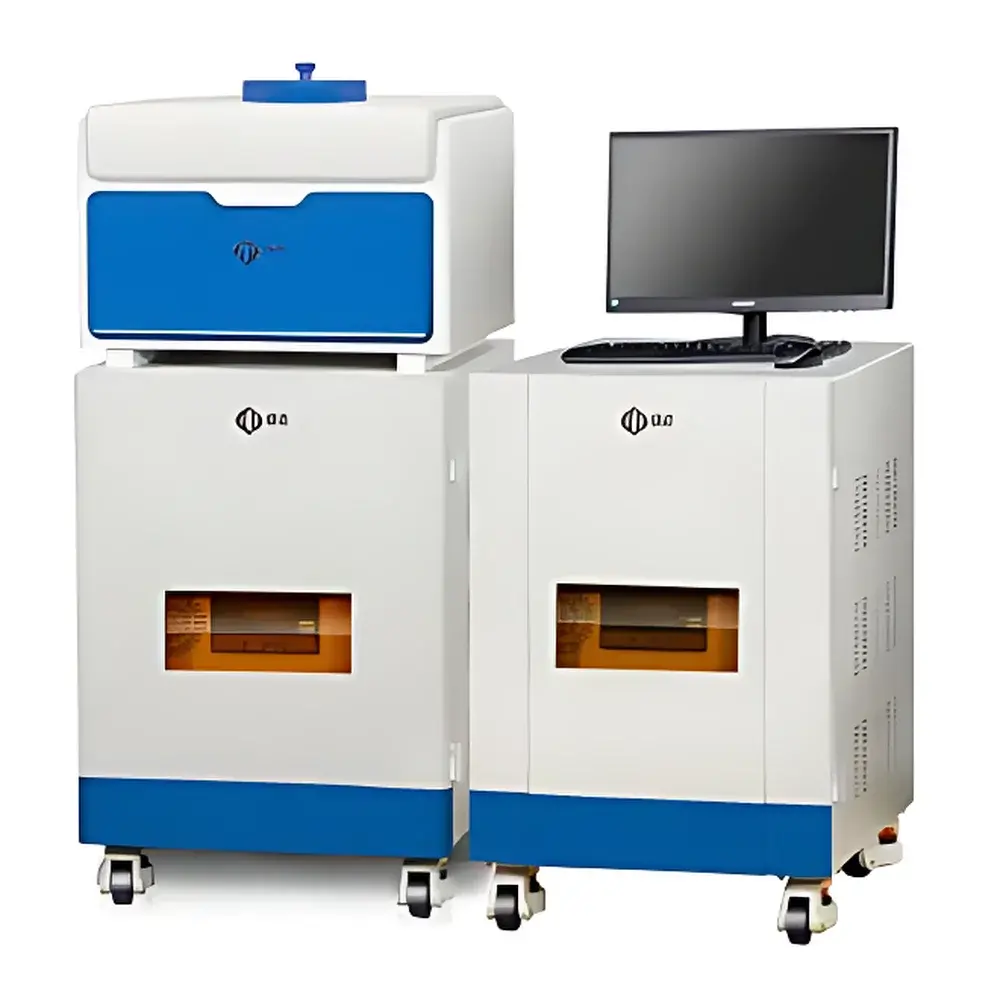
NIUMAG VTMR Variable-Temperature NMR Analyzer for Crosslink Density Analysis
| Brand | NIUMAG |
|---|---|
| Origin | Jiangsu, China |
| Manufacturer Type | Authorized Distributor |
| Origin Category | Domestic |
| Model | VTMR |
| Pricing | Available Upon Request |
| Magnet Type | Permanent Magnet |
| Magnetic Field Strength | 0.5 ± 0.05 T |
| Standard Temperature Range | Ambient to 130 °C |
| Optional Cryo/High-Temp Module | −100 °C to 200 °C |
| Imaging Capability | Optional |
| Core Technology | FLAT (Fast Low-Amplitude Transient) Pulse Sequence for Short-T₂/Weak-Signal Acquisition |
| Measurement Modes | T₁ & T₂ Relaxometry, NMR Imaging (optional), Quantitative Crosslink Density Mapping |
Overview
The NIUMAG VTMR Variable-Temperature NMR Analyzer is a benchtop, permanent-magnet-based nuclear magnetic resonance system engineered for quantitative crosslink density characterization and dynamic structural analysis of polymeric and soft materials under controlled thermal conditions. Operating at a stable field strength of 0.5 ± 0.05 T, the VTMR leverages low-field NMR principles—specifically spin–lattice (T₁) and spin–spin (T₂) relaxation time measurement—to non-invasively probe molecular mobility, network heterogeneity, and phase distribution in rubber, elastomers, gels, composites, and functional polymers. Its integrated variable-temperature module enables true in situ thermal ramping and isothermal hold protocols, facilitating real-time monitoring of vulcanization kinetics, curing progression, aging-induced chain scission, and solvent–polymer interaction thermodynamics. Unlike high-field NMR spectrometers, the VTMR prioritizes robustness, operational simplicity, and industrial deployment readiness—making it suitable for QC laboratories, R&D process development centers, and university core facilities where repeatability, throughput, and regulatory traceability are critical.
Key Features
- Engineered permanent magnet architecture delivering field homogeneity < 100 ppm over 30 mm DSV, optimized for routine T₁/T₂ relaxometry without cryogen dependency.
- Standard temperature control from ambient to +130 °C; optional extended-range module supporting −100 °C to +200 °C with ±0.1 °C stability and programmable ramp rates (0.1–5 °C/min).
- FLAT (Fast Low-Amplitude Transient) acquisition technology—specifically developed for detecting short-T₂ signals (< 100 µs) in highly crosslinked or rigid-phase domains, overcoming conventional dead-time limitations.
- Dual-mode operation: quantitative relaxometry (crosslink density, segmental mobility, swelling ratio estimation) and optional 2D/3D NMR imaging for spatial mapping of heterogeneity, filler dispersion, or microcrack propagation.
- Modular hardware design compliant with IEC 61000-6-3 (EMC) and IEC 61010-1 (safety); all electronics housed in shielded, fan-cooled enclosures meeting IP20 industrial environment requirements.
Sample Compatibility & Compliance
The VTMR accommodates cylindrical samples up to Ø25 mm × H50 mm, including raw rubber compounds, cured elastomer sheets, hydrogels, polymer pellets, fiber-reinforced composites, and emulsions. No sample preparation (e.g., dissolution, labeling, or sectioning) is required—enabling direct analysis of production-grade materials. The system supports ASTM D6204 (rubber crosslink density by NMR), ISO 17987 (low-field NMR for polymer characterization), and internal method validation per GLP/GMP frameworks. Data acquisition logs include full audit trails: timestamped temperature setpoints, pulse sequence parameters, RF calibration records, and operator ID—ensuring compliance with FDA 21 CFR Part 11 when paired with NIUMAG’s validated software suite.
Software & Data Management
NIUMAG’s proprietary MesoMR Studio v5.x provides a validated, Windows-based platform for instrument control, sequence programming, spectral processing, and report generation. Key modules include: Crosslink Density Calculator (based on Guth–Gold Equation and modified Flory–Rehner models), T₂ distribution deconvolution (NNLS and CONTIN algorithms), multi-exponential fitting with confidence interval estimation, and batch-mode processing for time-series or temperature-gradient experiments. All raw FID data are stored in HDF5 format with embedded metadata (temperature, field drift, coil Q-factor). Export options include CSV, XML, and PDF reports compliant with ISO/IEC 17025 documentation standards. Remote access, role-based user permissions, and electronic signature support are available for regulated environments.
Applications
- Rubber & Tire Industry: Real-time quantification of crosslink density evolution during sulfur/vulcanization cycles; comparison of accelerator systems; evaluation of reversion resistance at elevated temperatures.
- Adhesives & Coatings: Monitoring solvent evaporation kinetics, film formation, and glass transition onset via T₂ shift analysis across thermal ramps.
- Biomedical Polymers: Assessing hydration dynamics in hydrogels, degradation profiles of bioresorbable scaffolds, and protein–polymer interaction thermodynamics.
- Energy Materials: Characterizing lithium-ion battery separator wettability, electrolyte uptake in solid polymer electrolytes, and thermal stability of binder networks.
- Academic Research: Teaching NMR fundamentals, validating molecular dynamics simulations, and developing new relaxometric biomarkers for soft matter phase behavior.
FAQ
What is the minimum detectable crosslink density for elastomers using the VTMR?
The detection limit depends on polymer type and T₂ distribution width but typically achieves ±0.02 mol/m³ precision for natural rubber and SBR within 5 minutes acquisition time.
Can the VTMR be integrated into an automated production line?
Yes—via Ethernet TCP/IP interface and OPC UA-compatible API, enabling PLC-triggered measurements, pass/fail logic output, and MES integration.
Is NMR imaging mandatory for crosslink density analysis?
No—relaxometry-only configuration is standard; imaging is an optional upgrade for spatially resolved property mapping.
Does NIUMAG provide application-specific method development support?
Yes—customers receive dedicated method transfer services, including SOP drafting, uncertainty budgeting, and inter-laboratory validation assistance.
How does the VTMR ensure long-term field stability without superconducting magnets?
The permanent magnet assembly includes active temperature compensation and passive shimming; field drift is monitored continuously and corrected via real-time frequency lock using a reference signal from the sample itself.






