
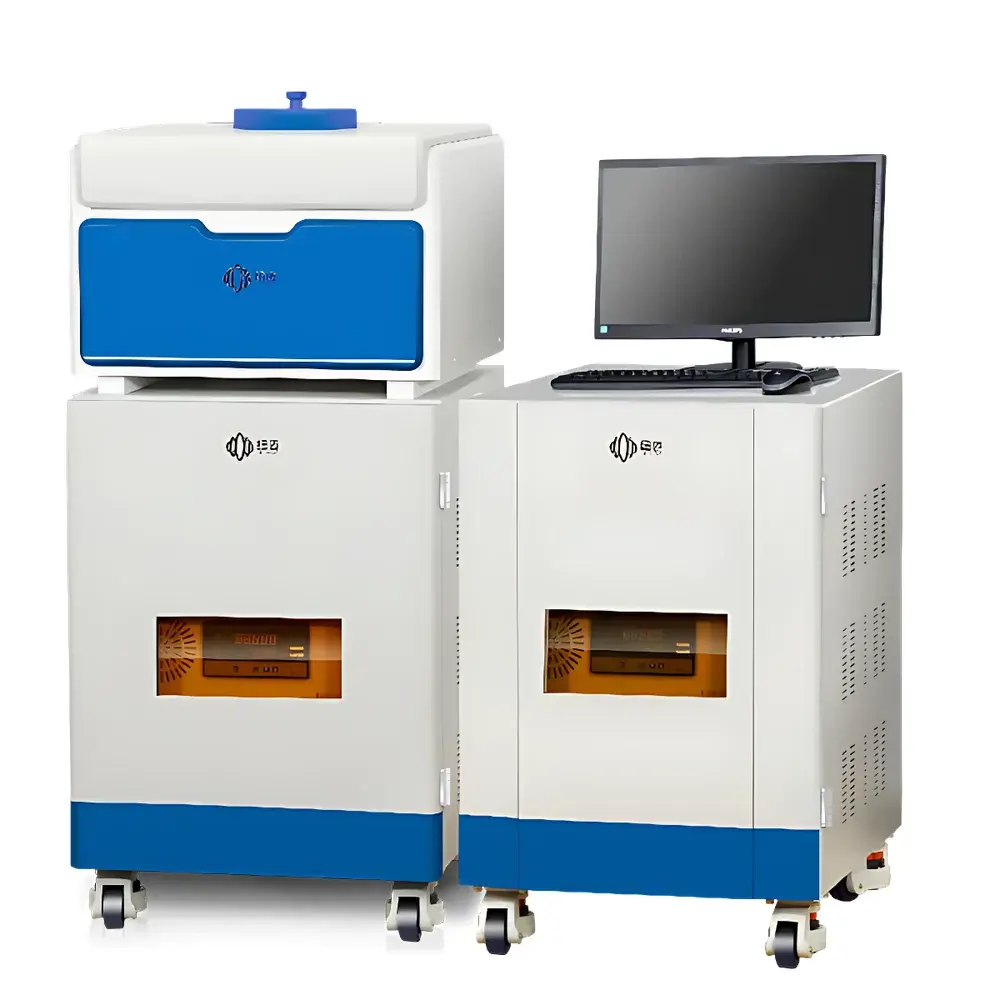
NIUMAG VTMR20-010V-1 Low-Field Nuclear Magnetic Resonance Analyzer for Inorganic Phase Change Materials
| Brand | NIUMAG |
|---|---|
| Origin | Jiangsu, China |
| Model | VTMR20-010V-1 |
| Instrument Type | Low-Field NMR Analyzer |
| Sample Compatibility | Solid-Liquid Dual-Phase |
| Magnet Type | Permanent Magnet |
| Static Field Strength | 0.5 ± 0.05 T |
| Standard Temperature Control Range | RT to 130 °C |
| Optional Cryo/High-Temp Module | –100 °C to 200 °C |
| Measurement Time per Sample | ~2 min |
Overview
The NIUMAG VTMR20-010V-1 is a purpose-engineered low-field nuclear magnetic resonance (LF-NMR) analyzer designed specifically for the structural and dynamic characterization of inorganic phase change materials (IPCMs). Unlike high-field NMR systems optimized for molecular structure elucidation, this instrument leverages the robust signal-to-noise performance of permanent-magnet-based 0.5 T field strength to quantify proton mobility, relaxation dynamics, and phase distribution in heterogeneous solid–liquid systems under controlled thermal conditions. Its core measurement principle relies on pulsed spin-echo sequences—primarily Carr–Purcell–Meiboom–Gill (CPMG)—to extract transverse relaxation time distributions (T2), which correlate directly with pore confinement, interfacial interactions, water mobility, and crystallization/melting kinetics. This enables non-invasive, quantitative tracking of phase transitions in real time, without sample destruction or labeling, making it ideal for iterative formulation development and long-term stability assessment in thermal energy storage applications.
Key Features
- Integrated temperature-controlled probe with standard RT–130 °C range and optional extended module (–100 °C to 200 °C) for full coverage of IPCM melting, supercooling, and solidification regimes
- High-sensitivity RF coil optimized for heterogeneous samples containing both crystalline hydrates and free/bound water phases
- Automated CPMG acquisition with <120-second typical measurement duration per temperature point, enabling rapid thermal ramping protocols
- Robust permanent magnet architecture requiring no cryogens or active shimming—suitable for QC labs and pilot-scale R&D environments
- Modular design supporting optional MRI capability for spatially resolved T2 mapping of phase heterogeneity within bulk samples
Sample Compatibility & Compliance
The VTMR20-010V-1 accommodates a broad spectrum of IPCMs—including sodium sulfate decahydrate, calcium chloride hexahydrate, magnesium nitrate hexahydrate, and eutectic salt mixtures—as well as composite formulations incorporating expanded graphite, silica aerogels, or polymer encapsulants. Its solid–liquid dual-phase capability allows simultaneous monitoring of crystalline lattice integrity (via restricted proton motion) and mobile phase content (via bulk-like T2 components). The system complies with ISO/IEC 17025 general requirements for testing laboratories and supports audit-ready data handling per GLP and GMP frameworks. All temperature ramps and pulse sequence parameters are logged with timestamped metadata, satisfying traceability requirements under FDA 21 CFR Part 11 when configured with electronic signature modules.
Software & Data Management
NIUMAG’s proprietary MesoMR software provides end-to-end workflow control—from method setup and automated thermal profiling to multi-exponential T2 inversion, diffusion-relaxation correlation (D–T2) analysis, and kinetic modeling of phase transition onset/offset temperatures. Raw FID data and processed relaxation spectra are stored in vendor-neutral HDF5 format, ensuring interoperability with MATLAB, Python (NumPy/SciPy), and third-party chemometrics platforms. Batch processing supports statistical comparison across formulation variants, while built-in ASTM E2936-compliant reporting templates facilitate regulatory submissions for thermal storage material qualification.
Applications
- Quantitative determination of bound vs. free water fractions during hydration/dehydration cycles
- Mapping of glass transition (Tg) and melting onset (Tm) via temperature-dependent T2 inflection points
- Evaluation of microencapsulation efficiency through relaxation contrast between core and shell phases
- Assessment of long-term cycling stability by tracking irreversible T2 distribution shifts after repeated thermal stress
- Correlation of pore-size distribution (derived from T2–surface relaxivity models) with thermal conductivity predictions
- In situ monitoring of ion gel phase separation kinetics and polymer chain mobility gradients
FAQ
What sample volume is required for reliable T2 quantification?
Standard measurements use 0.5–2.0 mL of powdered or pelletized IPCM in a 10 mm OD glass tube; minimal volume ensures uniform RF excitation and thermal equilibration.
Can the system distinguish between different hydrate phases (e.g., mono- vs. di-hydrate)?
Yes—distinct T2 components corresponding to structurally bound water (short T2, <1 ms), lattice-interstitial water (intermediate T2, 1–10 ms), and bulk-like melt (long T2, >50 ms) are resolvable with proper signal-to-noise and inversion regularization.
Is calibration required before each experiment?
No routine calibration is needed; field homogeneity and RF gain are factory-characterized and verified during annual service—only temperature sensor validation is recommended prior to critical thermal ramp studies.
How does LF-NMR compare to DSC for phase transition analysis?
While DSC measures enthalpy changes at discrete temperatures, LF-NMR provides continuous, composition-resolved dynamics—revealing sub-transition events, hysteresis, and localized phase immiscibility that DSC may average out.
Does the system support custom pulse sequences beyond CPMG?
Yes—advanced users can import custom pulse timing tables via ASCII interface, enabling inversion recovery (T1), stimulated echo (D-T2), or saturation recovery experiments for specialized IPCM diffusion or exchange studies.




