
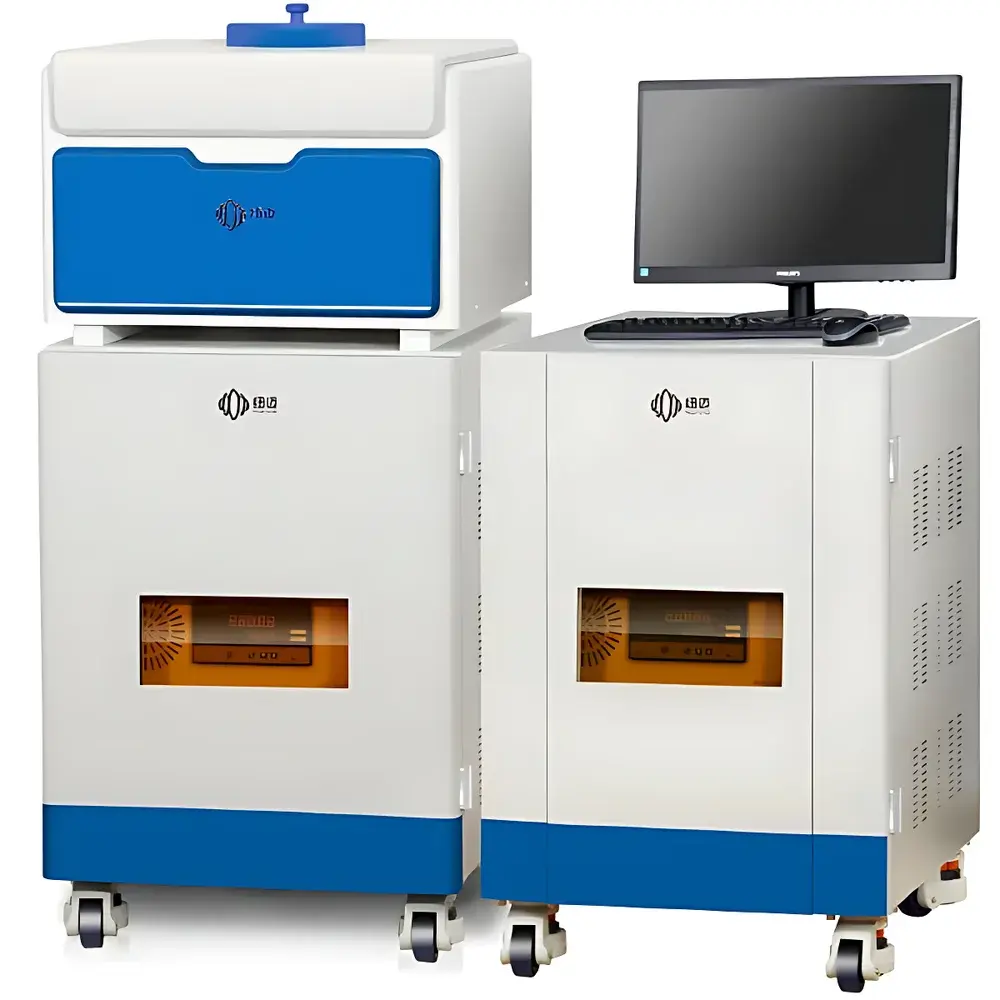
NIUMAG VTMR20-010V-5 Low-Field Nuclear Magnetic Resonance Analyzer for Ion-Exchange Membrane Pore Size Characterization
| Brand | NIUMAG |
|---|---|
| Origin | Jiangsu, China |
| Manufacturer Type | Authorized Distributor |
| Product Category | Domestic |
| Model | VTMR20-010V-5 |
| Instrument Type | Low-Field NMR Analyzer |
| Sample Compatibility | Solid–Liquid Hybrid Samples |
| Magnet Type | Permanent Magnet |
| Static Field Strength | 0.5 ± 0.05 T |
| Standard Temperature Control Range | 25–130 °C |
| Optional Cryo/High-Temp Module | –100 to 200 °C |
| Measurement Time per Sample | ≤2 min |
| Signal Source | Proton (¹H) Relaxation in Hydrated Membranes |
Overview
The NIUMAG VTMR20-010V-5 is a purpose-built low-field nuclear magnetic resonance (LF-NMR) analyzer engineered for non-invasive, quantitative pore size characterization of proton exchange membranes (PEMs) and other ion-conductive polymer electrolytes used in fuel cell systems. Unlike conventional porosimetry techniques—such as mercury intrusion or gas adsorption—the VTMR20-010V-5 leverages the physical principle of transverse relaxation (T₂) of water protons confined within membrane nanopores. When hydrated, PEMs retain water molecules whose rotational and translational mobility is directly modulated by pore geometry: larger pores yield longer T₂ relaxation times, while narrower pores impose stronger surface interactions, accelerating signal decay. By acquiring and inverting multi-echo CPMG decay curves, the system reconstructs a T₂ distribution spectrum that correlates quantitatively with pore size distribution via established diffusion-surface relaxation models (e.g., SDR and BPP frameworks). This enables direct, calibration-free estimation of effective pore diameters ranging from ~1 nm to several hundred nanometers—covering the critical functional range for Nafion®, sulfonated polyether ether ketone (SPEEK), and emerging hydrocarbon-based membranes.
Key Features
- Non-destructive, contactless analysis: No sample drying, coating, vacuum treatment, or chemical derivatization required—preserves native hydration state and microstructural integrity.
- Real-time in situ thermal profiling: Integrated high-precision temperature control (standard: 25–130 °C; optional extended range: –100 to 200 °C) enables dynamic monitoring of pore evolution under operational thermal stress.
- Rapid acquisition protocol: Full T₂ decay acquisition and inversion completed in ≤120 seconds per sample—optimized for high-throughput QC screening and iterative R&D workflows.
- Robust solid–liquid hybrid detection capability: Simultaneously resolves signals from bound water (in nanopores), interfacial water (at sulfonic clusters), and bulk-like water (in macrovoids), supporting multi-component relaxation analysis.
- Permanent magnet architecture: Stable 0.5 T field with <±0.05 T homogeneity over 30 mm DSV—eliminates cryogen dependency and ensures long-term field stability without shimming.
Sample Compatibility & Compliance
The VTMR20-010V-5 accepts standard PEM coupons (10–25 mm diameter, thickness ≤2 mm), fully hydrated or equilibrated at controlled RH. It supports comparative studies across membrane classes—including perfluorosulfonic acid (PFSA), hydrocarbon-based, composite, and anion-exchange membranes (AEMs). Data acquisition adheres to principles outlined in ASTM D7264 (flexural properties of polymer matrix composites) and ISO 178 (plastics—determination of flexural properties), where applicable to mechanical–structural correlation. While LF-NMR itself is not codified in fuel cell-specific standards, the methodology aligns with DOE Hydrogen and Fuel Cell Program guidelines for membrane structural metrology and supports GLP-compliant documentation when paired with audit-trail-enabled software (see Software & Data Management section).
Software & Data Management
The instrument operates with NIUMAG’s proprietary MesoMR Suite v4.x, a Windows-based platform compliant with FDA 21 CFR Part 11 requirements for electronic records and signatures. Core modules include: (i) automated CPMG sequence setup with variable echo spacing (TE = 0.1–2.0 ms); (ii) regularized T₂ inversion using non-negative least squares (NNLS); (iii) pore size conversion via user-selectable models (e.g., Coates–Denoo, SDR, or custom calibration curves); and (iv) batch processing with CSV/XLSX export and PDF report generation. Audit trails log all parameter changes, user actions, and data modifications. Raw FID and processed T₂ spectra are stored in vendor-neutral HDF5 format, enabling third-party analysis in MATLAB, Python (SciPy), or OriginLab.
Applications
- Quality control of PEM manufacturing batches—detecting inconsistencies in casting, annealing, or solvent removal steps.
- Structure–property correlation studies linking pore size distribution to proton conductivity, water uptake, and gas crossover rates.
- Evaluation of membrane degradation mechanisms (e.g., radical-induced scission, hydrolytic cleavage) under accelerated aging protocols.
- Screening of novel membrane formulations (e.g., graphene oxide hybrids, MOF-doped PEMs) for optimized nanoconfinement behavior.
- In situ validation of membrane electrode assembly (MEA) hydration states during simulated start–stop cycling.
FAQ
Does this system require cryogens or external cooling infrastructure?
No. The permanent magnet design operates at ambient temperature and requires only standard AC power and Ethernet connectivity.
Can T₂ distributions be correlated to absolute pore diameters without reference standards?
Yes—using physics-based surface relaxivity (ρ₂) and diffusion coefficient (D) inputs derived from literature or calibrated on model porous glasses (e.g., Vycor, controlled-pore glass).
Is the system suitable for measuring dry or partially dehydrated membranes?
It is optimized for hydrated samples. Dehydrated membranes yield weak or undetectable ¹H signals; rehydration prior to measurement is recommended.
What level of technical support and method development assistance is provided?
NIUMAG offers application engineering support, including on-site method validation, training workshops, and collaborative protocol development aligned with DOE and IEA fuel cell testing protocols.





