
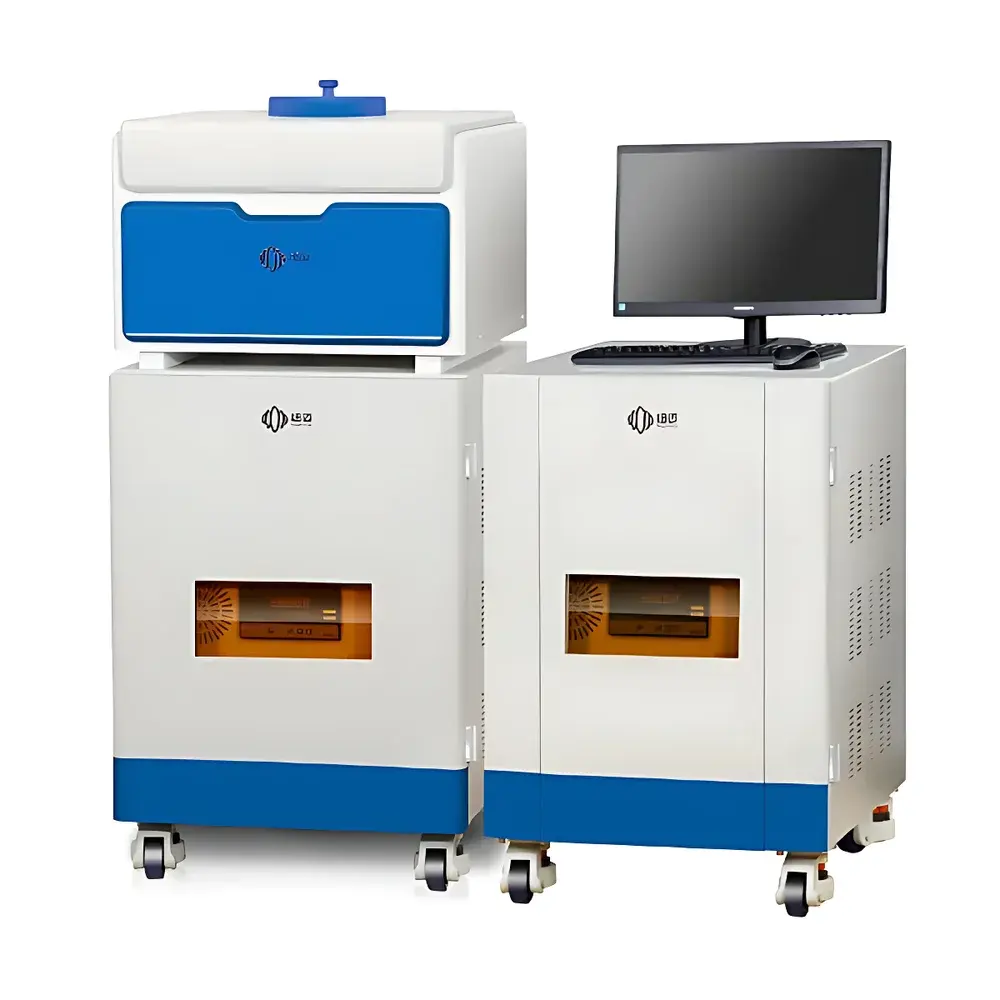
NIUMAG VTMR20-010V-6 Low-Field Nuclear Magnetic Resonance (LF-NMR) Pore Size Analyzer for Proton Exchange Membranes
| Brand | NIUMAG |
|---|---|
| Origin | Jiangsu, China |
| Instrument Type | Low-Field NMR Analyzer |
| Model | VTMR20-010V-6 |
| Sample Compatibility | Solid-Liquid Hybrid (Hydrated PEMs) |
| Operating Field Strength | ~0.5 T (Typical for VTMR Series) |
| Temperature Control Range | –40 °C to +120 °C (Programmable, In Situ) |
| Measurement Principle | Transverse Relaxation (T₂) Distribution Analysis of Confined Water Protons |
Overview
The NIUMAG VTMR20-010V-6 is a purpose-engineered low-field nuclear magnetic resonance (LF-NMR) analyzer designed specifically for non-destructive, quantitative characterization of pore size distribution and pore structure evolution in proton exchange membranes (PEMs) under controlled thermal conditions. Unlike conventional mercury intrusion porosimetry or gas adsorption techniques—which require vacuum drying, high pressure, or sample destruction—this system leverages the intrinsic magnetic properties of hydrogen nuclei (¹H) in water molecules as natural probes. When hydrated PEMs are placed in the static magnetic field, water confined within membrane pores exhibits characteristic transverse relaxation times (T₂), which correlate directly with pore geometry via surface-to-volume ratio effects governed by the Brownstein–Tarr model. Shorter T₂ values indicate stronger surface interactions—typical of nanoscale pores (<10 nm)—while longer T₂ components reflect larger, less restricted water domains. This physical basis enables high-reproducibility, calibration-free pore size quantification across the 0.1–1000 nm range without assumptions about pore shape or connectivity.
Key Features
- Integrated programmable temperature stage enabling precise in situ thermal control from –40 °C to +120 °C with ±0.1 °C stability—critical for simulating PEMFC cold-start, steady-state, and thermal cycling conditions.
- Dedicated pulse sequence suite optimized for T₂ decay acquisition in heterogeneous, low-mobility aqueous environments typical of sulfonated polymer membranes (e.g., Nafion®, Aquivion®, hydrocarbon-based PEMs).
- Robust magnet architecture with active shielding and field homogeneity <5 ppm over 20 mm DSV—ensuring stable signal-to-noise ratio (SNR) during long-duration variable-temperature experiments.
- Modular RF probe design accommodating standard 10 mm OD glass tubes or custom-fit membrane holders with integrated hydration ports for dynamic humidity control during measurement.
- Compliance-ready data acquisition engine supporting audit trails, user access levels, and electronic signatures per FDA 21 CFR Part 11 requirements when configured with optional software modules.
Sample Compatibility & Compliance
The VTMR20-010V-6 accepts both dry and fully hydrated PEM specimens—including cast films, reinforced composites, and catalyst-coated membranes—without pretreatment or metalization. Its solid-liquid hybrid capability accommodates samples ranging from 5 mg to 2 g in mass, with thickness up to 1.5 mm. All measurements conform to ISO 15701:2020 (NMR-based pore size analysis), ASTM D7892–19 (low-field NMR for polymer hydration studies), and support GLP/GMP-aligned workflows. Instrument validation documentation—including field mapping reports, T₂ repeatability studies, and temperature calibration certificates—is provided per ICH Q2(R2) guidelines for analytical method verification in regulated R&D environments.
Software & Data Management
Acquisition and analysis are performed using NIUMAG’s proprietary MesoMR Studio v5.x platform, featuring automated T₂ inversion using non-negative least squares (NNLS) with regularization parameter optimization. The software exports pore size distributions (PSD) in cumulative/differential formats compliant with ASTM E1155–21, generates Arrhenius plots of T₂ vs. 1/T for activation energy estimation, and supports batch processing of multi-temperature datasets. Raw FID and processed T₂ spectra are stored in HDF5 format with embedded metadata (timestamp, temperature setpoint, RF power, echo spacing), ensuring full traceability. Export options include CSV, MATLAB .mat, and PDF reports with customizable templates aligned to internal QA protocols or journal submission standards (e.g., Journal of Power Sources, Electrochimica Acta).
Applications
- Quantifying thermal-induced swelling/shrinkage of PEM nanostructure during operational temperature ramps (e.g., 30 °C → 80 °C → 30 °C).
- Correlating water uptake hysteresis with irreversible pore collapse after accelerated stress testing (AST) per DOE protocol.
- Evaluating degradation mechanisms in aged membranes exposed to open-circuit voltage (OCV) hold or cyclic load conditions.
- Screening novel anion exchange membranes (AEMs) and hydrocarbon alternatives for pore stability under low-humidity operation.
- Supporting DOE Hydrogen Program targets for membrane durability (>5,000 h) through microstructural benchmarking against reference materials.
FAQ
How does LF-NMR differentiate between interfacial water and bulk-like water in PEMs?
It relies on distinct T₂ relaxation components: interfacial water (bound to sulfonic acid groups) exhibits T₂ < 1 ms, while intermediate and bulk-like water show progressively longer T₂ (1–100 ms). Multi-exponential fitting resolves these populations quantitatively.
Can the system measure membranes under humidified gas flow?
Yes—when coupled with optional environmental chambers (e.g., HumiCell™ module), real-time NMR monitoring during controlled RH exposure (10–95% RH) is supported.
Is cryogenic cooling required for sub-zero measurements?
No—the integrated Peltier-based stage achieves –40 °C without liquid nitrogen, minimizing thermal lag and condensation risks.
What validation data is provided for regulatory submissions?
Includes IQ/OQ documentation, T₂ precision studies (RSD < 2.5% across n=6 replicates), and temperature uniformity maps per ISO/IEC 17025:2017 Annex A.3.
Does the instrument support third-party software integration?
Yes—via TCP/IP API and Python SDK for automation within LabVIEW, MATLAB, or custom LIMS environments.




