
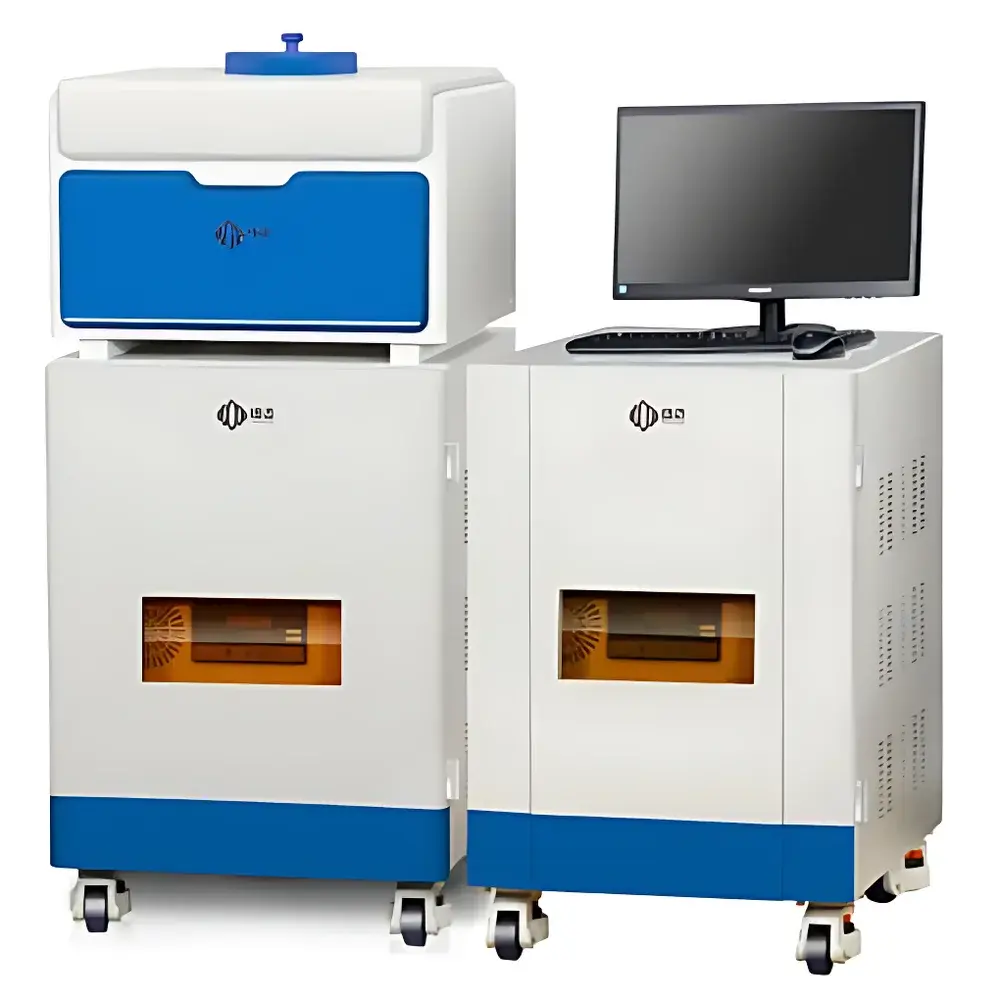
NIUMAG VTMR20-010V Low-Field Nuclear Magnetic Resonance Analyzer for Crosslink Density and Relaxometry Imaging
| Brand | NIUMAG |
|---|---|
| Origin | Jiangsu, China |
| Model | VTMR20-010V |
| Instrument Type | Low-Field NMR Analyzer |
| Sample Type | Solid-Liquid Dual Compatibility |
| Operating Mode | Pulsed Fourier Transform |
| Magnet Type | Permanent Magnet |
| Magnetic Field Strength | 0.5 ± 0.05 T |
| Effective Sample Volume | Ø8.5 mm × H20 mm |
| Temperature Control Range | Ambient to 130 °C (standard), extended options available |
Overview
The NIUMAG VTMR20-010V is a benchtop low-field nuclear magnetic resonance (NMR) analyzer engineered for quantitative crosslink density characterization and multi-parameter relaxometry imaging of polymeric and elastomeric materials. Based on the fundamental principles of pulsed Fourier-transform NMR, the system measures spin–lattice (T₁) and spin–spin (T₂) relaxation dynamics of hydrogen nuclei (¹H) in mobile and bound polymer phases. These relaxation parameters correlate directly with molecular mobility, network rigidity, and crosslink density—enabling non-destructive, reagent-free assessment of vulcanization state, aging effects, phase distribution, and compositional homogeneity. Unlike high-field superconducting NMR systems requiring cryogenic maintenance, the VTMR20-010V employs a stable permanent magnet assembly operating at 0.5 T, delivering robust signal reproducibility under industrial laboratory conditions without liquid nitrogen or helium dependency.
Key Features
- Integrated precision temperature control module (ambient to 130 °C standard), enabling in-situ monitoring of thermal transitions, cure kinetics, and time–temperature superposition behavior
- Optimized RF coil geometry and gradient compatibility supporting both bulk relaxometry and spatially resolved imaging (e.g., slice-selective T₂ mapping)
- Sub-30-second acquisition time per measurement—ideal for high-throughput quality assurance workflows in rubber compounding and polymer production lines
- No sample derivatization, solvent extraction, or chemical labeling required; only minimal physical trimming to fit the Ø8.5 mm × 20 mm detection volume
- Self-shielded permanent magnet architecture with passive field stabilization—zero cryogen consumption, negligible long-term drift, and compliance with ISO/IEC 17025 environmental stability requirements
Sample Compatibility & Compliance
The VTMR20-010V accommodates heterogeneous solid–liquid systems including raw rubber stocks, cured elastomer sheets, thermoplastic vulcanizates (TPVs), silicone gels, epoxy resins, latex dispersions, and filled composites. Its design supports ASTM D6204 (Standard Test Method for Rubber Property—Measurement of Crosslink Density by Low-Field NMR), ISO 15232 (Plastics—Determination of Crosslink Density Using NMR Relaxation), and aligns with FDA-recommended analytical method validation principles for material characterization in regulated manufacturing environments. Data integrity meets ALCOA+ criteria (Attributable, Legible, Contemporaneous, Original, Accurate, Complete, Consistent, Enduring, Available), and audit trails comply with 21 CFR Part 11 when operated with validated software configurations.
Software & Data Management
The instrument is controlled via NIUMAG’s proprietary NMR Analysis Suite v4.x—a Windows-based platform supporting pulse sequence customization (CPMG, IR, Inversion Recovery), automated T₁/T₂ inversion, multi-exponential decay fitting (using non-negative least squares), and crosslink density calculation based on Flory–Rehner theory or empirical calibration models. Raw FID data are stored in vendor-neutral formats (e.g., .fid, .txt) and exportable to MATLAB, Python (NumPy), or JMP for advanced statistical modeling. Software modules include batch processing, report generation with customizable templates (PDF/Excel), and role-based user access control—facilitating GLP/GMP-aligned documentation practices.
Applications
- Quantitative crosslink density profiling across sulfur-, peroxide-, and metal oxide-cured elastomers
- In-process monitoring of rubber vulcanization kinetics and endpoint determination
- Aging studies: tracking oxidative degradation, chain scission, and network rearrangement in service-aged components
- Quality control of polymer blends—determining rubber-to-plastic ratio in TPVs and TPOs
- Resin formulation development: evaluating epoxy amine stoichiometry, gel point prediction, and post-cure evolution
- Latex solid content analysis and coagulation uniformity assessment
- Viscoelastic property inference via T₂ distribution width and bimodal peak separation (bound vs. mobile phase fractions)
FAQ
Does the VTMR20-010V require cryogens or external cooling infrastructure?
No. It uses a passively stabilized permanent magnet operating at 0.5 T, eliminating dependence on liquid nitrogen or helium.
Can it measure crosslink density without reference standards?
Yes—absolute quantification is possible using Flory–Rehner modeling with known polymer-specific parameters (e.g., χ parameter, molar mass between crosslinks); however, factory-calibrated reference curves are recommended for routine QC.
Is temperature-controlled NMR testing compliant with ISO 17025?
When operated within specified thermal stability limits (±0.5 °C over 30 min) and validated per ISO/IEC 17025 Clause 7.7, the system satisfies metrological traceability requirements for accredited laboratories.
What sample preparation is required for solid elastomers?
Samples must be cut to fit within the Ø8.5 mm × 20 mm active volume; no drying, solvent immersion, or surface treatment is necessary.
How does the system handle ferromagnetic fillers (e.g., carbon black)?
Carbon black and other common reinforcing fillers do not significantly perturb ¹H NMR signals due to their diamagnetic nature and lack of unpaired electrons—validated per ASTM D6204 Annex A3.




