
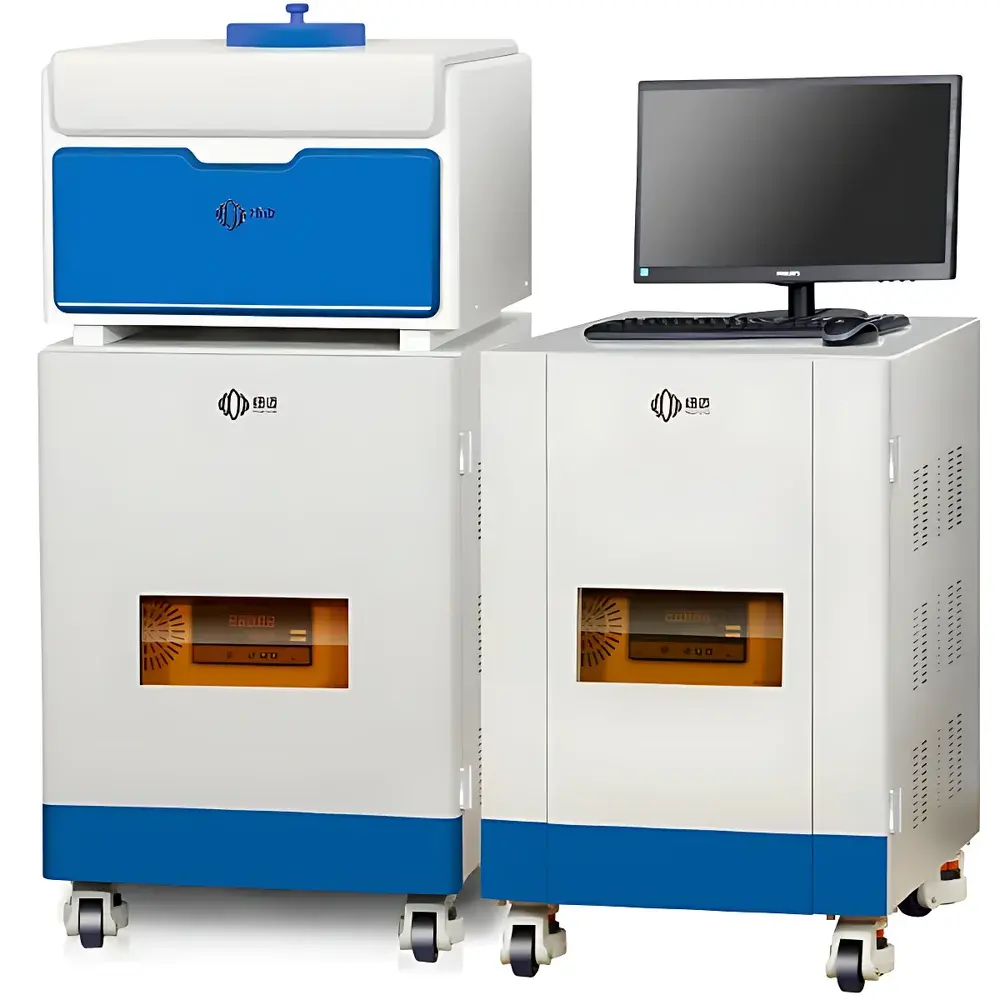
NIUMAG VTMR20-010V-I Low-Field Nuclear Magnetic Resonance Crosslink Density Analyzer
| Brand | NIUMAG |
|---|---|
| Origin | Jiangsu, China |
| Model | VTMR20-010V-I |
| Instrument Type | Low-Field NMR Analyzer |
| Sample Compatibility | Solid-Liquid Dual-Phase |
| Magnet Type | Permanent Magnet |
| Static Magnetic Field Strength | 0.5 ± 0.05 T |
| Standard Temperature Range | Room Temperature to 130 °C |
| Optional Variable-Temperature Module | –100 °C to 200 °C |
| Imaging Capability | Optional |
| Typical Measurement Time | ≤2 min per sample |
| Measurement Principle | Spin-Spin Relaxation (T₂) Analysis via CPMG Pulse Sequence |
Overview
The NIUMAG VTMR20-010V-I Low-Field Nuclear Magnetic Resonance Crosslink Density Analyzer is an engineered solution for non-destructive, quantitative characterization of polymer network architecture. Based on the physical principle of transverse relaxation time (T₂) decay measurement—acquired via Carr–Purcell–Meiboom–Gill (CPMG) pulse sequences—the instrument probes molecular mobility differences between crosslinked and mobile chain segments. In elastomers, rubbers, thermosets, and hydrogels, T₂ distribution profiles directly correlate with crosslink density, bound rubber fraction, phase separation, and solvent diffusion behavior. Unlike destructive chemical methods (e.g., equilibrium swelling or titration), this NMR-based approach preserves sample integrity, enables repeated measurements under identical conditions, and supports in situ monitoring of curing, aging, or solvent uptake processes without sample preparation or reagents.
Key Features
- Non-invasive, reagent-free analysis: Eliminates solvent consumption, chemical waste, and sample degradation associated with classical wet chemistry techniques.
- Rapid acquisition: Full T₂ relaxation curve acquisition and crosslink density quantification completed in ≤120 seconds per sample—ideal for high-throughput QC and real-time process development.
- Broad sample compatibility: Accommodates solids (vulcanized rubber, cured resins), semi-solids (gels, pastes), powders, and liquid dispersions within a single platform.
- Thermal control integration: Standard temperature stage supports operation from ambient to +130 °C; optional cryo-heating module extends range to –100 °C to +200 °C for dynamic vulcanization or low-Tg polymer studies.
- Modular imaging capability: Optional NMR imaging (MRI) module enables spatial mapping of proton density and T₂ heterogeneity—critical for detecting internal voids, filler dispersion uniformity, or moisture ingress in composite materials.
- Robust permanent magnet architecture: Delivers stable, drift-free field homogeneity (<0.1 ppm/h) without cryogens or external power supply, ensuring operational reliability in industrial lab environments.
Sample Compatibility & Compliance
The VTMR20-010V-I accepts samples in standard 10 mm or 15 mm OD glass or quartz tubes, accommodating volumes from 0.2 mL to 8 mL. It supports heterogeneous systems including filled elastomers, polymer blends, silica-reinforced composites, and swollen hydrogels. Data acquisition and reporting workflows are designed to align with GLP-compliant documentation requirements. While not FDA-cleared as a medical device, the system’s audit trail functionality—including user login logs, parameter change history, and raw FID/T₂ data archiving—supports 21 CFR Part 11 readiness when deployed in regulated R&D or manufacturing settings. Method validation protocols follow ISO 17025 principles, and crosslink density calibration models may be referenced against ASTM D6204 (Standard Test Method for Rubber—Determination of Crosslink Density by Swelling) for correlation studies.
Software & Data Management
The proprietary MultiQ™ software suite provides integrated acquisition, processing, and modeling tools. Key modules include: (i) automated T₂ inversion using non-negative least squares (NNLS) algorithms; (ii) multi-exponential fitting for distinguishing bound, intermediate, and free proton populations; (iii) crosslink density calculation via Flory–Rehner theory or empirical calibration curves; (iv) batch processing for comparative aging or formulation screening; and (v) export of ASCII/CSV datasets compatible with MATLAB, Python (NumPy/Pandas), or statistical platforms such as JMP or Minitab. All raw data files retain full metadata (pulse sequence parameters, temperature, date/time stamp, operator ID), enabling traceable reprocessing and method transfer across instruments.
Applications
- Crosslink Network Quantification: Determination of crosslink density (ν, mol/m³), bound rubber content (%), and segmental mobility gradients in SBR, NR, EPDM, silicone, and polyurethane systems.
- Formulation Optimization: Correlation of accelerator/sulfur ratios, filler loading, or plasticizer content with network homogeneity and relaxation dynamics.
- Aging & Degradation Monitoring: Tracking T₂ shortening or bimodal distribution shifts during thermal oxidative aging, UV exposure, or ozone attack.
- Process Control: Real-time monitoring of vulcanization kinetics in extrusion lines or mold cavities using fiber-optic probe adapters (customizable).
- Composite Characterization: Assessment of interfacial adhesion quality via bound water/filler interactions in nanocomposites or cementitious materials.
- Hydrogel & Biomaterial Studies: Quantifying mesh size, swelling ratio, and drug release kinetics through diffusion-weighted NMR and relaxometry.
FAQ
What physical parameter does this instrument measure to derive crosslink density?
It measures the transverse relaxation time (T₂) distribution of hydrogen nuclei (¹H) using the CPMG pulse sequence. Crosslink density is inferred from the amplitude and decay rate of the immobilized polymer chain component, typically modeled using the Flory–Rehner equation.
Can the system analyze powdered or granular samples without pelletization?
Yes—dry powders, pellets, and irregular solids are directly compatible provided they fit within the standard sample tube dimensions and do not exceed magnetic susceptibility limits (e.g., no ferromagnetic contaminants).
Is method validation support available for regulated environments?
NIUMAG provides IQ/OQ documentation templates and assists with protocol development aligned with ISO/IEC 17025 and ASTM D6204 correlation guidelines. Full validation packages require site-specific implementation.
Does the instrument require liquid nitrogen or helium cooling?
No—this is a permanent magnet-based low-field system operating at ambient temperature. No cryogens, vacuum pumps, or external chillers are required.
How is data integrity ensured during long-term deployment?
MultiQ™ software enforces role-based access control, automatic timestamping, immutable raw data storage, and configurable audit trail logging—features supporting GxP-aligned data governance frameworks.





