
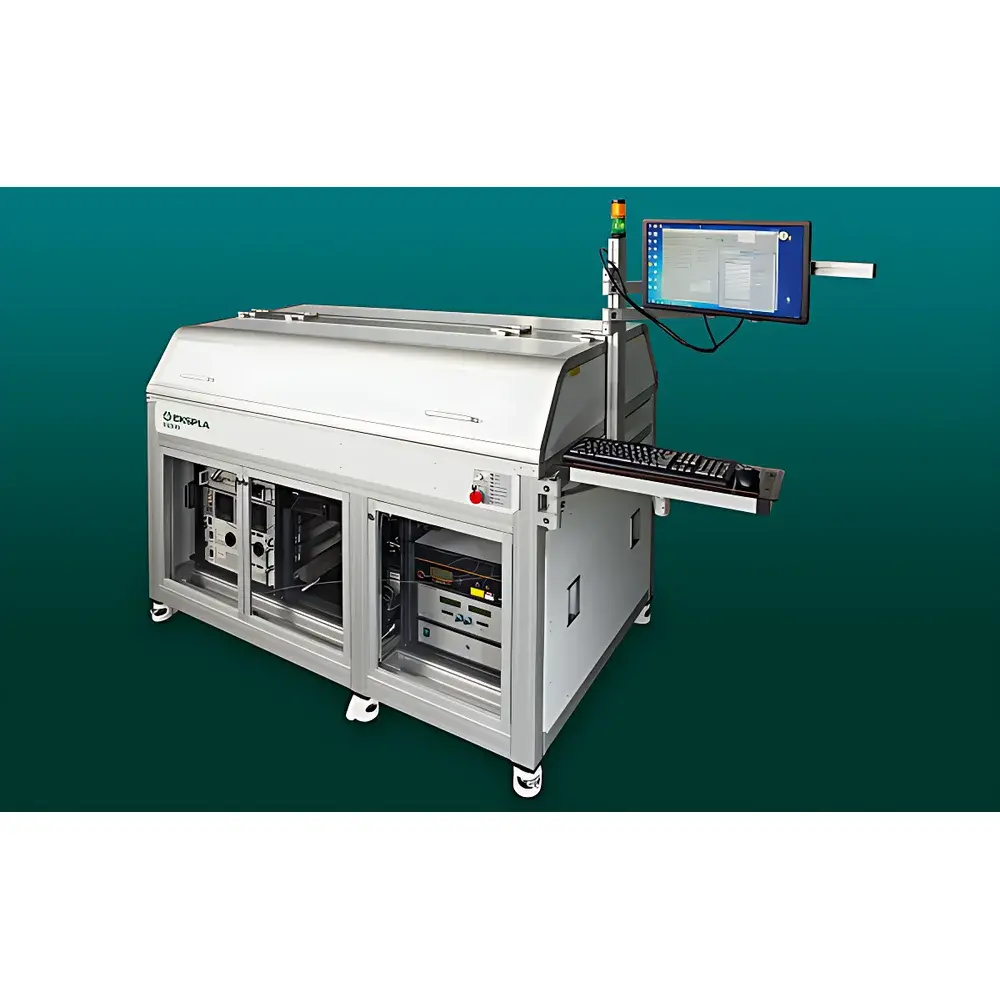
NL942-SH High-Power Solid-State Laser with Temporal Pulse Shaping Capability
| Brand | Ekspla |
|---|---|
| Model | NL942-SH |
| Output Energy | up to 1.7 J @ 1064 nm (per channel), up to 0.9 J @ 532 nm (per channel) |
| Repetition Rate | 100 Hz |
| Pulse Width | 50 ns (FWHM) |
| Beam Profile | Top-Hat Spatial Distribution |
| Pulse Shaping Method | Electro-Optic Modulation Driven by Arbitrary Waveform Generator (AWG) |
| Cooling | Integrated Water-Cooling System |
| Power Supply | Built-in Industrial-Grade PSU |
| Form Factor | Mobile Laser Head with Integrated Optomechanics and Thermal Management |
Overview
The NL942-SH is a dual-channel, high-energy, diode-pumped solid-state (DPSS) laser system engineered for precision temporal pulse shaping in demanding scientific and industrial applications. Operating at fundamental wavelength 1064 nm and frequency-doubled output at 532 nm, the system delivers up to 1.7 J per channel at 1064 nm and up to 0.9 J per channel at 532 nm, with a stable 100 Hz repetition rate and a nominal pulse duration of 50 ns (FWHM). Its defining capability—real-time temporal waveform control—is achieved through an electro-optic modulator (EOM) driven by a high-bandwidth arbitrary waveform generator (AWG), enabling programmable intensity profiles across the pulse envelope without mechanical delay lines or external pulse pickers. This architecture supports advanced pump-probe experiments, laser-induced breakdown spectroscopy (LIBS) optimization, shock physics studies, and tailored material ablation where pulse shape directly governs energy coupling efficiency and plasma dynamics.
Key Features
- Dual-output architecture with independent optical paths—each channel provides full spectral and temporal control at both 1064 nm and 532 nm.
- Top-hat spatial beam profile ensures uniform irradiance distribution across the target plane, critical for consistent ablation thresholds and minimized thermal gradients in thin-film processing.
- Integrated electro-optic pulse shaper with AWG interface allows user-defined temporal profiles—including square, ramp, multi-peaked, or custom waveforms—with sub-nanosecond timing resolution and high fidelity (<3% RMS deviation from target shape).
- Self-contained mobile laser head incorporates semiconductor-pumped Nd:YAG amplifier stages, high-efficiency harmonic generation crystals, active cavity stabilization, and real-time internal diagnostics (e.g., pulse energy monitoring, temperature logging, EOM voltage tracking).
- Industrial-grade design compliant with IEC 60825-1 Class 4 laser safety requirements; includes interlock-ready connectors, beam shutter integration, and embedded fault logging for traceable operation in regulated environments.
Sample Compatibility & Compliance
The NL942-SH is compatible with optically transparent, semi-transparent, and opaque solid-state targets—including metals, ceramics, polymers, and composite materials—provided beam delivery optics are appropriately selected for wavelength and fluence. Its top-hat beam enables predictable fluence mapping essential for ISO 11551-compliant laser-induced damage threshold (LIDT) testing and ASTM F2135-22 certified surface modification protocols. The system supports GLP/GMP-aligned operation via hardware-triggered data capture and timestamped diagnostic logs. While not FDA-cleared as a medical device, its pulse control fidelity meets technical prerequisites for preclinical photoacoustic imaging source development under ISO 13485-aligned R&D workflows.
Software & Data Management
Control is implemented via Ekspla’s proprietary LaserStudio software suite, offering GUI-based waveform design, real-time oscilloscope-style pulse monitoring, and synchronized trigger management for external detectors or motion stages. All pulse parameters—including applied AWG voltage sequence, measured energy per shot, cavity alignment status, and coolant temperature—are logged in HDF5 format with metadata compliant with FAIR data principles. Export options include CSV and MATLAB-compatible binaries. Audit trail functionality records operator login, parameter changes, and system warnings—supporting 21 CFR Part 11 readiness when deployed with validated network authentication and electronic signature modules.
Applications
- Laser-driven particle acceleration and plasma wakefield experiments requiring precisely shaped driver pulses.
- Time-resolved thermoreflectance and ultrafast ellipsometry, where pump pulse asymmetry must be eliminated to avoid artifact generation in carrier dynamics modeling.
- High-precision LIBS analysis on heterogeneous geological samples, leveraging tailored pulse shapes to suppress continuum background and enhance line-to-background ratios.
- Shock compression studies using dual-pulse configurations—e.g., pre-compression followed by drive pulse—with nanosecond-level inter-pulse delay stability.
- Development of next-generation laser ignition systems for internal combustion engines, where controlled energy deposition profiles improve flame kernel initiation repeatability.
FAQ
What is the maximum allowable jitter between the two output channels?
Channel-to-channel timing jitter is ≤ 200 ps RMS over 24 hours under constant ambient conditions, verified via fast photodiode + digital oscilloscope calibration traceable to NIST standards.
Can the NL942-SH operate in single-shot mode with external TTL triggering?
Yes—external TTL input accepts 3.3 V/5 V logic signals with ≤ 5 ns rise time; minimum inter-shot interval is 10 ms, and trigger latency is 42 ± 3 ns (deterministic, hardware-gated).
Is harmonic generation optional or integrated?
SHG (532 nm) is fully integrated and aligned at factory; THG (355 nm) and FHG (266 nm) modules are available as field-installable add-ons with recalibrated energy monitoring and beam pointing stability compensation.
Does the system support remote monitoring via Ethernet or RS-232?
Standard Gigabit Ethernet interface enables full bidirectional communication (SCPI over TCP/IP); RS-232 is retained for legacy DAQ integration but lacks firmware update capability.
What maintenance intervals are recommended for the semiconductor pump diodes?
Pump diode lifetime exceeds 2 billion shots at rated operating conditions; preventive replacement is advised after 18 months of continuous 100 Hz operation or upon diagnostic log indication of >15% output drift across thermal cycles.




