
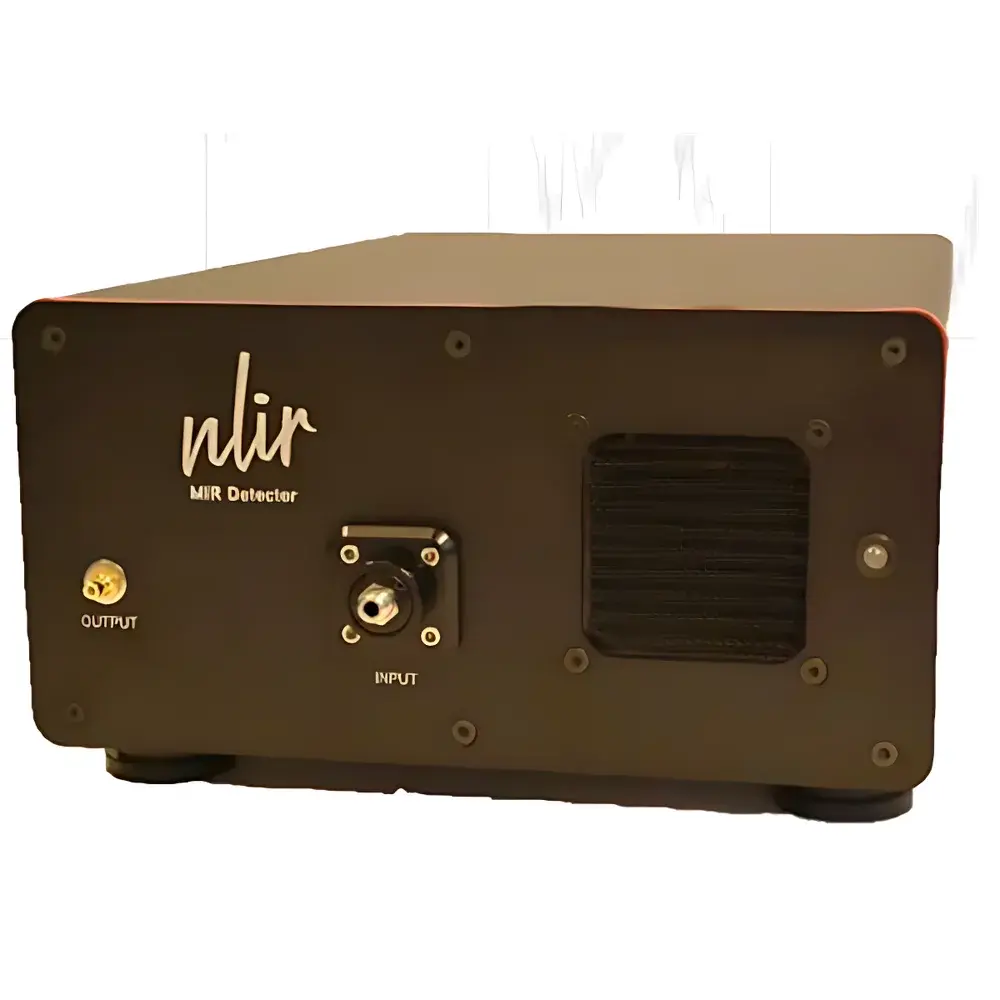
NLIR D2250 Single-Wavelength Mid-Infrared Upconversion Detector
| Brand | NLIR |
|---|---|
| Origin | Denmark |
| Model | D2250 |
| Center Wavelength | 2.2–5.0 µm (tunable 2.7–4.3 µm) |
| Optical Bandwidth | 15–200 nm |
| Electrical Bandwidth (3 dB) | DC–10 GHz |
| NEP | 1×10⁻¹⁵–1×10⁻⁹ W/√Hz |
| Rise Time | 34 ps–170 ns |
| Responsivity | up to 2×10⁹ V/W (DC), 6×10⁸ V/W (AC) |
| Input | SMA-coupled free-space or 200 µm MIR fiber (NA=0.26) |
| Operating Temperature | ≤30 °C |
| Dimensions | 100 × 306 × 200 mm³ |
| Weight | 5 kg |
| Integrated Preamp | Yes |
| Compliance | RoHS, CE |
Overview
The NLIR D2250 is a high-performance, single-wavelength mid-infrared (MIR) upconversion detector engineered for precision photonic measurement in the 2.2–5.0 µm spectral range. Unlike conventional thermal or semiconductor-based MIR detectors—such as InSb, HgCdTe, or InAsSb—the D2250 employs a patented nonlinear optical upconversion process: incident MIR photons are mixed with a high-stability pump laser inside a periodically poled lithium niobate (PPLN) crystal, generating near-visible signal photons (e.g., ~650–850 nm) via sum-frequency generation (SFG). These upconverted photons are then detected by ultra-low-noise, high-speed silicon photodiodes—leveraging mature CMOS-compatible readout architectures unavailable in native MIR semiconductors. This architecture fundamentally decouples detection performance from cryogenic cooling requirements and eliminates dominant sources of background-limited noise inherent to room-temperature MIR photodetectors. As a result, the D2250 delivers shot-noise-limited sensitivity at ambient temperature, with electrical bandwidths scalable from DC to 10 GHz—enabling time-resolved analysis of nanosecond-scale MIR transients without compromise in signal-to-noise ratio.
Key Features
- Single-wavelength selectivity with tunable center wavelength (2.7–4.3 µm standard; extended 2.2–5.0 µm on request), achieved via angle- or temperature-tuned PPLN crystal phase-matching
- Electrical bandwidth spanning DC to 10 GHz (model-dependent), supporting pulse characterization, QCL beam diagnostics, and real-time modulation analysis
- Ultra-low noise-equivalent power (NEP) down to 1×10⁻¹⁵ W/√Hz at DC–20 MHz bandwidth, enabled by low-dark-current Si photodiode and integrated low-noise transimpedance amplifier
- Free-space and fiber-coupled input options: accepts 200 µm core MIR fiber (NA = 0.26) or collimated beams (0.5 mm optimal spot size); SMA interface allows rapid reconfiguration between coupling modes
- Plug-and-play operation: fully integrated pump laser, nonlinear crystal, filtering optics, Si detector, and amplification stage housed in a thermally stabilized, vibration-damped aluminum enclosure
- Compliance-ready design: CE-marked, RoHS-compliant, and compatible with GLP/GMP environments when paired with audit-trail-capable data acquisition systems
Sample Compatibility & Compliance
The D2250 is optimized for coherent and incoherent MIR sources including quantum cascade lasers (QCLs), optical parametric oscillators (OPOs), supercontinuum sources (e.g., NKT Photonics MIR-SC), and broadband thermal emitters filtered to <200 nm bandwidth. Its polarization-sensitive response (optimal for vertically polarized input) requires alignment control but enables polarization-resolved measurements when integrated into ellipsometric or interferometric setups. The detector meets IEC 61326-1 for electromagnetic compatibility and conforms to EN 61000-6-3 for industrial emission limits. While not intrinsically certified for hazardous locations, its sealed optical path and absence of high-voltage biasing make it suitable for Class 1 Div 2 environments when installed per manufacturer guidelines. No regulatory certification (e.g., FDA, ATEX) is claimed; users must validate system-level compliance per application-specific standards (e.g., ASTM E1421 for IR spectroscopy, ISO 13485 for medical device R&D).
Software & Data Management
The D2250 operates as an analog voltage-output device (50 Ω terminated), requiring external digitization via oscilloscopes, lock-in amplifiers, or PCIe DAQ cards. NLIR provides MATLAB and Python SDKs (via PyVISA) for automated wavelength calibration, gain profiling, and NEP mapping across operational temperature and pump power ranges. Raw voltage traces retain full temporal fidelity—critical for time-of-flight spectroscopy or cavity ring-down applications. When integrated into validated analytical workflows, the detector supports 21 CFR Part 11 compliance through third-party DAQ platforms offering electronic signatures, audit trails, and data integrity controls. Firmware updates (delivered via USB-C) maintain traceability of calibration coefficients and pump laser operating parameters—essential for ISO/IEC 17025-accredited laboratories.
Applications
- Pulse characterization of QCLs and OPOs: sub-nanosecond rise time resolution enables direct measurement of pulse width, jitter, and amplitude stability
- Real-time industrial process monitoring: detects trace gas absorption features (e.g., CH₄ at 3.3 µm, CO₂ at 4.2 µm) in combustion exhaust or semiconductor chamber effluents
- Free-space optical communication: demodulates high-speed MIR carrier signals in atmospheric transmission windows (3–5 µm)
- Laser-induced breakdown spectroscopy (LIBS) in MIR: captures transient plasma emission with >100 ps temporal resolution
- Fiber-optic sensor interrogation: reads wavelength-shifted signals from MIR fiber Bragg gratings or Fabry–Pérot cavities
- Ultrafast spectroscopy: synchronizes with femtosecond pump-probe systems via TTL trigger output for gated detection
FAQ
Does the D2250 require cryogenic cooling?
No. The upconversion architecture enables high-sensitivity detection at ambient temperature (≤30 °C). Active cooling is neither required nor recommended.
Can the center wavelength be changed after purchase?
Yes—within the 2.2–5.0 µm range—by replacing the phase-matched PPLN crystal and recalibrating the pump wavelength. NLIR offers factory reconfiguration services.
What is the maximum average optical power the input can handle?
For free-space input: ≤100 mW (focused to ≤0.5 mm spot). For 200 µm fiber: ≤50 mW average power to avoid thermal lensing in the crystal.
Is polarization control mandatory?
Yes. Optimal responsivity occurs with vertical linear polarization aligned to the crystal’s extraordinary axis. A half-wave plate and polarizer are recommended for unpolarized sources.
How is calibration traceability maintained?
Each unit ships with NIST-traceable responsivity and NEP certificates, measured against calibrated blackbody and tunable laser standards. Calibration data is embedded in firmware and accessible via API.
Can multiple D2250 units be synchronized for multi-channel MIR detection?
Yes—using the shared pump laser synchronization port (SMA TTL) and external clock distribution, enabling phase-coherent multi-detector arrays for heterodyne or imaging applications.



